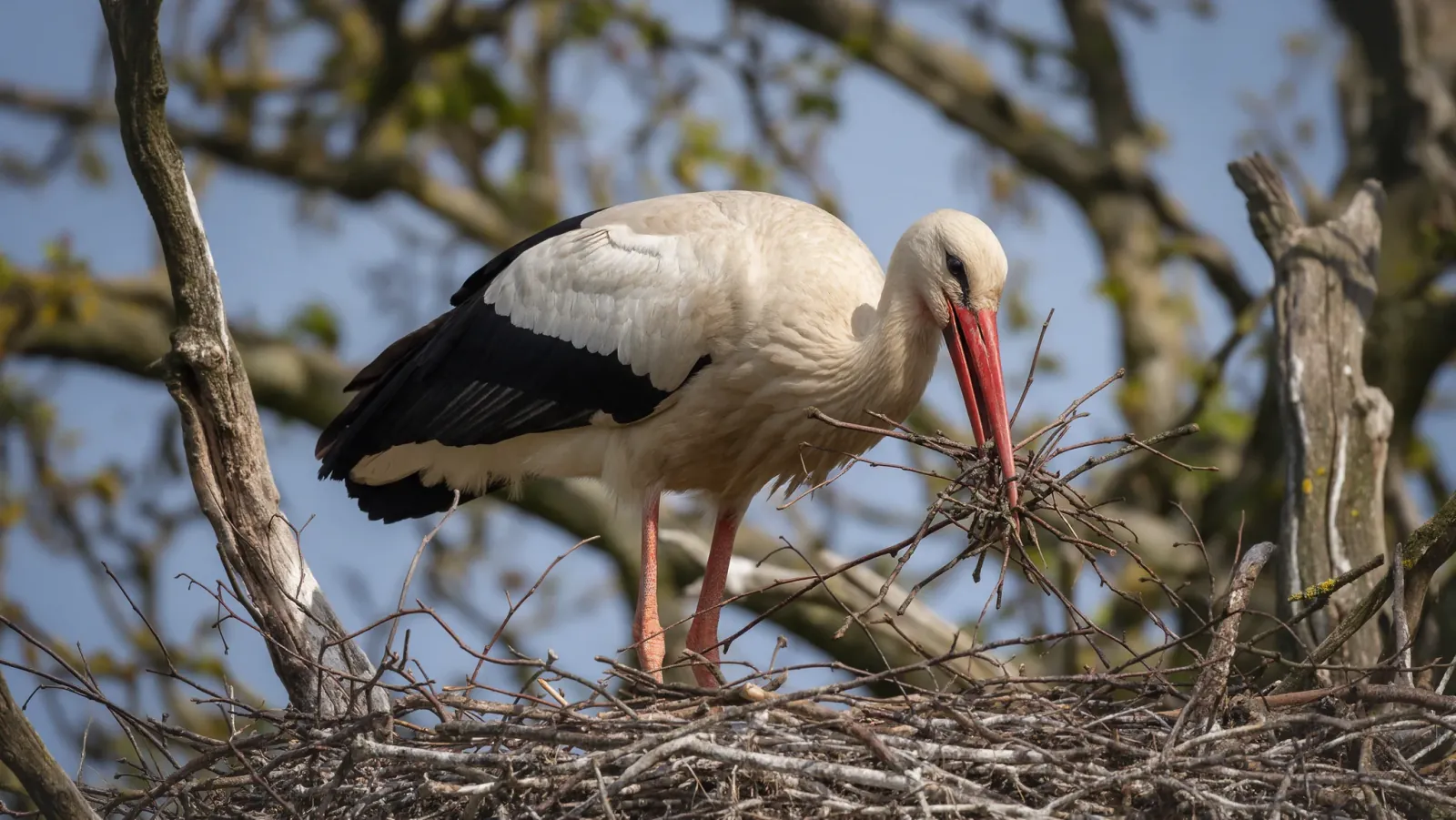
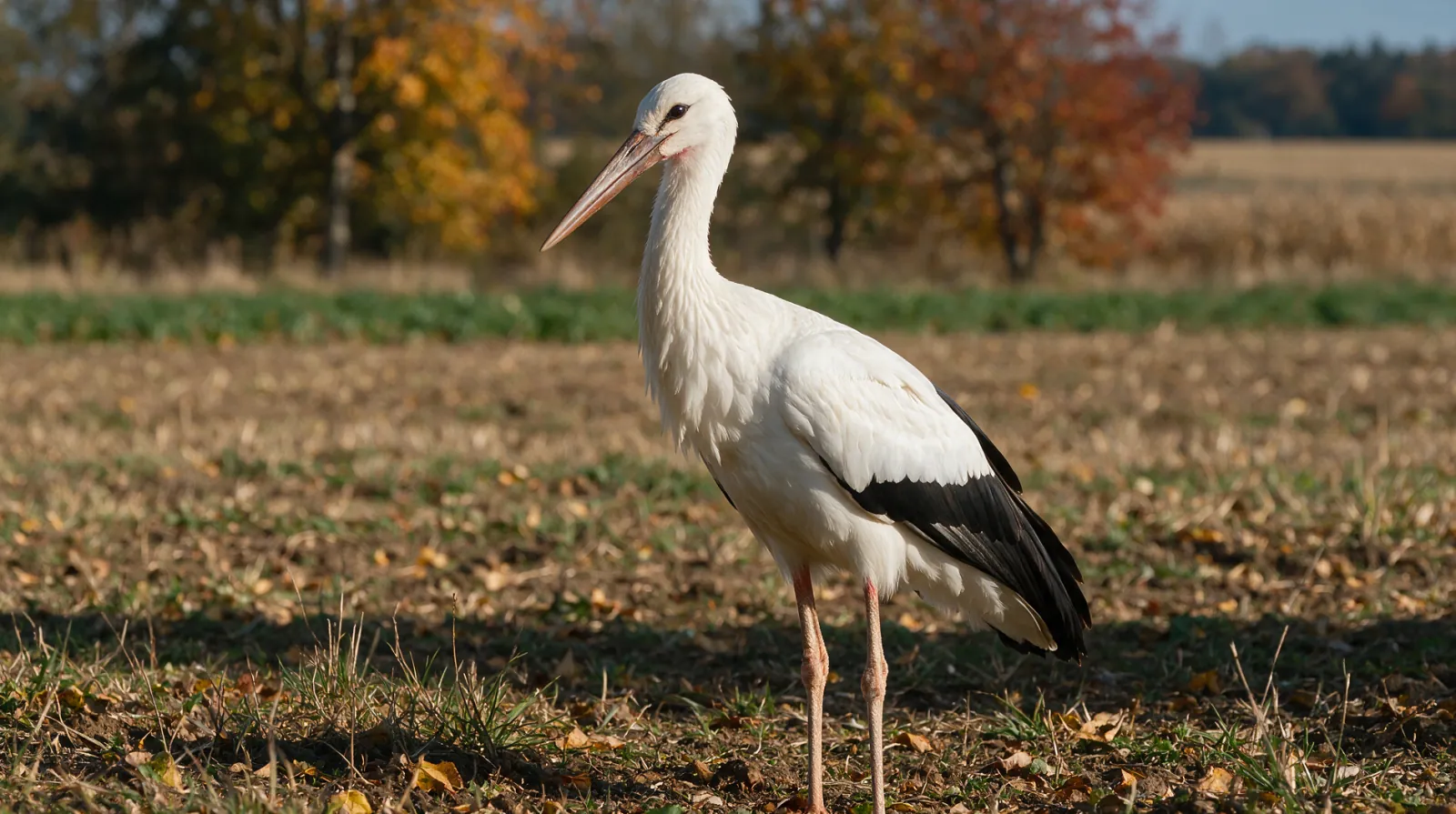
A stork leaves evidence of its life in three places: the eye that reads the field, the print it leaves in mud, and the ring a person put on its leg. Each one tells a different part of the same story.
The eye of a hunter
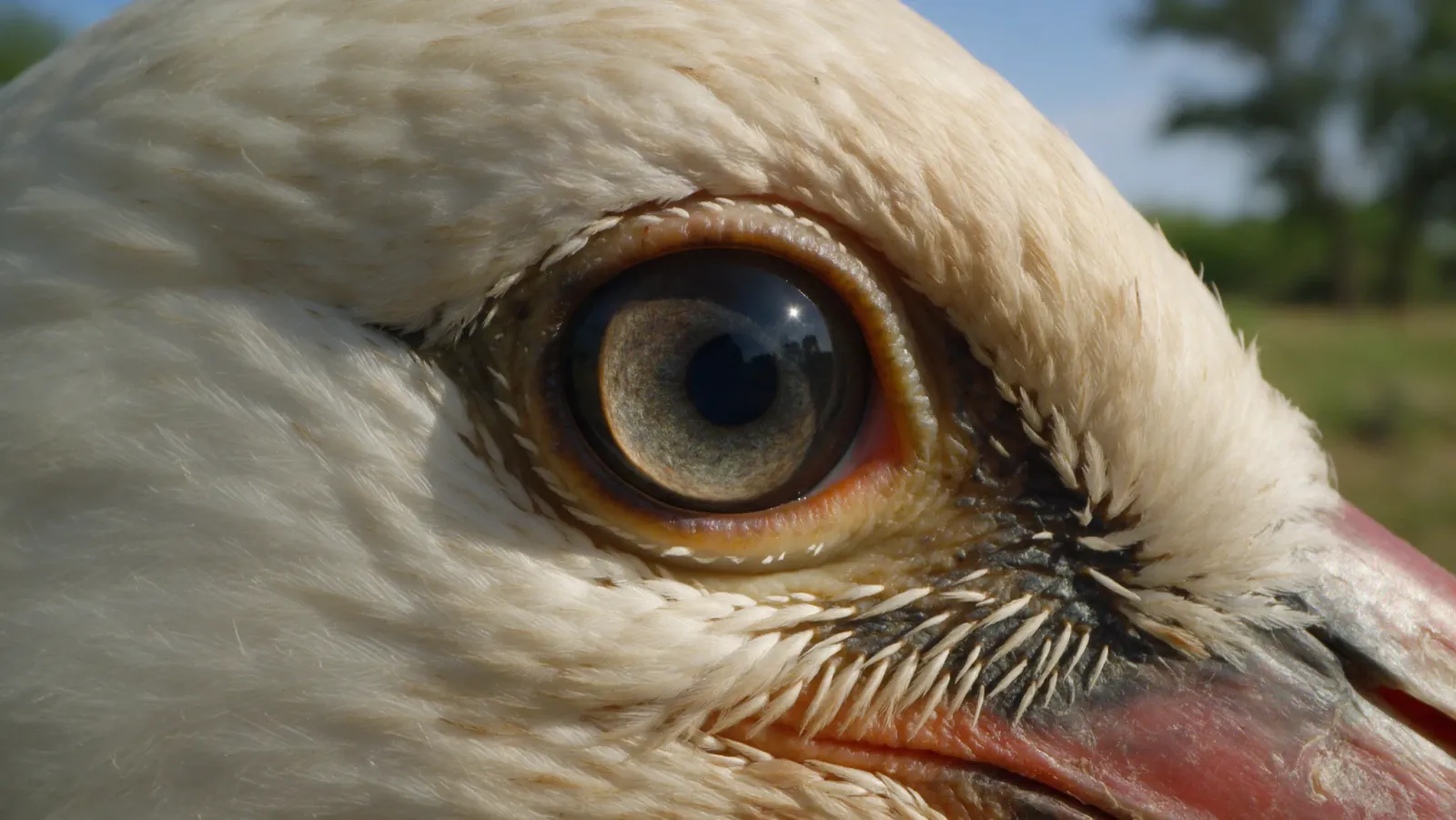
A stork's eye is small, dark and set low on the side of the head, and what it sees is a wide, flat world of moving water and grass. The white stork hunts by sight. It walks slowly through a wet meadow or stands in the shallows, and the eye finds the food before the bill does. The eye is sharp, and it is built for noticing movement against a still background. Most of the food a stork eats stays still until it has to move, and the movement gives it away. A stork sees the small thing before it sees the shape of the thing. Because the eye sits on the side of the head, the bird sees almost all the way around itself, which matters for a bird that must hunt and watch for danger at once. The bird's head turns often, and the eye does the rest. A stork standing motionless in a meadow is working. It is seeing, the whole field held in one dark eye, waiting for the single small movement that sends the bill down into the grass. A stork does not chase. It walks, watches, and when the eye reports something the neck dips and the bill does the rest.
Near and far
The eye has to work at two distances. Close to, it picks a beetle off a stem; far off, it watches a field for the movement of another stork. The bird can focus quickly between the two, and it does it while standing on one leg. A stork can switch from the mud at its feet to the far hedge without moving its head. The eye also picks up the flash of a fish turning, which is often the only sign that anything is there. The same eye that reads the wet grass reads the sky. A white stork spends long hours soaring, and from up there it picks out the line of a river, a field full of other storks, a slope that throws up a thermal, a place to land and feed. Migration is a long, high journey, and the bird finds its way with the sun, the land and an eye that misses little. On a clear day a soaring stork can be watched from the ground as a speck that never seems to move.
Three toes in the mud
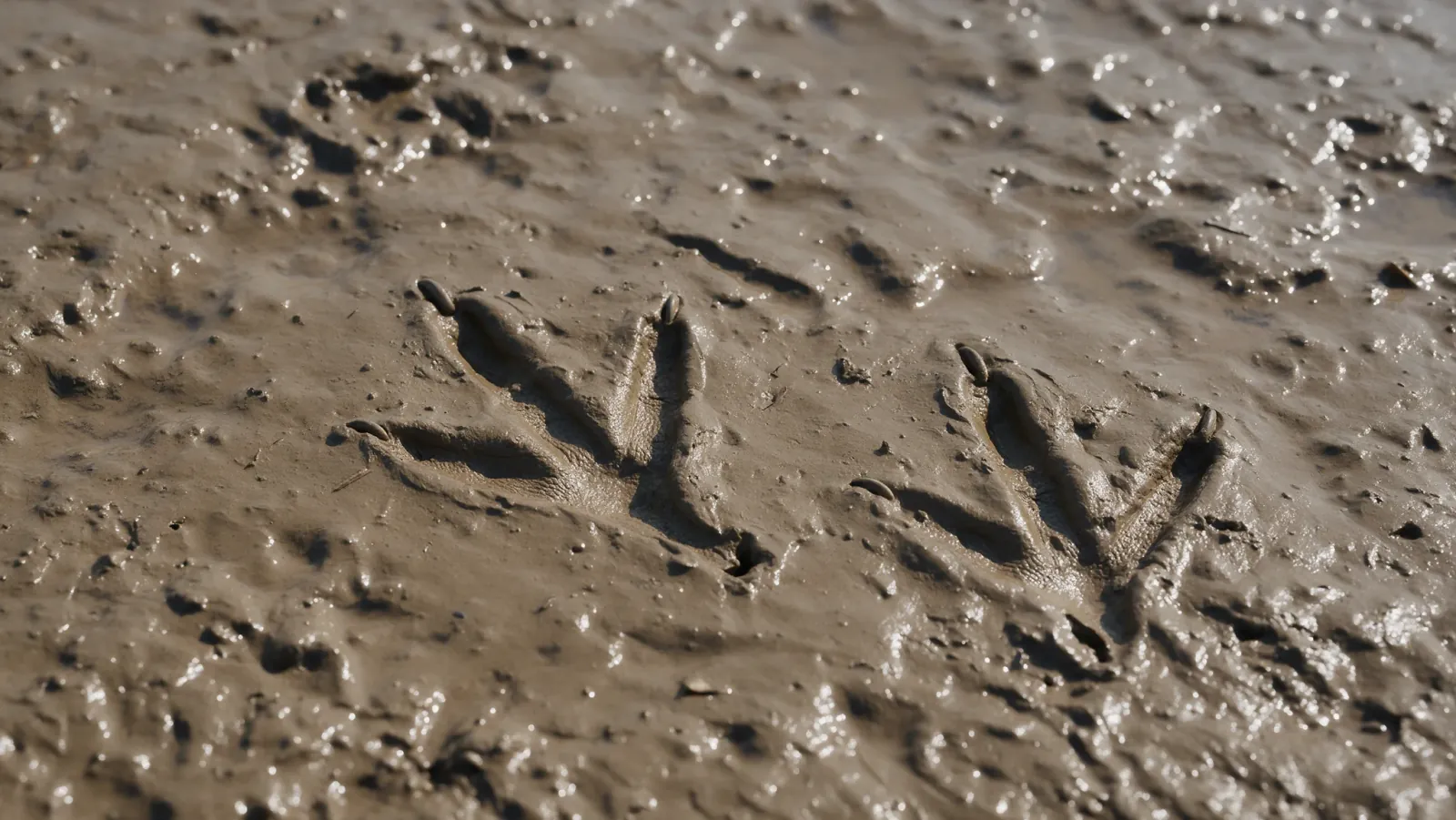
The footprint of a stork is easy to read in wet mud, once you know what to look for. A stork walks on long legs, and where it steps it leaves a clear mark: three long toes forward and one smaller toe back. There is no webbing between the toes, the way there is on a duck. The shape is made for walking on soft ground. The three front toes are long and spread, so the bird does not sink into soft ground. The hind toe is short and points back, and it helps the bird grip as it steps through shallow water and wet grass. Each toe ends in a small claw, and in firm mud the claw leaves its own fine mark. A full-grown white stork leaves a mark far larger than the smaller wading birds that share its marsh, and the difference is plain side by side. The claw marks are often the clearest part of a large print.
What a trail records
A footprint is a small diary of a moment. The depth shows how soft the mud was and how heavily the bird leaned. The space between prints shows the length of its stride, and a slow walk leaves a line set neatly one behind the other. A bird that stood still leaves deep, clear prints. A bird that walked and fed leaves a wandering trail that doubles back on itself, a record of every place it stopped to probe the mud. A feeding trail can run for many metres along a ditch. The same bird leaves different marks on different ground. In soft wet mud the whole foot sinks and the print comes out sharp and deep. On firmer ground only the toes and claws show, and on sun-baked earth it may be a pale scuff. After rain a trail can last for days, and then a dry spell erases it. The best place to find a stork's print is the edge of shallow water, where the mud is soft and the bird has been feeding. A receding puddle, a cattle-trampled bank, the wet margin of a rice field: all of them hold prints well.
The ring on the leg
One white stork looks much like another, so the people who study them put rings on the birds. A stork gets a ring while it is still a chick in the nest, too young to fly. The ring is light, made of metal or hard plastic, and it stays on the leg for life. Each carries a code, a short string of letters and numbers, and that code is the bird's name in the record books. A ring is fitted so it will not tighten as the leg grows. The chick is back in the nest within minutes. Because a stork often returns to the same nest, a researcher can read the ring through a telescope and know at once whether the bird on the roof is the one that nested there last spring. A code read twice, in two different years, tells a small and quiet story: the bird left, crossed the sea, wintered far away and came home. A single ring can follow a bird for twenty years. Most are never read again, and the few that are give the study its shape. A ring recovered after death is worth more than one read at a nest, because it gives a date and a place.
Colour rings and trackers
One ring is not always easy to read from a distance, so many projects use coloured rings in combination. A bird might carry a red ring above a white one on its left leg and a blue ring on the right. Each combination stands for one bird, and a trained watcher can read the colours from far off without disturbing it. Coloured rings turn a flock into a set of names. For birds a researcher wants to follow closely, there are larger tools. A satellite tag or a small transmitter can sit on a stork's back, held by a light harness, and send a signal that shows where the bird is. A tag lets a scientist follow one stork across a whole migration, day by day. A tag can fail or fall off, while a ring keeps its code for the whole life of the bird. A ring is only useful if someone reads it. Birdwatchers, farmers, reserve staff and other researchers send codes and dates to national ringing schemes, and a single sighting can add a year to a bird's known life. The work is not glamorous, and it depends on people who happen to have a telescope pointed at the right nest.
Explore the gift