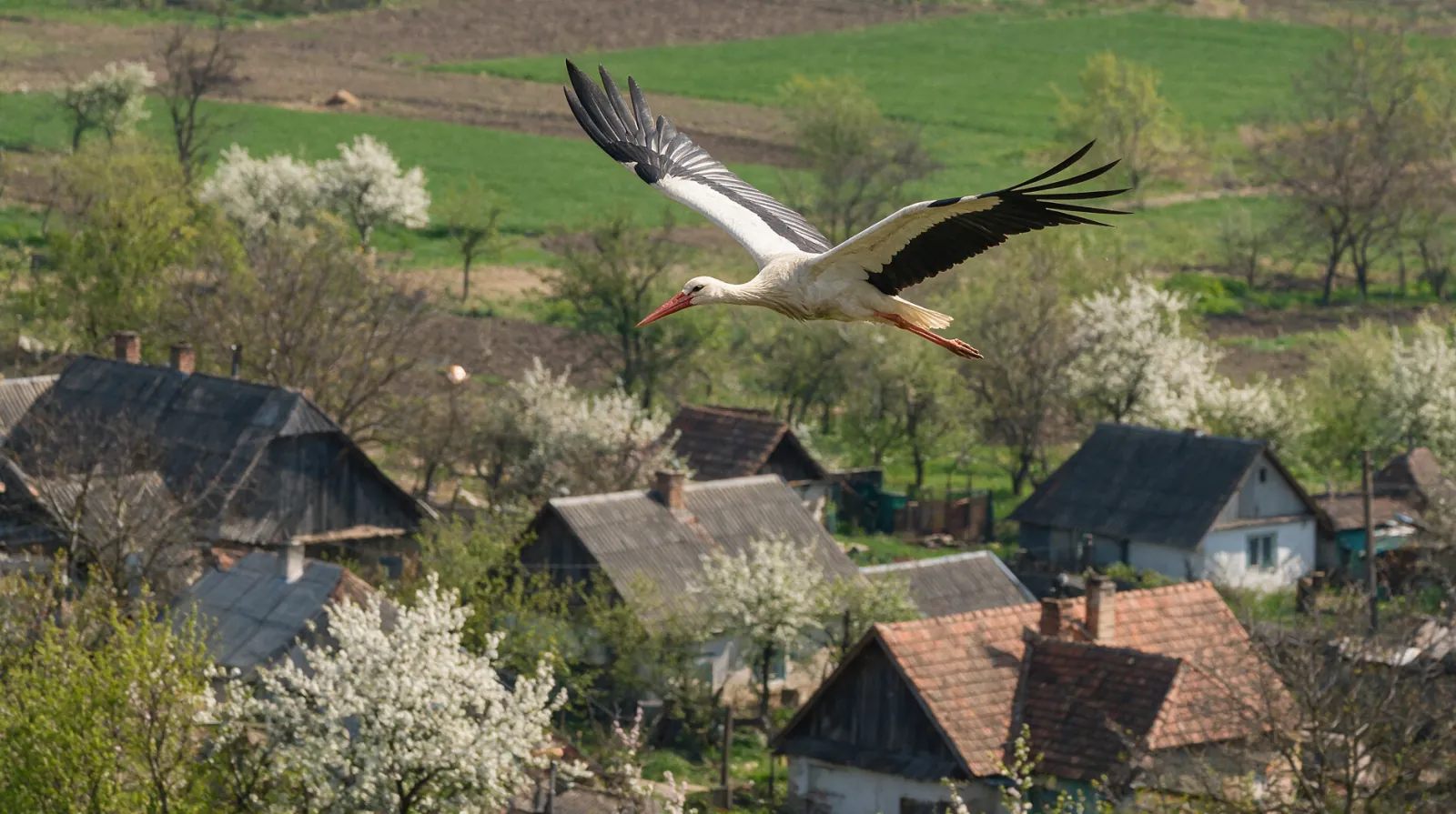
The sun reaches a wet meadow at first light, and the ground begins to give back the warmth it held overnight. A white stork standing in the grass waits for that change. When a column of warm air lifts off a ploughed field, the bird opens its wings and circles into it. The journey south begins with a climb rather than a wingbeat.
Warm ground, rising air
Land does not heat evenly. Bare soil warms faster than grass, a ploughed field faster than a pond, a dark road faster than a wood. Where the ground is warm, the air just above it warms, expands and rises, and cooler air slides in to take its place. What starts as a shimmer over one field can become a column hundreds of metres tall. A stork finds these columns the way a person finds a warm patch of floor in a cold house, by paying attention.
Slopes and valleys shape the ladder as well. A hillside facing the sun warms early and can start a column before the flat fields below have stirred. A valley can hold warm air in a way that makes the climb easier. A bird crossing unfamiliar country reads those shapes quickly, because the rules are the same everywhere: warm ground, rising air, a column to ride. The best lift often forms over stubble, asphalt and roof tiles, the surfaces that give up heat fastest.
Climbing in circles
Inside the column the bird holds its wings wide and fixed, the long black primaries spread like fingers, the tail making small corrections. It circles, and every turn carries it higher. A bird that flapped would spend muscle and fat it cannot spare; a bird that circles spends only time. On a good morning the climb is quick. Within minutes the stork is high enough to see the next field, the next road, the next column, and it leaves the thermal at the top and glides away.
This is why a stork over a field can look as if it is going nowhere. It is buying altitude, and the altitude is the journey. A bird that tried to fly straight from the ground would spend its reserves in an hour. A bird that climbs first can travel for the rest of the morning on almost no effort, with the land turning slowly below and the next thermal showing itself as a shimmer or a small cloud.
What the bird sees below
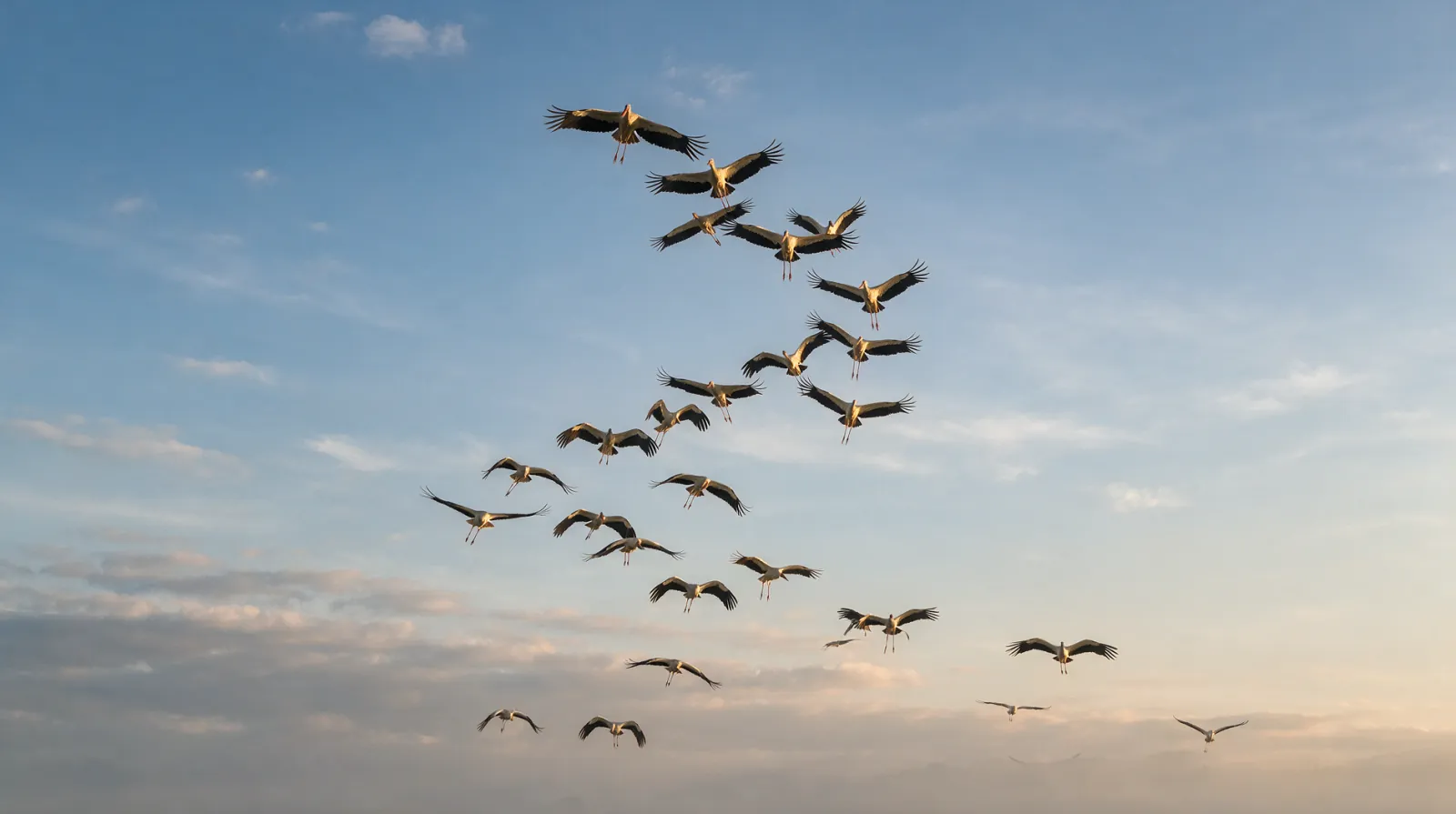
From a height the signs are plain. Ploughed earth, stubble, asphalt, roof tiles and dry grass give up heat quickly. Water and deep shade do not. Storks watch each other as well. A group of birds circling in the distance is a marker on the map, and others drift toward it, joining the same column until a scattered flock becomes a single turning spiral.
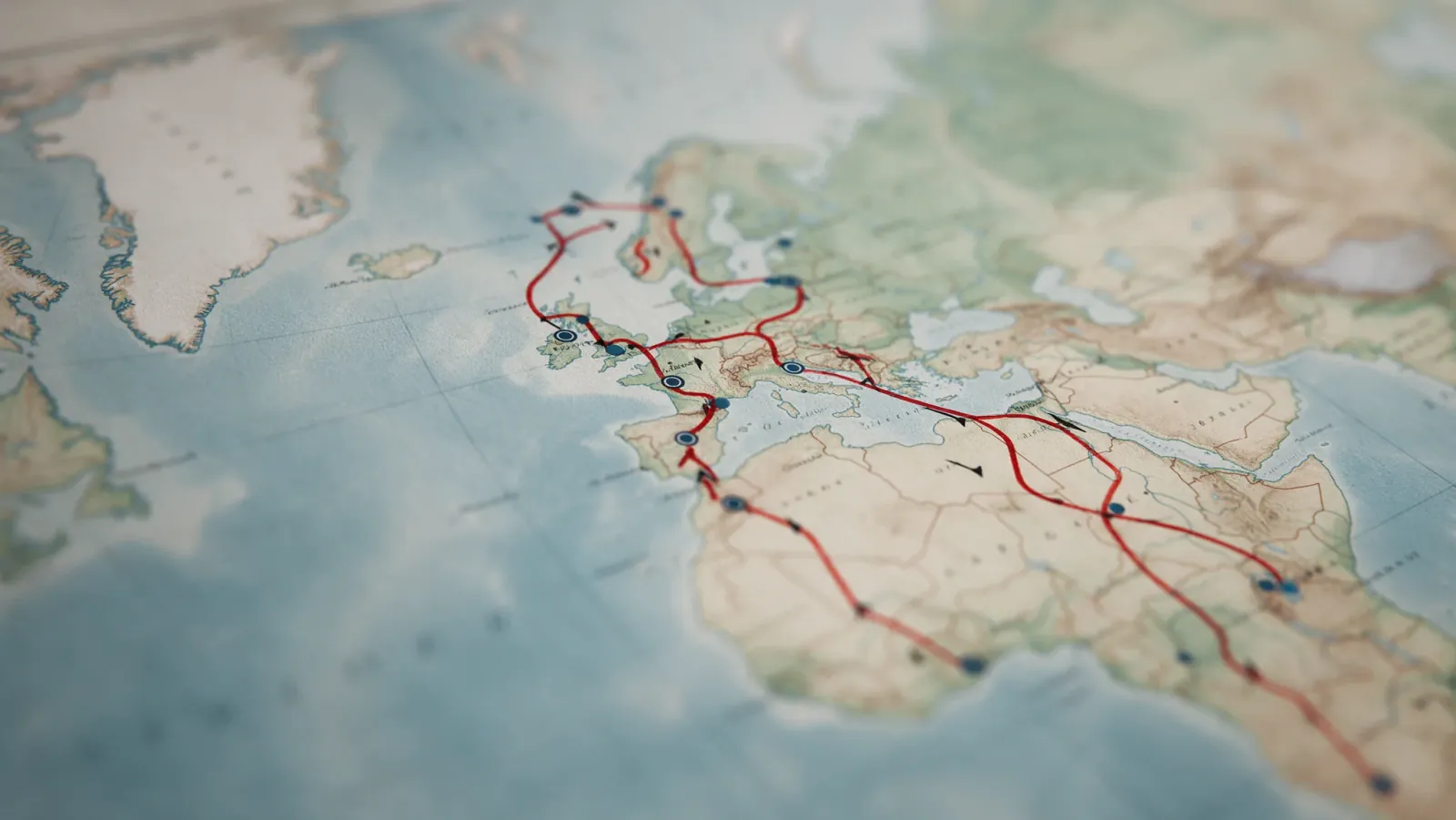
On clear afternoons the first small clouds appear over the strongest thermals, and the birds use those clouds as landmarks too. A good thermal two miles off course is worth the detour if it carries the bird high enough for the next long glide. That is one reason a tracked route looks like a scribble on a screen: the bird is following the air, and the air is patchy.
A young stork learns the signs by following. It sees an adult leave a column at the top and copy the glide, and it sees the same adult refuse to leave the ground under a flat grey sky. The ladder is read rather than taught, and a bird that watches learns where the next rung will be.
The glide between rungs
Climbing is half the work. Between one column and the next the stork glides downward, trading height for distance. The aim is to reach the next thermal before the height runs out. The journey south is a chain of short glides linked by climbs, and the chain holds only while the weather holds. A bird that misjudges must flap, or land, or start again from the ground. Experienced storks leave a column early enough to arrive at the next with room to spare.
A crosswind pushes a gliding bird sideways. The stork corrects, but the correction costs distance, so the track develops a zigzag. On a long glide the drift can be many miles, and the bird may arrive at the next thermal further off course than it expected. The compass keeps the heading roughly right, and the wings do the rest. A stork in a strong crosswind is working the whole time, even when its wings are still.
The first climb of the day matters more than any other. A stork that leaves the roost and finds a strong column early can be high before the day heats up, and the height carries it through the slow hours. A bird that misses the first lift spends the morning low and working, and the difference shows by noon.
A hundred birds in one column
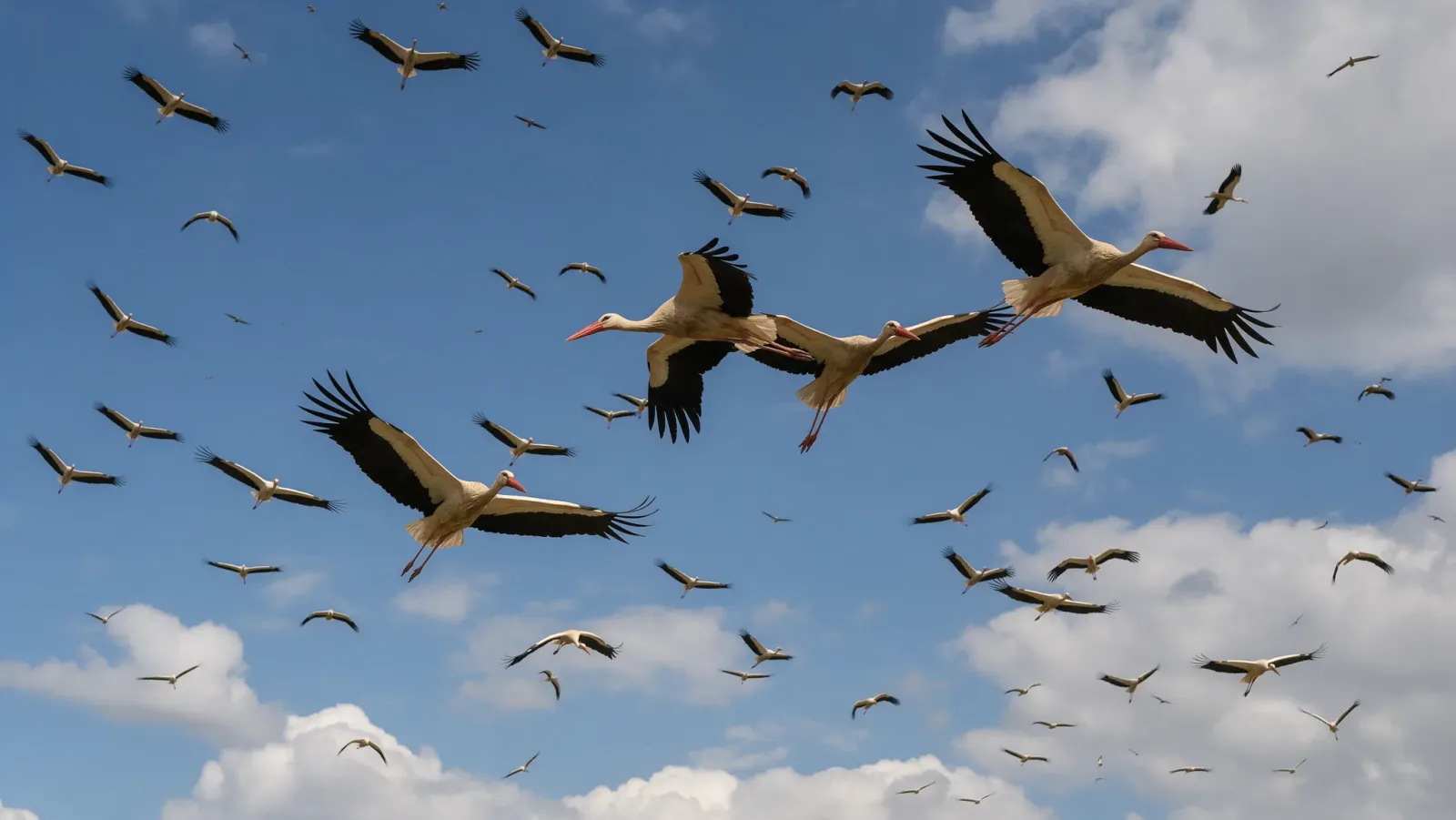
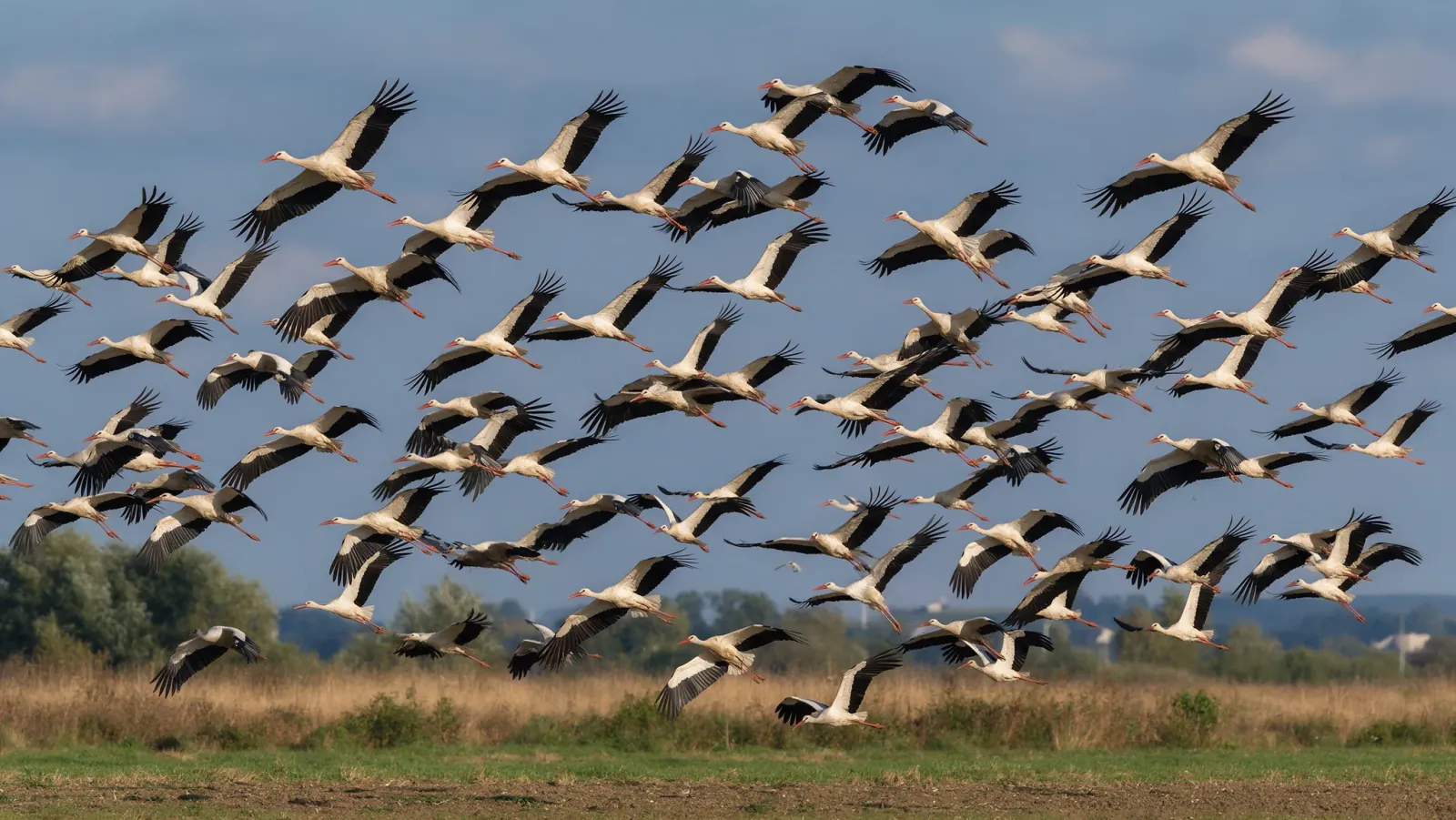
Over a field, storks turn together in a slow wheel. The first birds find the thermal and start to circle, and others drift toward them, drawn by the shape of birds turning in the same place. Inside the column the flock becomes a spiral. The birds do not touch, and they do not collide, though they pass close enough to see the black flight feathers and the red legs trailing.
Numbers help. A flock finds thermals faster than a single bird, and a bird that loses the lift can follow the others. Many birds searching the same sky will find the next column sooner than one bird alone. A lone stork can spend a whole morning hunting lift that a flock finds in minutes. The column lifts them all, and the weakest bird rises with the strongest.
The flock is not silent. Bills clatter, a dry wooden sound that carries a long way. Wings creak and whistle as the birds adjust, and a hundred pairs of wings make a noise like cloth in wind. Then the thermal weakens, the wheel breaks, and the birds stream away, and the sound goes with them.
Counting a flock in a thermal is close to impossible. The birds turn, overlap and pass behind one another, and the wheel keeps rising. A watcher counts twenty, loses the thread, and starts again at forty. The honest answer is a range, and the range is usually wider than the guess.
The days the ladder fails
Cloud, rain and cold ground break the chain. Under a flat grey sky the land warms too slowly, and the columns never grow. Storks then stay on their roofs and in their fields, feeding, preening, waiting. Some will fly low on flapping wings for a short distance, but the long free miles are gone until the sun returns.
A bird that has fed well can afford to wait. A bird that has not must take the risk of flying low and flapping, and the cost of that decision shows up days later, far from where it was made. A stopover marsh and a sunny morning belong to the same system.
This is why migration is not a schedule. The birds travel when the air allows it and stop when it does not. A week of poor weather can hold a whole flock in one valley. By late afternoon the ladder weakens. The ground cools, the columns thin, and the storks come down one last time, choosing a roost for the night. Tomorrow, if the sun is out, the climb begins again.
Explore the gift