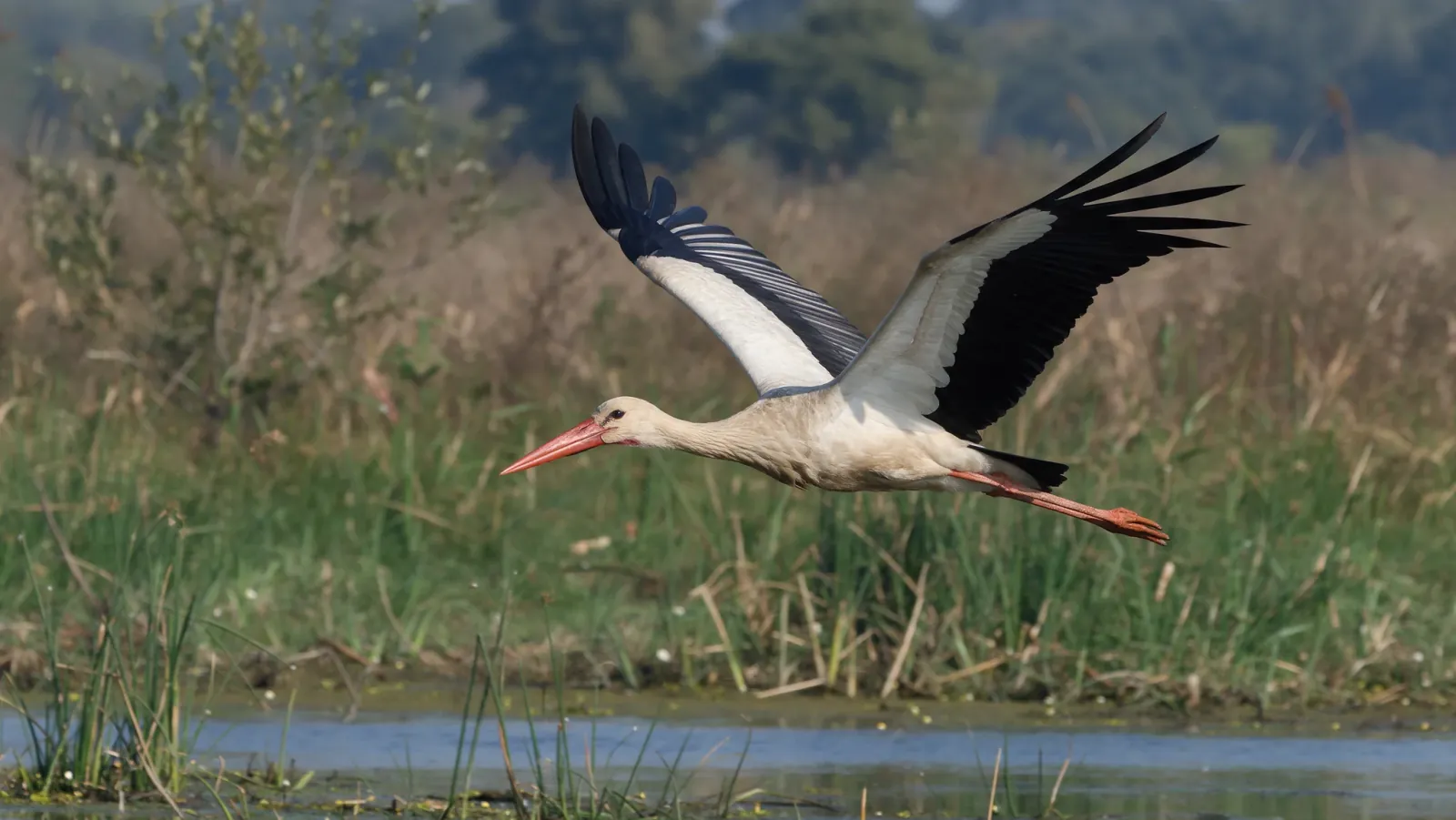
A stork climbs into the sky at noon on columns of warm air called thermals, and it does it without a single flap. The sun heats the ground, the ground heats the air above it, and that air rises in invisible towers. The bird finds one, spreads its long wings, and lets the lift carry it upward in slow circles.
What a thermal is
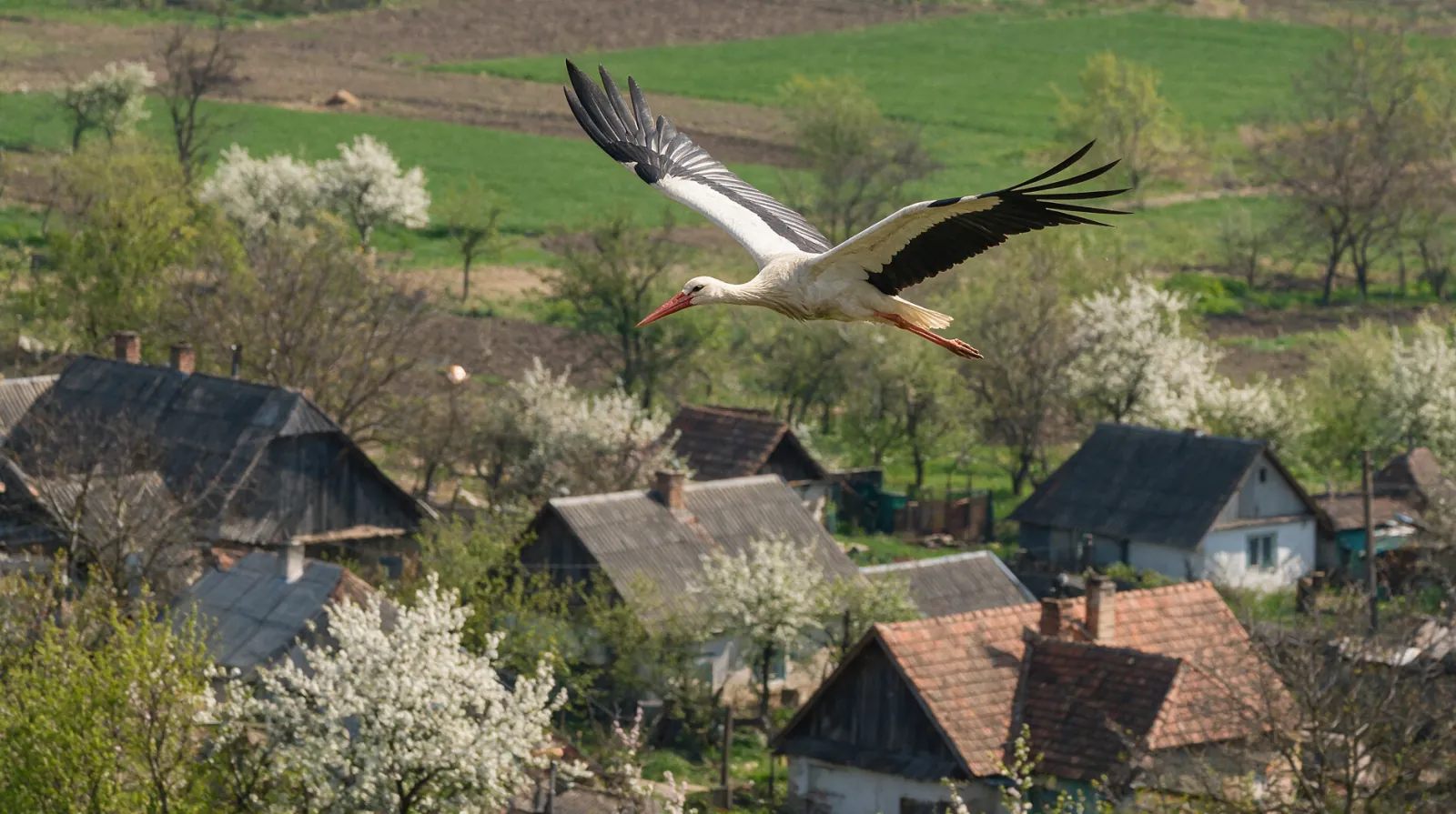
Warm air rises in a column above ground that has heated in the sun. On a sunny day, bare fields, roofs, and dry slopes heat faster than the shaded ground nearby. The air above them warms, grows lighter, and rises, cooling as it climbs. The strongest thermals form around midday, when the sun is highest and the ground is warmest. This is why storks circle high at noon and why the sky over a warm field can fill with them in the early afternoon. In the cool of morning and evening the ground is colder, the air is still, and the birds stay low. A ploughed field, a stretch of tarmac, and a bare roof all make good sources, which is why storks often circle above the edges of towns.
Finding the lift
A stork finds a thermal by feel. When the bird crosses the edge of a rising column, the air beneath it suddenly supports more of its weight, and the bird banks into the lift and starts to circle. The circles keep the bird inside the rising air, the way a boat stays in a current. It tightens the turn when the lift weakens and widens it when the lift is strong, working the column until it has been carried as high as the air will take it. The bird reads the air through its wing tips, and it never needs to see what it is riding. A stork in a thermal often looks as if it is doing nothing at all, and that is close to the truth: the air is doing the work.
The kettle
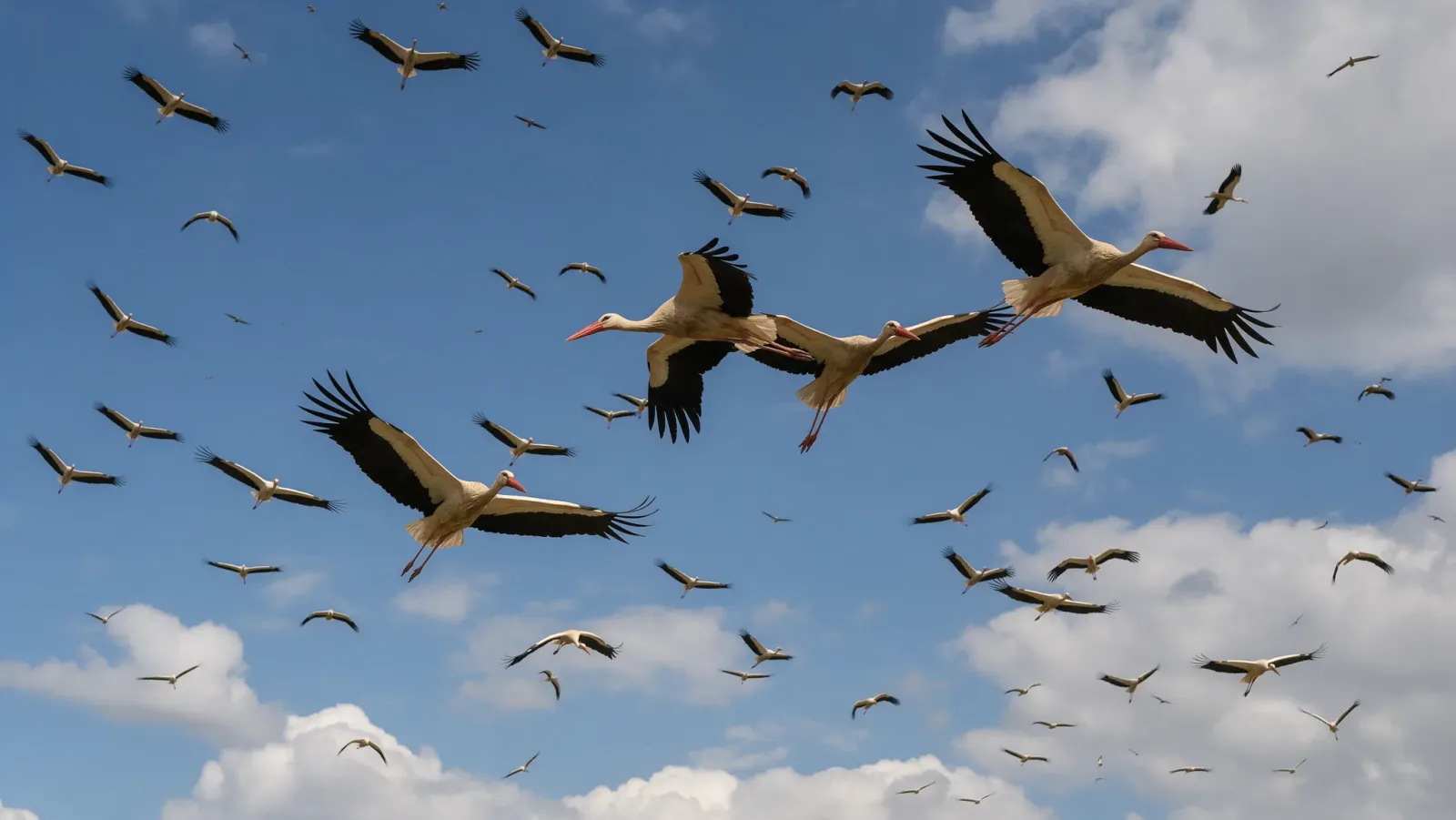
The spiral starts with a few storks finding a thermal and beginning to circle. As they rise, other storks see the lift and fly in to join, and the spiral grows. The birds turn together with their wings set, each one holding its place in the rising column. The circles widen as the flock climbs, and the whole mass spreads into a broad, turning shape of white and black. Birds join from every direction, some from the next field, some from a roof a kilometre away, until the column holds a crowd. From the ground the birds become specks, but the turning is steady and shared. The higher they go, the smaller they seem, and the whole kettle can vanish into a bright sky within minutes.
The circling is how a stork climbs without spending strength. The warm air carries the birds up, and each turn keeps them inside the column where the lift is strongest. A kettle also keeps the flock together. Birds that rise on the same thermal stay as one group, and when the lift thins at the top, the whole flock glides off toward the next thermal and the next climb. The shared climb is the flock travelling as one, bird by bird. A bird that loses the lift drops out of the column and glides away to look for another, and the kettle closes behind it.
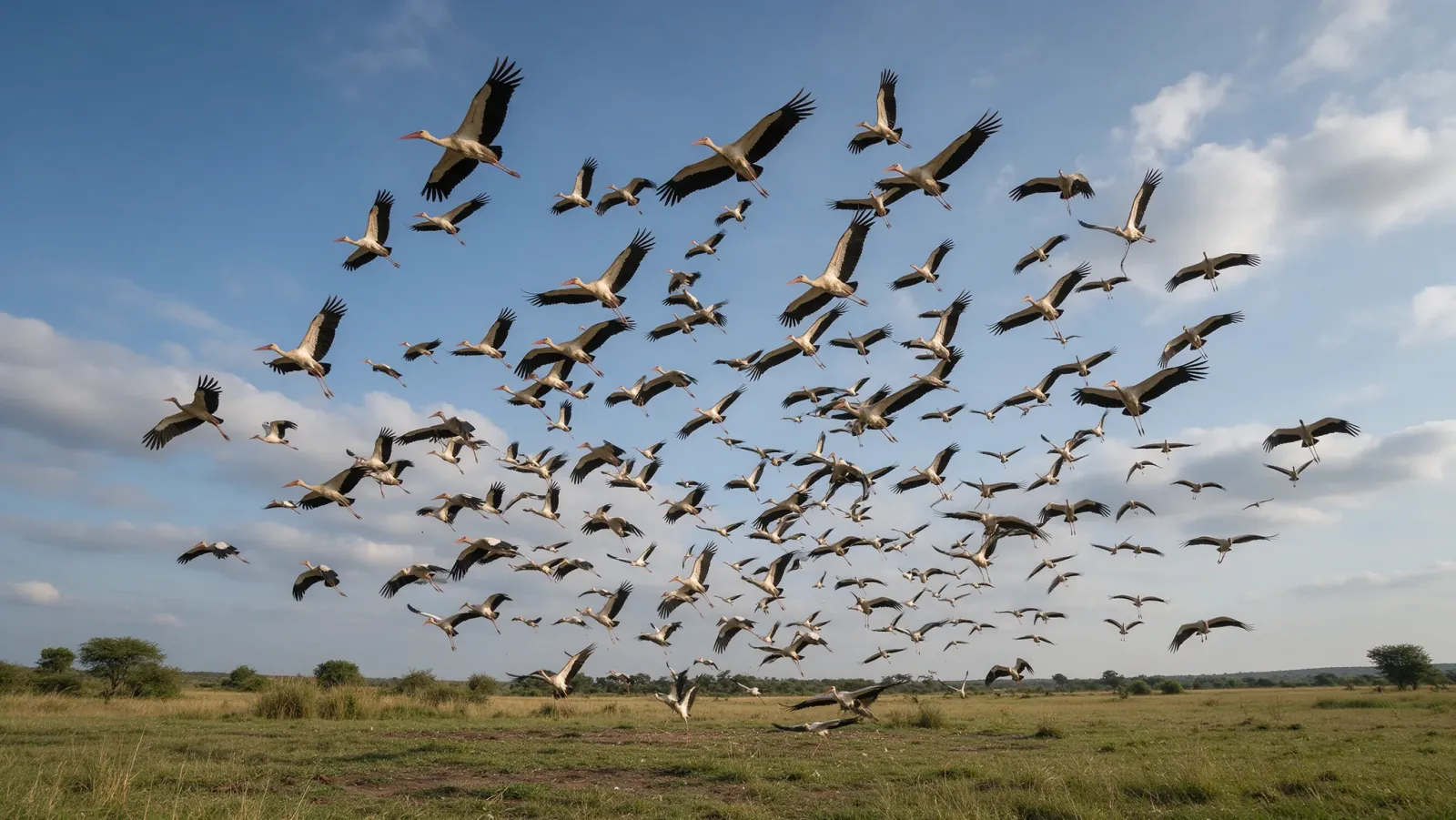
A kettle is easy to spot once you know the shape: a slow whirl of large birds against a bright sky, no flapping, no straight lines. Binoculars are barely needed. The birds drift upward for several minutes, and then the whole group slides away in one direction. That slide is the moment to watch. The flock leaves the thermal at the top, glides south or south-west, and begins to lose height. Somewhere ahead is another column, and the birds will find it and climb again. This pattern, climb, glide, climb, is how the flock crosses a continent in stages, and it is why storks follow ridges and warm plains.
Other large soaring birds do the same thing. Buzzards, kites, and vultures gather in kettles on migration, and hawk watchers count them at ridge lines where the thermals are reliable. Storks are among the most visible kettlers because they are big, pale, and travel in numbers. A kettle of white storks over a village is hard to mistake for anything else.
Why height pays
Climbing costs almost nothing, and the height pays for itself. From a thousand metres up, a stork can glide for a long way before it needs another thermal, and the country below opens out into a map of fields, rivers, and possible food. On migration, this is how storks cross continents. They rise on one column, glide south until the air runs out beneath them, then find the next column and climb again. A bird that flapped the whole way would burn through its reserves in a fraction of the distance. The birds also use the height to look ahead, and a stork at the top of a climb can see water, fields, and the shape of the country for a long way.
The gathering before departure
Before the flight south, storks come together in fields and on rooftops until a loose flock has formed. The gatherings appear in places the storks already know: the wet meadows and cut fields where they fed all summer. One stork becomes three, three become a dozen, and soon the field is full. The same fields host the gathering year after year, and the birds return to ground they already know. The flock is loose. Birds spread out to feed, draw back together, and shift from field to field through the afternoon. In the evening they may rise together and settle on roofs and pylons to roost.
The last weeks before departure are spent eating. Storks feed heavily on insects, frogs, and small rodents, and the birds that will cross the Sahara need reserves to carry them over country with little water. A stork that has fed well leaves with fat under the skin and in the flight muscles. A stork that has not may delay, or may not go at all. In parts of western Europe, more and more white storks now spend the winter in Spain and Portugal instead of crossing the desert, feeding on rice fields and open ground. Those birds skip the desert crossing entirely, and the habit has spread through the western populations.
The timing of the gathering varies with age. Adults that have finished raising chicks often leave earlier, while young birds may drift south later, sometimes in loose groups of their own. A young stork on its first migration learns the route by flying among birds that have done it before. Not every bird in a gathering is about to leave. Some are local birds still feeding, some are passing through, and some will stay if the winter is mild. The flock is a mixing point as much as a departure lounge.
When the sky gives nothing
Not every noon offers lift. Overcast weather flattens the thermals, and rain shuts them down completely. On those days storks stay on the nest or in the fields and wait, because flying without lift is expensive work. Strong wind is also a problem. A gale breaks the columns apart and makes the air rough, and the birds keep low until it passes. The whole system depends on still, sunny weather, and a run of grey days will hold a flock on the ground. In settled summer weather the pattern repeats every afternoon, and a colony can set its clock by the first bird to lift off.
Watch a stork in the middle of a hot day and you may see it step off a roof, spread its wings, and start to turn. Within a few minutes it is a speck, and the circling continues. The bird is not going anywhere in particular. It is climbing to look, or to rest in the air before the long glide south.
Explore the gift