Storks are soarers, and soaring runs on weather. A white stork would rather climb on rising air than beat its wings across a field, so its movements follow the wind and the sun. Learn a few signs and you can put yourself under the birds.
Thermals begin over warm ground
Warm air rises over surfaces that heat quickly. Ploughed fields, bare slopes, dark roofs, and dry tracks give off columns of lift once the sun has been on them. Storks find those columns and circle up in them, wings held flat, without a stroke. On a clear morning the first lift appears as the ground warms. A slope facing the early sun is often the first place to look. If you can feel warmth on your face, the air above that ground is probably rising.
The ground keeps giving clues after midday. A dark field beside a pale one will be working harder, and a track between crops can send up a line of lift. Watch where the swallows and buzzards gather. They use the same air the storks use, and they often show you the column before the stork arrives.
The morning clock
The day has a shape. Early on, the air is cool and still, and storks stay on the nest or feed in the shallows. As the ground warms, the first thermals form and the birds rise. The middle of a warm day is the best time to see storks in the air, and a poor time to see them close, because the birds are high and drifting. Late afternoon brings another window as the lift softens and the birds come down to feed. A cold, still day keeps them grounded for hours.
That shape changes with the season. In March the lift comes late and weakly, and the birds spend more time on the nest. By June the ground warms early and the first climb may come before you have finished your coffee. A warm day after a cold night often gives the sharpest lift, because the ground heats fast while the air above it is still cool.
Still air changes the plan. A day with no wind and no sun keeps the thermals from starting, and the birds stay on the ground, feeding in the shallows or standing on the nest. That feels like bad luck and is good luck for a close watcher. A grounded stork is a stork you can study. Without the option of climbing, it stays put, and you get the slow behaviour that flight hides: the walk, the strike, the long wait.
Wind direction and flight lines
A stork climbs in a tight spiral, wings flat, until it is a small white fleck. Then it levels out and glides downwind, losing height slowly, until it finds the next column and climbs again. The rhythm is climb, glide, climb. A flock on the move traces that rhythm across the sky in long, shallow steps. The height of the birds tells you how good the day is. High birds have strong lift; low birds are working harder.
Watch the wind and you can guess the route. Storks drift with a tailwind and avoid a strong headwind when they can. They follow coastlines, river valleys, and ridges where the lift is reliable and the crossing is short. A steady breeze across open country will push travelling birds along a line, and you can stand at the edge of that line and wait. Travelling storks climb, glide, and climb again, while feeding storks circle one patch of sky. A bird that keeps coming back to the same piece of sky is staying. A bird that keeps sliding away is going.
Large shapes in the land funnel birds. A headland or a river bend will show the same route used again and again. Storks follow the shape of the land. Put yourself on that shape and wait.
Clouds that mark lift
Flat-bottomed cumulus clouds often sit on top of rising air, and the lift is under them. A line of them across the sky can mark a route. A solid grey sheet suppresses the sun and the thermals with it, so storks stay low and feed. High, thin cloud may still let enough sun through for lift. You do not need a forecast to read this. Look up, feel the wind, and notice where the shadows are sharp.
A front changes the day. Ahead of rain, the wind often turns and strengthens, and birds may feed hard before the weather closes in. During a long spell of rain, storks sit tight and wait. After a front passes, the air clears and the lift returns, and the birds are often on the move again. Watch the sky for the hour before the weather changes. That hour is often the best of the day.
Read the ground, the wind, the clouds, and the hour together. A warm slope with cumulus above it, a steady tailwind, and the middle of the day add up to birds in the air. A cold, flat, still morning keeps the birds on the ground, where you can watch them closely.
Side light
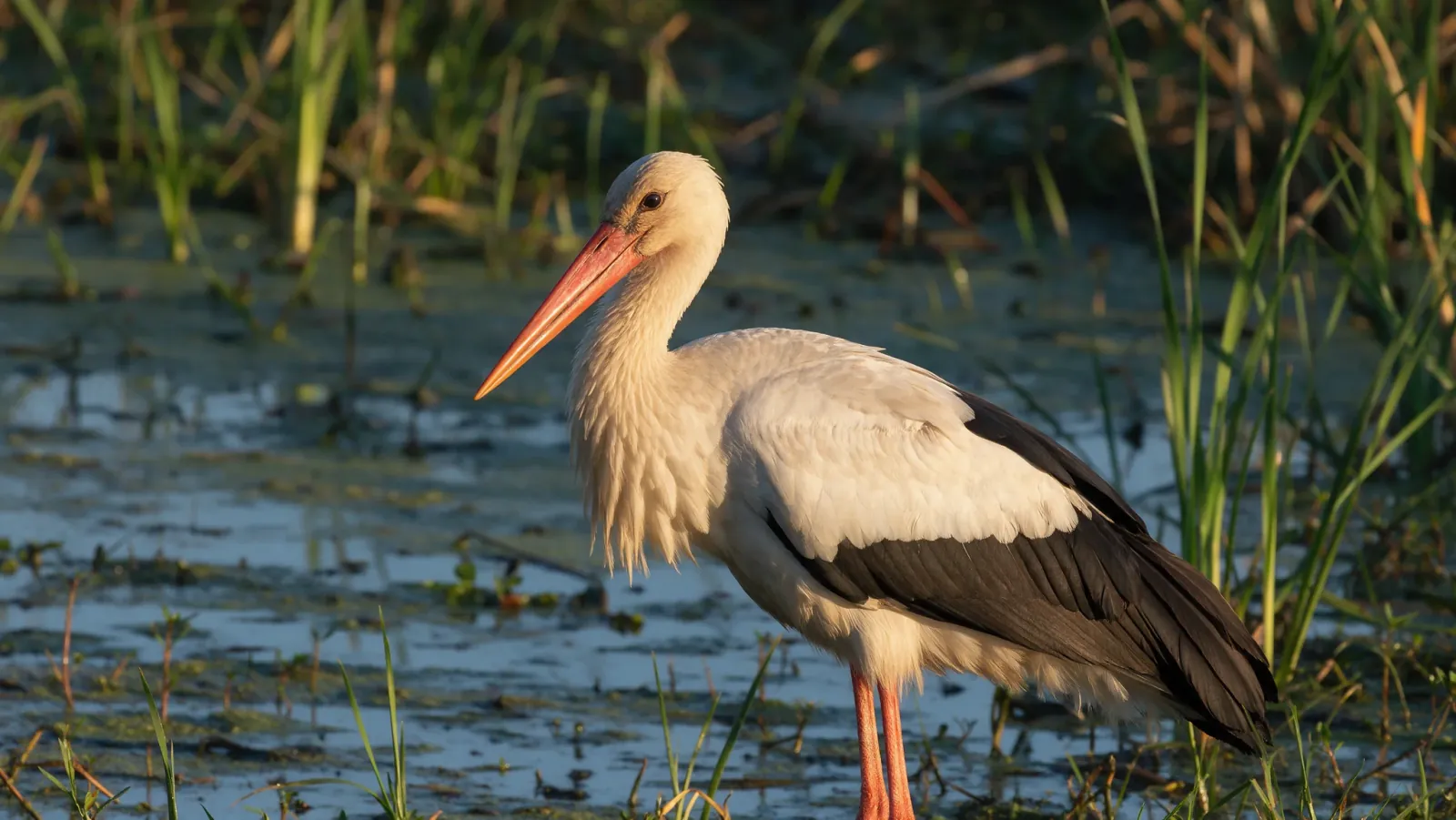
Sunlight that comes across a field separates a white bird from a pale background. It shows the edge of the wing and the black tips. Front light flattens, and back light turns the bird into a silhouette. The best light comes across the field. Stand so the sun is at your shoulder. The same field that looks flat at noon will show every feather when the light is low and angled.
Mist is the first hour's gift. It softens the far bank and leaves the near bird sharp, and the light comes through it without glare. The mist burns off quickly, so the first twenty minutes are the ones to keep. If the forecast says fog, go early and choose a spot where the sun will reach the water.
The first and last hours
Early light is cool and low. It catches white feathers against dark ground and makes the distance look shorter. The air is still, and the birds are feeding. The first hour after sunrise is the most generous. It rewards the person who got up.
Evening light is warmer and easier to reach. It turns the water gold and the white backs honey. The birds drift in to roost, and the field settles. The last hour is the social hour. Pairs meet, and the colony becomes loud before it goes quiet. You can watch the whole return from a road or a path, and the light holds long enough to see the greetings. Stay until the colour goes.
The clock moves through the year. In early spring the dawn watch begins late and the dusk watch comes early, so a short day fits both into a lunch break. By June the light lasts from before five until after ten, and the edges stretch so far apart that you must choose one. Take the hour you can keep. A watch you repeat is worth more than a perfect watch you manage once.
Grey days and backlight
An overcast sky flattens the colours, and it also removes the glare. The bird's shape reads clearly against the field. Grey light is good for detail and bad for distance. Stay close to your subject and use the even light. Backlight turns the stork into a dark shape with a bright rim. Use it for mood, and use side light for identification.
Sometimes the light is so good that binoculars are unnecessary. A stork at the edge of a field, lit from the side, is a thing to watch with the naked eye. Put the glass down and let the scene be wide. Note the hour and the direction of the sun beside your sightings, and after a season you will know which fields are best at which times.
Explore the gift