The fledgling called Lark began as a small heap of white down in a nest at the top of a poplar. She was one of three, and for weeks the only thing that marked her out was her voice. She begged louder than the others, her bill wide open the moment a shadow crossed the nest. Her first summer is the story of a body learning what air can do.
Down in the poplar
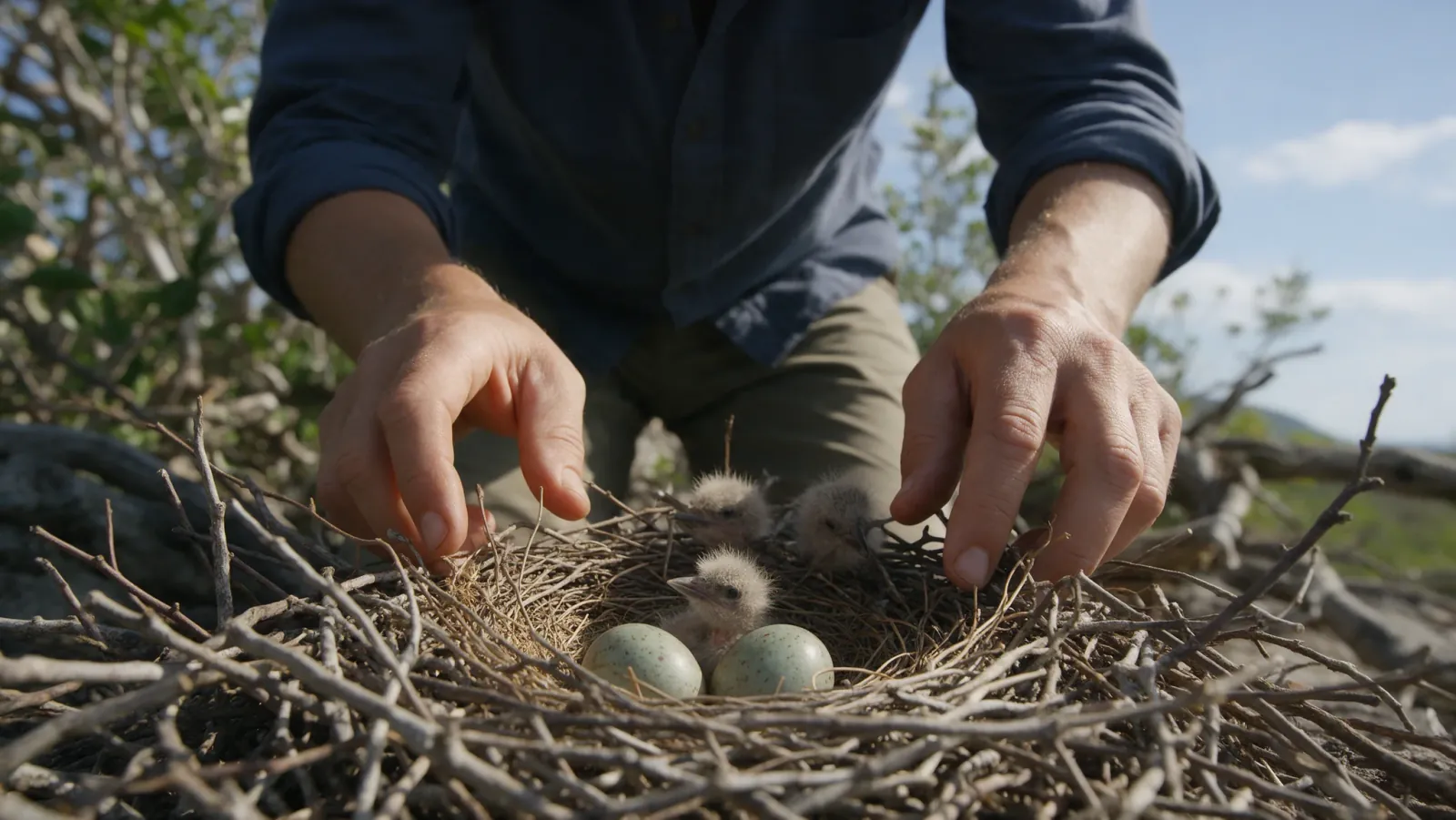
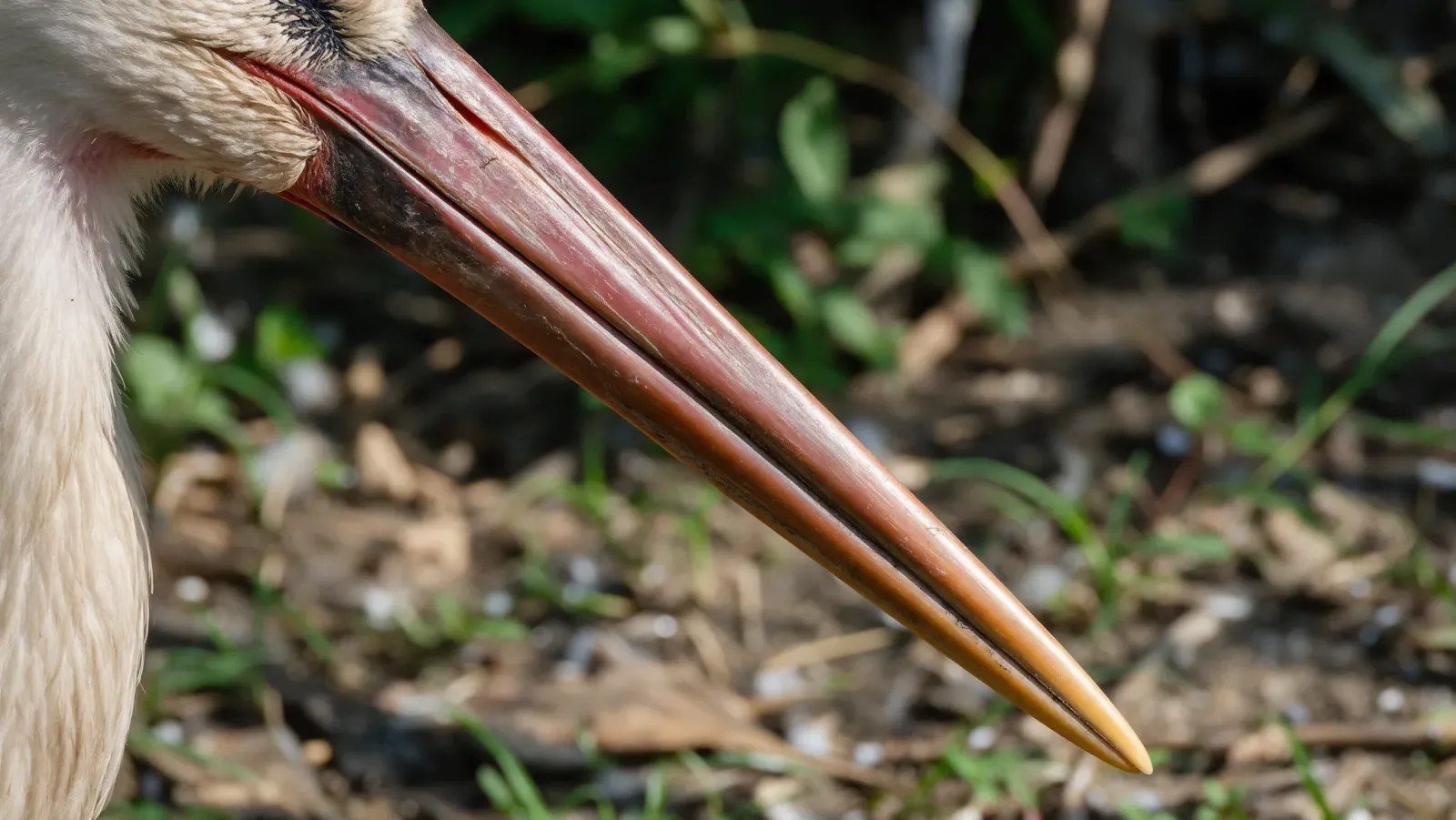
A stork chick is helpless at first. It cannot stand, it cannot regulate its own heat, and it needs food constantly. Lark spent her first days under a parent's breast, and her first week learning to sit up and grab at a bill. The nest was her whole world, and she measured it in bills and shadows.
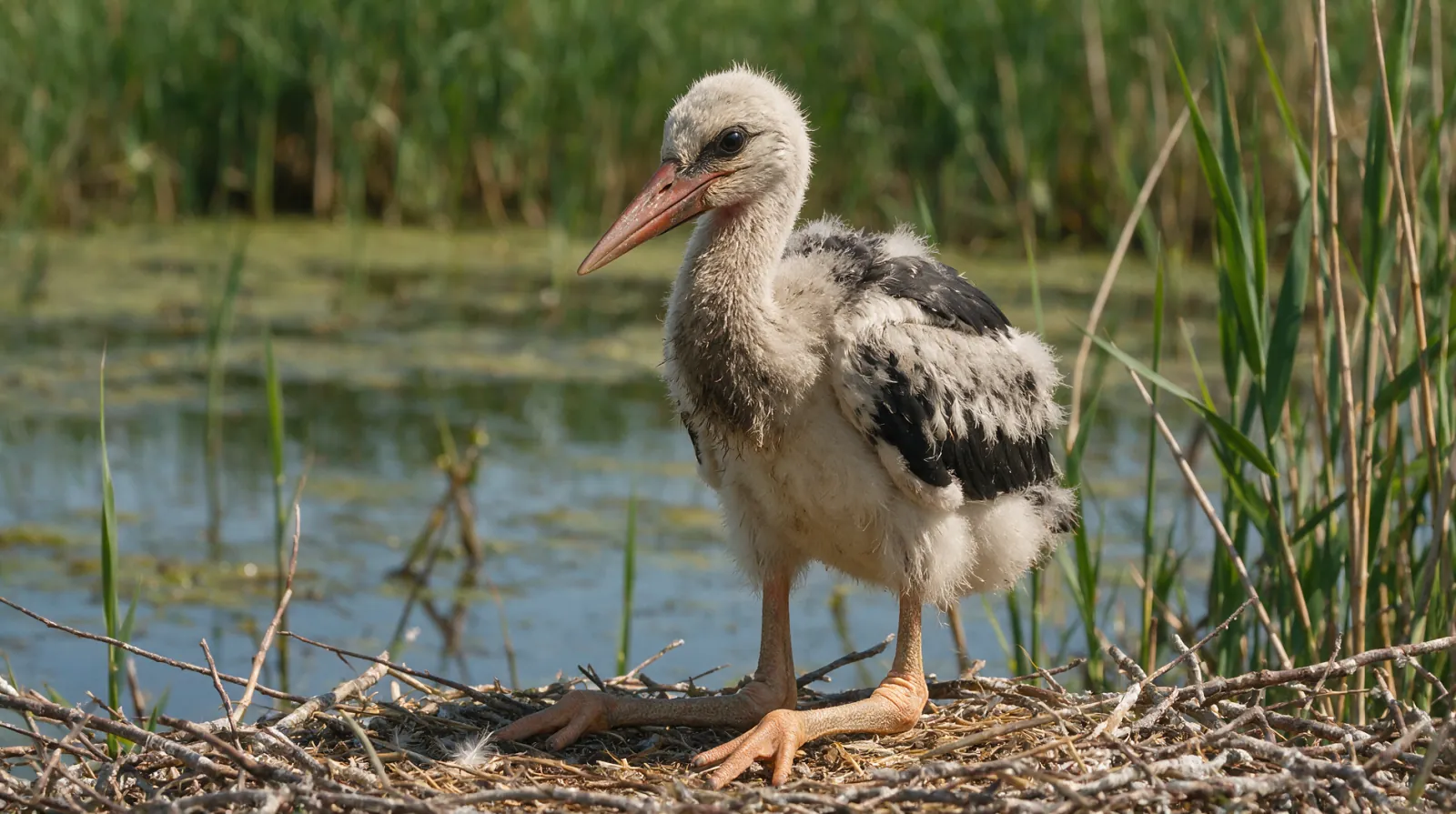
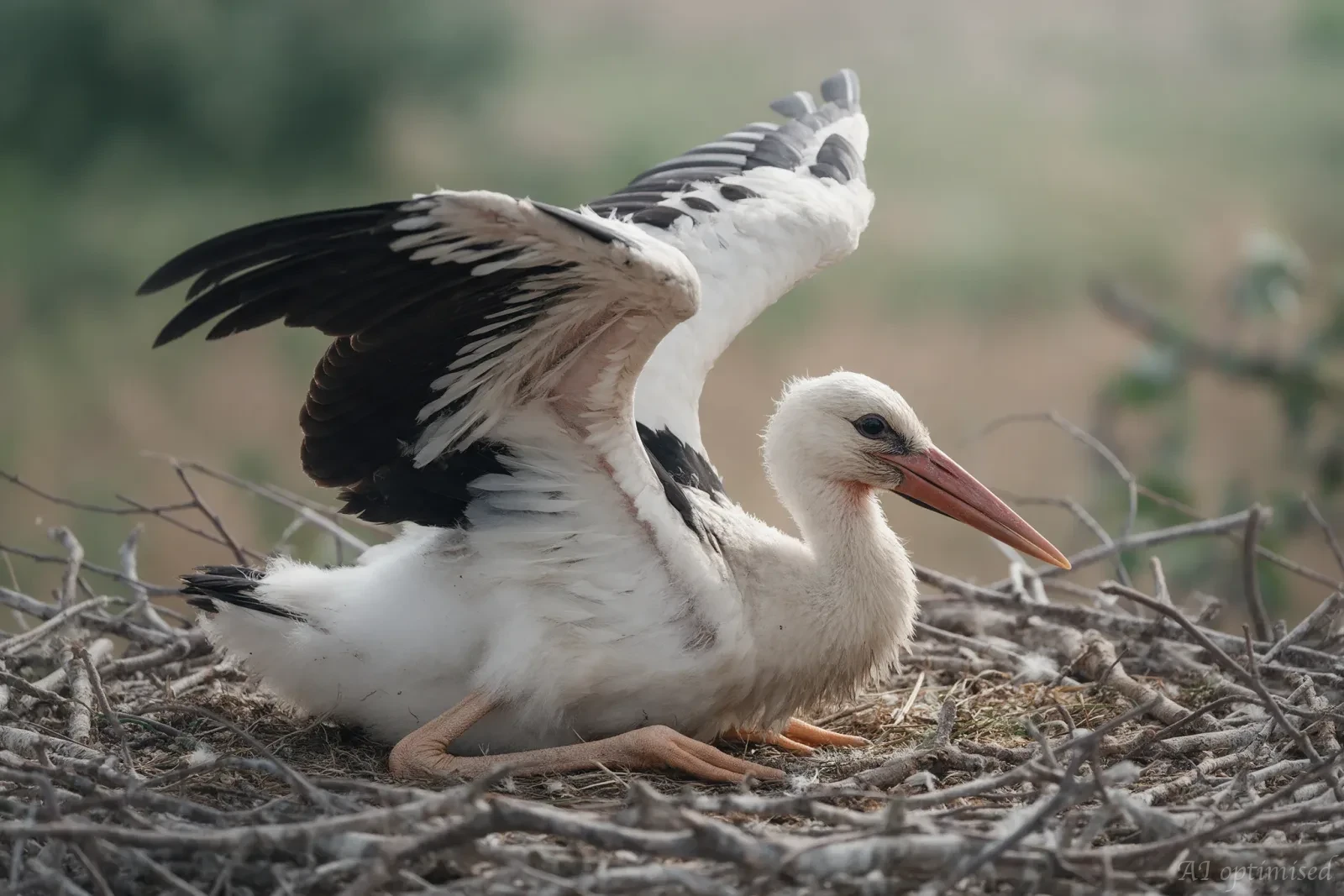
By the second week she could stand, and by the third she could walk the rim. The nest had begun to feel small. A white stork chick grows fast on a diet of insects, worms, frogs and whatever small creatures a parent brings back, and the body that will one day carry a two-metre wingspan is built in a few months.
The nest itself is a platform of sticks with a soft centre. It holds the warmth of several bodies, and it becomes a training ground with no instructor. Everything is learned by imitation, and by falling a few centimetres.
The edge of the nest
Fledging starts long before flying. The chicks stand at the rim and flap, and the wind lifts them a little, and their wing muscles strengthen with every attempt. Lark was the boldest of the three. She stood with her toes on the edge and beat the air until she wobbled.
A young stork practises flight for days before it leaves the nest, and the practising looks like impatience. Her siblings watched her and then copied her, and the nest shook with three pairs of wings. The wings were already close to two metres across, a strange thing to carry before you know what it is for.
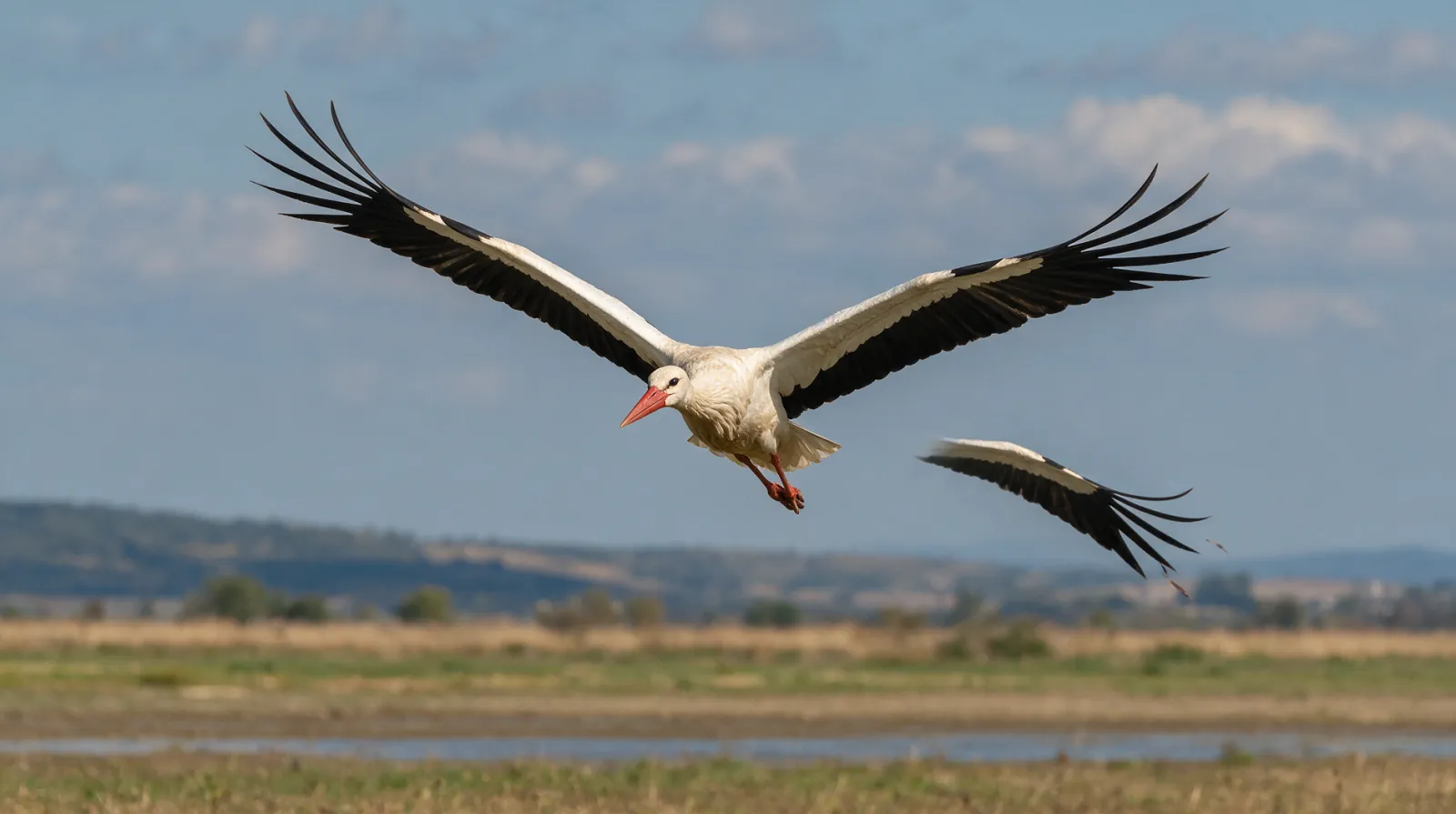
She went on a still morning. There was no ceremony. She leaned forward, the air took her, and she was out over the field with her wings wide and her legs trailing. She flew a hundred metres and landed badly in the grass, and then she stood there looking around as if she had planned it.
The second flight was better. The third was almost good. By the end of the week she could circle the poplar and come back to the nest, and the field below had become a place she could visit. She still came back to the nest to sleep, and she still begged, though less each day.
Rian's first circle
Rian's first flight happened on a still, warm afternoon in July, and nobody in the village noticed. He was a young white stork, ringed as a chick, and his reconstructed track had not left the nest for weeks. Then the points began to move in small circles, and the circles grew.
Young storks often fledge into a headwind, because moving air pushes against the wings and gives lift before the bird has any speed. Rian would have faced into it, half spread his wings, and felt the nest go light beneath him. The tag recorded none of that. It recorded the nest, then a point thirty metres away, then another.
A stork does not need to be taught to use a thermal. The skill is old and instinctive: find the rising air, turn into it, hold the wings still. His early points describe small circles, each a little wider than the last. He stayed close to the nest. He was learning how to stay up.
By evening the points had formed a loose ring around the nest. By the next morning the ring was wider. Within a week he had found the wet meadow to the south, and after that the map shows a triangle: nest, meadow and the sky between them. Every successful migration is built on a summer of short, safe flights over ground the bird knows.
A wind that does not move her
Sigrid was the stork who stayed calm when the wind came up, and in the flat country the wind came up often. The other storks in the field would shuffle and shift when a gust crossed the meadow, lifting and settling like uneasy guests. Sigrid stood where she was.
She had been raised on a pole in the middle of the flat land, and she had learned weather the way a sailor learns the sea. A stork is a big bird with a long lever of a body, and a gust can move it. In a strong wind a stork turns into it, lowers its head and waits, because there is nothing else to do.
There are no hills to break the wind. It comes off the sea and crosses the fields for miles, and the trees are all bent the same way. A stork that lives there learns to stand low and choose its ground. When the flock was nervous, Sigrid was the still point. The younger birds watched her and settled.
One afternoon a squall came across the flat land with rain in it. The flock broke and scattered. Sigrid stayed in the middle of the field with her back to the rain and her feet set, and the squall passed over her and went on toward the sea. Standing in wind is work. The muscles in her legs and back carried the load, and after a long blow she was tired in a way that food did not fix.
The detour that became a route
Eirik took the long way round, and he made it home just the same. Each autumn the white storks of his valley left for warmer ground, and most went the short way, the way their parents had gone. Eirik went another way.
No one marked the moment he left the flock. The birds were strung out over a wide valley, and he was flying at the edge, and by evening his line had bent west while the rest went south. He was a young bird on his second migration, and he had a route in his head that did not match the route in theirs. A stork's migration is learned, and a young bird can learn it slightly wrong.
He followed a river west until it met the sea, and then he followed the coast. The coast was longer than the direct route and safer than the open water. He passed towns he had never seen, and fishing boats, and a long line of mudflats full of birds. He fed there for three days. Then the coast turned south, and he turned with it. He crossed a range of low hills and came down into a plain of wet fields, and the plain was full of storks. He joined them for a week and left with them at the crossing.
That stretch was the part he had been dreading without knowing it. He reached the shore in the evening, found the usual crowd, and waited two days for the wind. When it came he went with a flock of strangers, and the sea was wider than the river and flatter than any field he had crossed. He kept his eyes on the far shore and beat his wings when he sank. The shore came up slowly, and when his feet touched it he stood for a while without moving. Spring came, and he flew north by the ordinary route. The nest on the roof was still there.
The field after fledging
Lark began to learn the field once she could fly. She learned to follow the plough, where the turned soil brings worms and insects to the surface. She learned to stand in a wet field without moving and let the frogs come to her. She learned the sound of a tractor and the shape of a good ditch. She learned that a field cut for hay is easy walking and a field left long is not. She learned to drink from a ditch without wetting her breast feathers, and to land uphill when the wind was behind her.
The first summer is a long apprenticeship, and most of it happens on the ground. A stork that learns where the ground stays soft can feed through a hard week. A stork that learns the air can leave when the season turns.
Someone below had said she would fly soon, like a lark, and the name had stuck. Lark was a white stork, growing tall and heavy, and by August she was nearly the size of her parents. The name stayed anyway. Names for wild birds are like that. They are not accurate, and they hold the affection of the people who gave them.
By September the nest was empty. The three young storks had gone south with the flock, and the poplar held only sticks. The nest waits for the next spring, when a pair will land on it and the whole thing will begin again.
Explore the gift