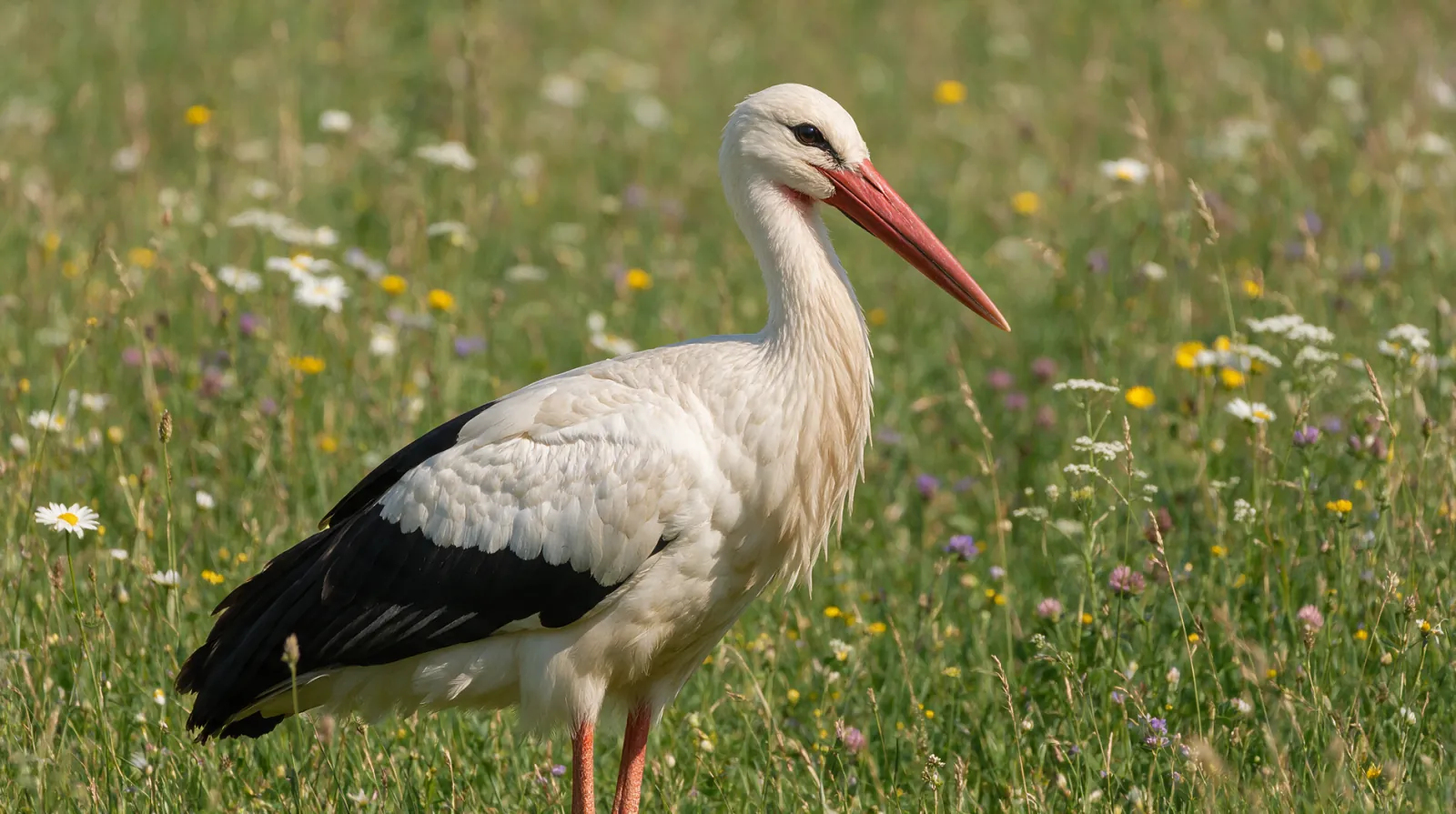
A white stork can spend a whole summer in one meadow and learn it the way a person learns a garden. Elowen arrived in spring, when the late rains had left the ground full of water, and she stayed. The grass grew tall, was cut, and grew again, and she waded through it day after day.
The first hour
Her days began before the village was awake. She stepped into the wet grass and stood still until the insects settled around her, then moved slowly, her long legs lifting and falling. Dew soaked her legs, and she left a trail of prints that the sun dried away before noon. Frogs jumped from her path, and her bill closed on them with a small hard sound. She ate beetles, grasshoppers and the small frogs that came up out of the wet ground, and she never seemed to hurry between them.
The best feeding of the day comes in the first hour of light, before the meadow warms and the small lives move deeper into the grass. The sun came up over the hedgerow, the field turned gold, and Elowen fed until she was full.
The long afternoon
The middle of the day was for rest. When the sun stood high and the air shimmered, she found a shallow pool and stood in it, or spread her wings and let the heat soak into them. She stood so still that dragonflies landed on the reeds beside her and forgot she was there. Sometimes she slept standing, her head tucked back, and the only movement in the meadow was the drift of clouds. Her feathers were glossy from preening, and she kept them that way through the heat.
The river bend
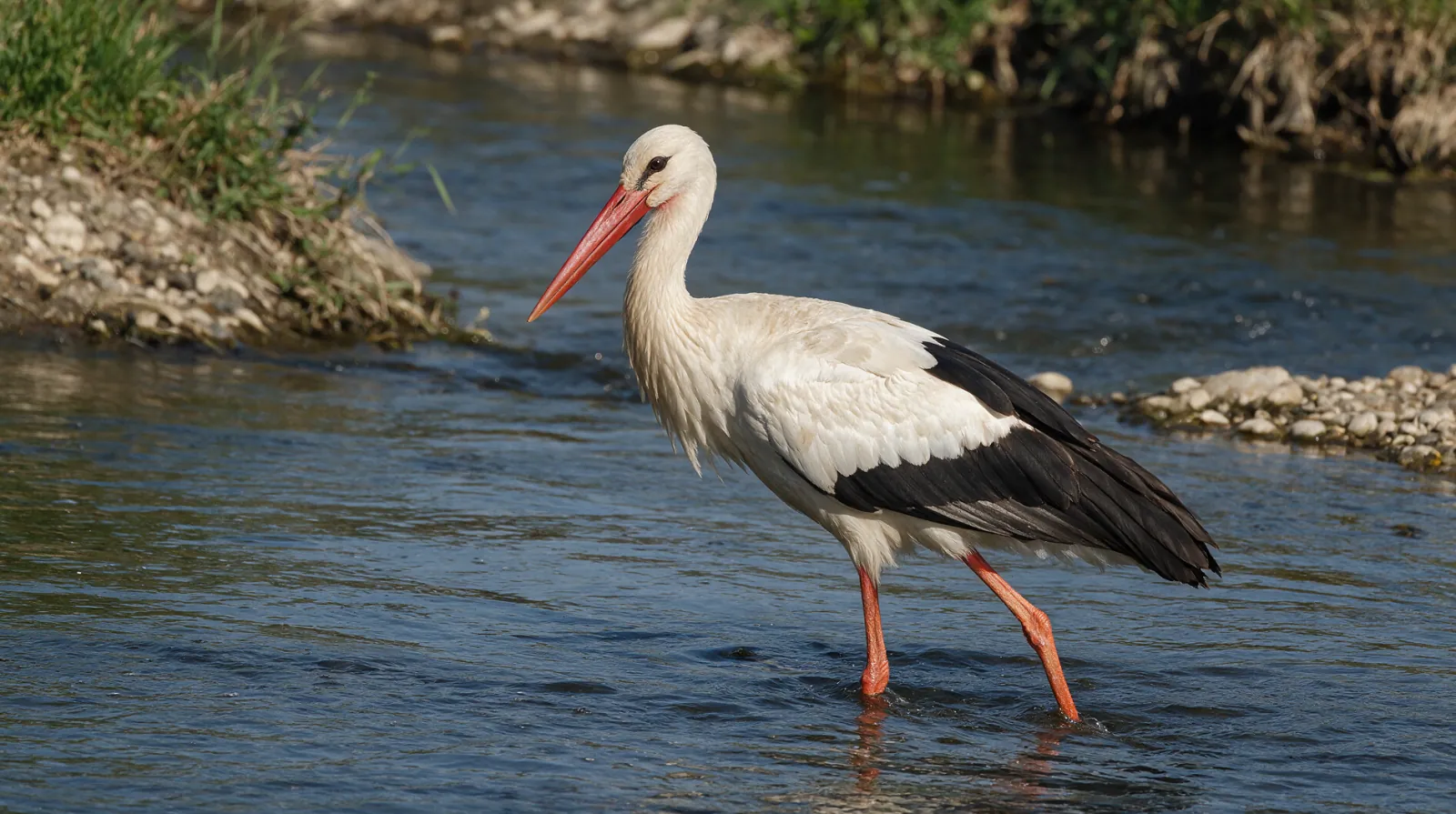
On the outside of a curve the current runs fast and cuts a deep channel. On the inside it slows, spreads and drops its silt, and the shallows that form are exactly the ground a stork needs. Frogs gather there. Small fish get trapped as the water drops. The mud stays soft enough for a long bill to work through.
Mira found this without guidance. She waded the inside edge, probing as she went, and the bend gave back what she asked. A river bend is a larder that refills itself, as long as the water keeps its shape.
For weeks Mira had wandered. A young stork is restless, moving from field to field, testing one feeding ground and then another. Then her days began to repeat. Morning at the bend, midday on the bank, evening at the bend again. A day at the bend has a rhythm. She arrives in the cool of the morning, when the water is still and the mist lies over it. She wades slowly, head down, the long red bill closing on one small creature and then another. By midday, when the heat rises, she rests on the bank with her bill tucked. By evening she is feeding again.
The bend stays the same, and the same water brings the same small lives. The same water, the same mud, the same supply of small lives, day after day. A hunter learns a place by heart, and the richest part of this bend is where the frogs lie thick.
The quiet neighbour
Riven is the stork the village almost forgot to notice, and that suits him. While the other storks clatter and come and go, he stands at the edge of the village in the long grass by the ditch, so still that people walk past without seeing him. Most storks are easy to spot. They stand on roofs, in open fields, on poles, and they announce themselves with their bills. Riven chooses the margins. He stands among the reeds where the grass is tall and the light is flat, and his white body becomes part of the day.
His day has almost no events in it. He stands. He watches the water. He takes a step, stops, and watches again. When something moves in the shallows, his head goes down and the bill closes, and then he is still once more. A stork that stands still is hunting, and the stillness is the method. Frogs and insects respond to movement. A bird that wades and splashes sends everything into cover. A bird that waits lets the small lives forget it is there.
His patience pays in ordinary ways. He feeds well without spending much energy, which matters in late summer when the body is storing fat for the journey. He is rarely chased off a pool. He sees more than the busy birds do, because nothing he does frightens the field.
The company of the field
The meadow was never empty. Lapwings called from the far side, skylarks sang above it, cattle grazed at the fence, and a grey heron fished the ditch with the patience of a bird twice Elowen's age. She paid them little mind. The heron never spoke to her, and she never spoke to it, and they fished the same ditch in peace. In the evenings swallows crossed low over the grass, the frogs started, and Elowen stood in the middle of it.
A grey heron fished Mira's bend most mornings. It arrived before her and left after her, and the two of them kept a distance that neither needed to negotiate. The heron took fish. Mira took frogs. The bend held enough for both. Once, a young fox came down to drink and the heron lifted with a harsh croak, and Mira merely walked two steps further into the shallows.
The village learned to check for Riven. A person walking the lane will glance at the grass by the ditch, and if the white shape is there, the day feels ordinary and correct. The grass is tall there because the verge is never cut. It grows up through nettles and cow parsley, and by July it is high enough to hide a standing stork to the shoulder.
The rain and the turn
One afternoon rain came across Elowen's meadow, soft at first and then steady. She stood in the open while it fell. The grass bent under the weight, and the field turned a deeper green. When it stopped, water lay in shining sheets in the low places, the frogs came out, and she fed easily in the cool air. She shook out her wings afterwards and preened each one in turn.
By August the mornings were cooler and the other storks had begun to gather in the fields, restless and loud. Elowen felt it too. The stubble fields filled with birds from other villages, and the talk among them was all of the south. She knew the meadow would soon be empty, and she did not hurry. She walked the grass in the long light and let the slow days be what they were.
Mira left the bend the way a person leaves a house, with the certainty that it would still be there. The river keeps its bends, and a stork remembers. In the spring she would find the water where she left it, and the frogs would be waiting.
Riven stayed in the grass by the ditch until the season turned. One morning the grass was empty. The storks had gone south, and the field was quiet.
Explore the gift