The stork family holds around twenty living species, and one of them, the white stork, ties Europe, Africa and Asia into a single yearly route. The family is small by the standards of other bird families, and it is spread across the warm world.
One design, many homes
Every stork is recognisably a stork: long-legged, long-billed, silent or nearly so, and flying with the neck stretched out. Different as they look, they share the same long legs, long bill and patient walk. Every one hunts shallow water and open ground, on long legs with a long bill for catching. They nest high, on cliffs, in trees or on the roofs we build for them. They raise their young on food carried in the bill, and they clatter instead of sing. The plan has changed little over a long stretch of time. The family's oldest members have been wading the same kind of ground for millions of years, and the shape has proved hard to improve. Together the species make a map of the world's wet places. A flooded meadow in Poland, a rice field in India, a forest river where the black stork hunts alone, a mangrove coast where the milky stork feeds: each bird marks a particular kind of water.
The giants and the shy cousins
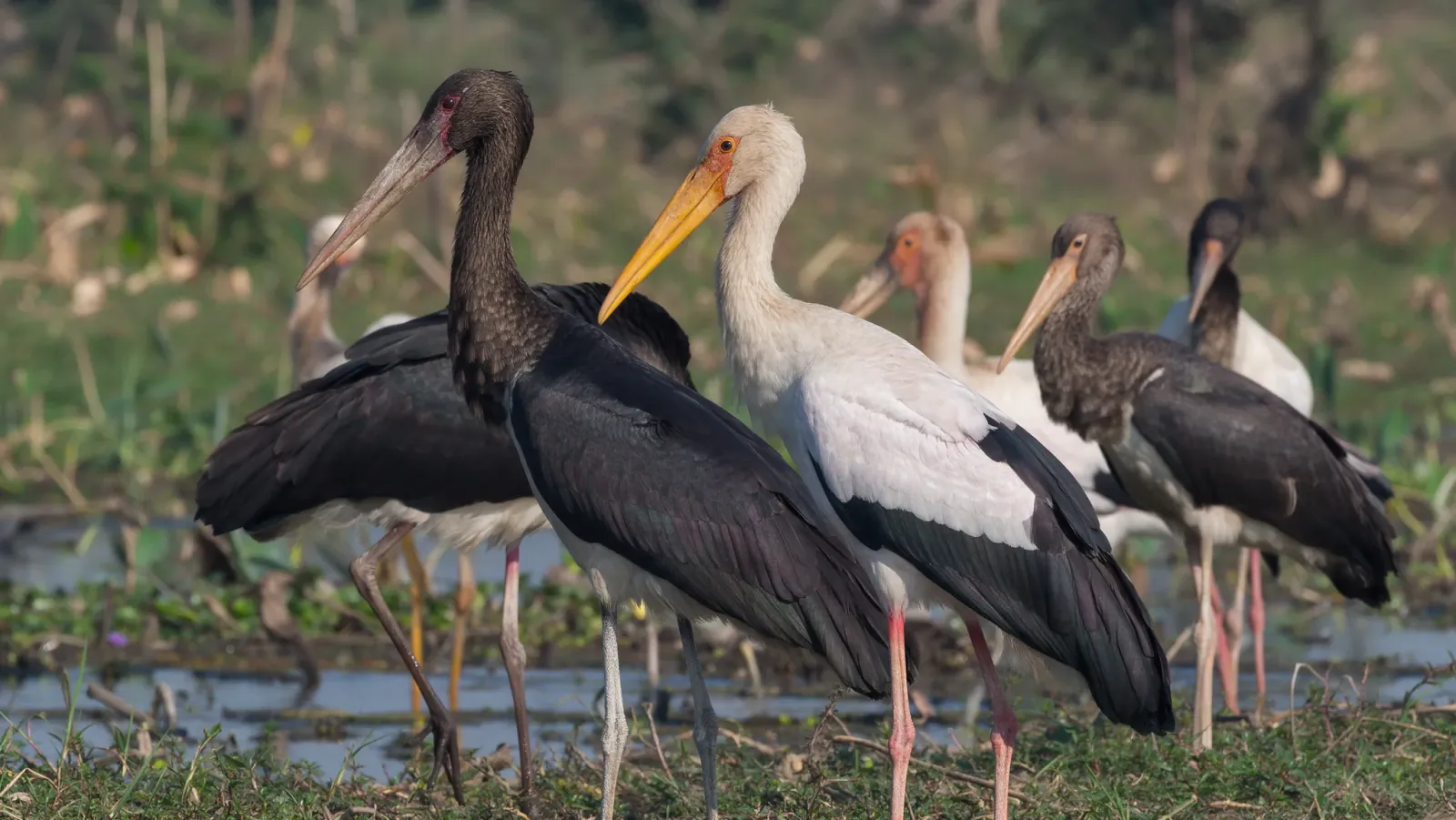
In Europe the family is known through two birds. The white stork is the village bird, at home on roofs and chimneys, a pale figure standing over a field. The black stork is its shy relative, a bird of deep forest and quiet rivers that avoids people. The two share a continent and a migration but almost never a nesting place, one drawn to our roofs and the other to the empty woods. A family can hold very different temperaments. Beyond Europe the family grows larger and stranger. The marabou of Africa is a huge, bare-headed scavenger that walks the savanna and the edges of towns. The greater adjutant of Asia is one of the biggest storks of all. The saddle-billed stork, with its red and yellow bill, wades African rivers. The jabiru stands in the wetlands of the Americas, and the painted, milky and yellow-billed storks fill the shallows of Asia and Africa. Each is different in colour and size, and all keep the same straight-necked flight. Where the water is healthy, a stork of some kind is usually there. The rarest are tied to a single kind of wetland, and they vanish when it does.
Where the white stork nests
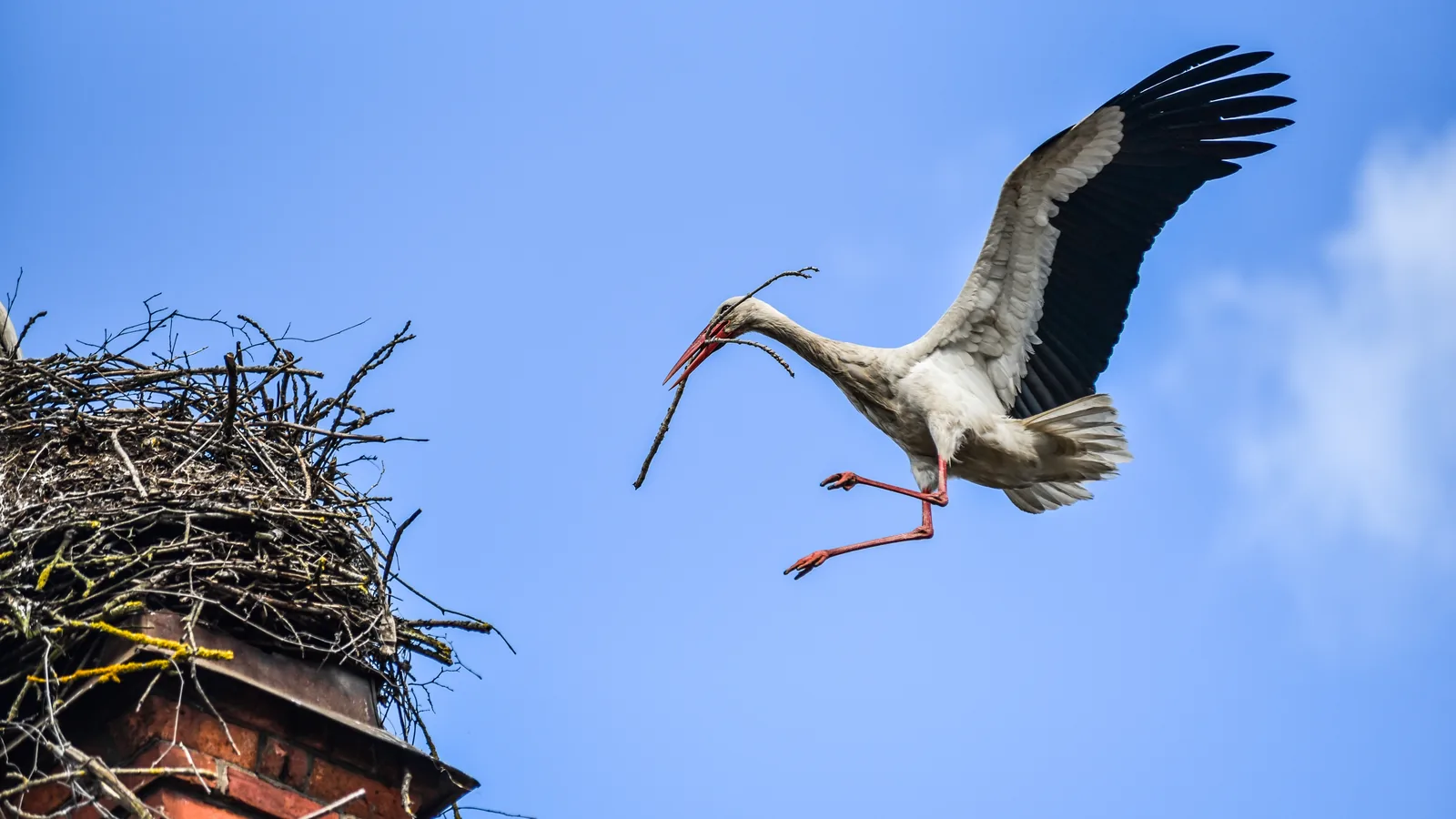
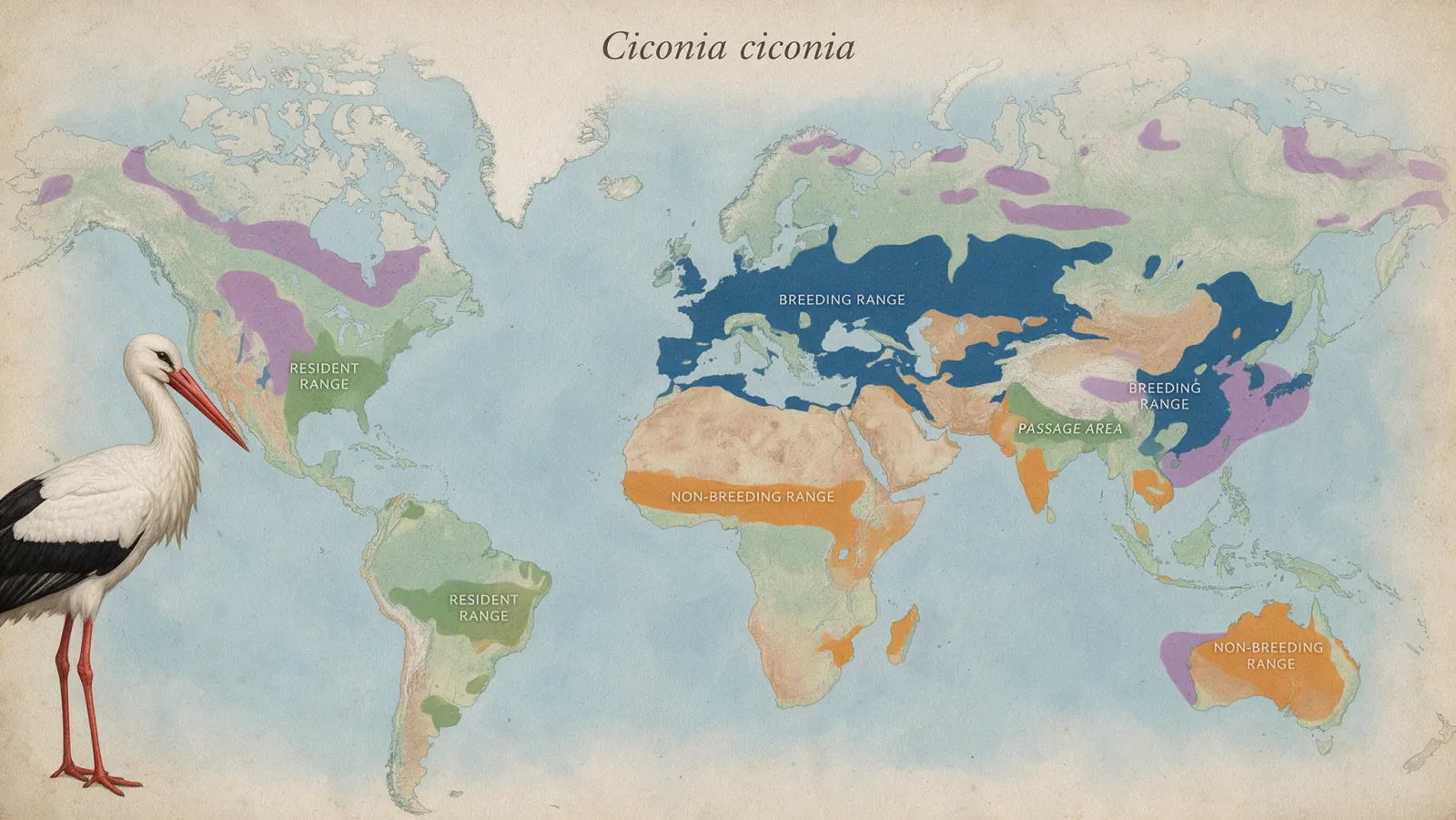
In spring and summer the white stork breeds across a broad band of Europe, from Spain and Portugal in the west through central and eastern Europe, and east into parts of western and central Asia. It nests on rooftops and poles in villages, and in trees and on cliffs in wilder places. In some towns the nests are counted each spring by volunteers. The same nest is often used for years, and the same pair returns to it. The chicks are raised through the long days of the northern summer. A pair may raise three or four chicks in a good year. Each spring the white stork comes back from Africa to the same roof, the same chimney, the same pole, and the village below waits for it.
The journey south
When summer ends the storks gather and leave. They do not fly over open sea, so they take the long way around, and the population funnels through a few narrow crossings. Western birds cross at the Strait of Gibraltar, and eastern birds cross the Bosphorus and the land bridge at the eastern end of the Mediterranean. They keep to the land because the warm rising air they soar on does not form over the sea. From the crossings they follow the land south, down the Nile valley or down the eastern side of Africa. Birds from the same region tend to use the same crossing each year. Each route has its own weather, and the birds time their travel to it. A stork standing in an African field in winter may be the same bird that clatters on a European roof in April. The journey is a long commute, and the nest is the fixed point at either end of it.
The winter in Africa
The wintering grounds lie mostly in Africa, across a wide band of savanna and wetland south of the Sahara. There the storks feed in grass and shallow water, living the same quiet hunting life they live in a European summer under a warmer sun. Some birds stop in the north of Africa, and many go far south. The birds spread out in winter, and the young ones often stay for their first full year. They grow strong before making the long trip back north. Not all survive the journey, and the first migration is the hardest of a stork's life. Birds that nest in the east of the range winter in parts of Asia as well as Africa. Some that breed in the east winter in the Indian subcontinent, and others cross into Africa with the western flocks. The bird is at home in many places because it keeps moving between them.
What a ring can tell
A white stork does not announce its age, and left alone it looks much the same at ten and at twenty-five, so the only way to know how long one has lived is to mark it and meet it again. A stork is ringed as a chick, usually before it can fly, with a light metal band closed around the leg above the foot. Most ringed storks are never seen twice, but some are. A few are seen again after a very long time, and every recovered ring adds a point to the map of a stork's life. Many storks live into their teens, and a fair number pass twenty. The oldest birds on record have lived past thirty. That is a long life for a wild bird, and it means one stork can return to the same nest for more than two decades. The oldest storks are usually known at a nest, because that is where a ringed bird is seen most often. The nest may be older than the observer, and the bird may have raised chicks in it before the observer was born. The bird has flown to Africa and back thirty times. The ring gives a date and a place, and nothing more. It cannot say how many eggs the bird laid, how many chicks fledged, or what weather it crossed. Those details come from watching, season after season. The oldest stork on record did nothing out of the ordinary except to do ordinary things for a very long time: the same migration, the same nest, the same patient hunting in wet grass.
Birds that are not storks
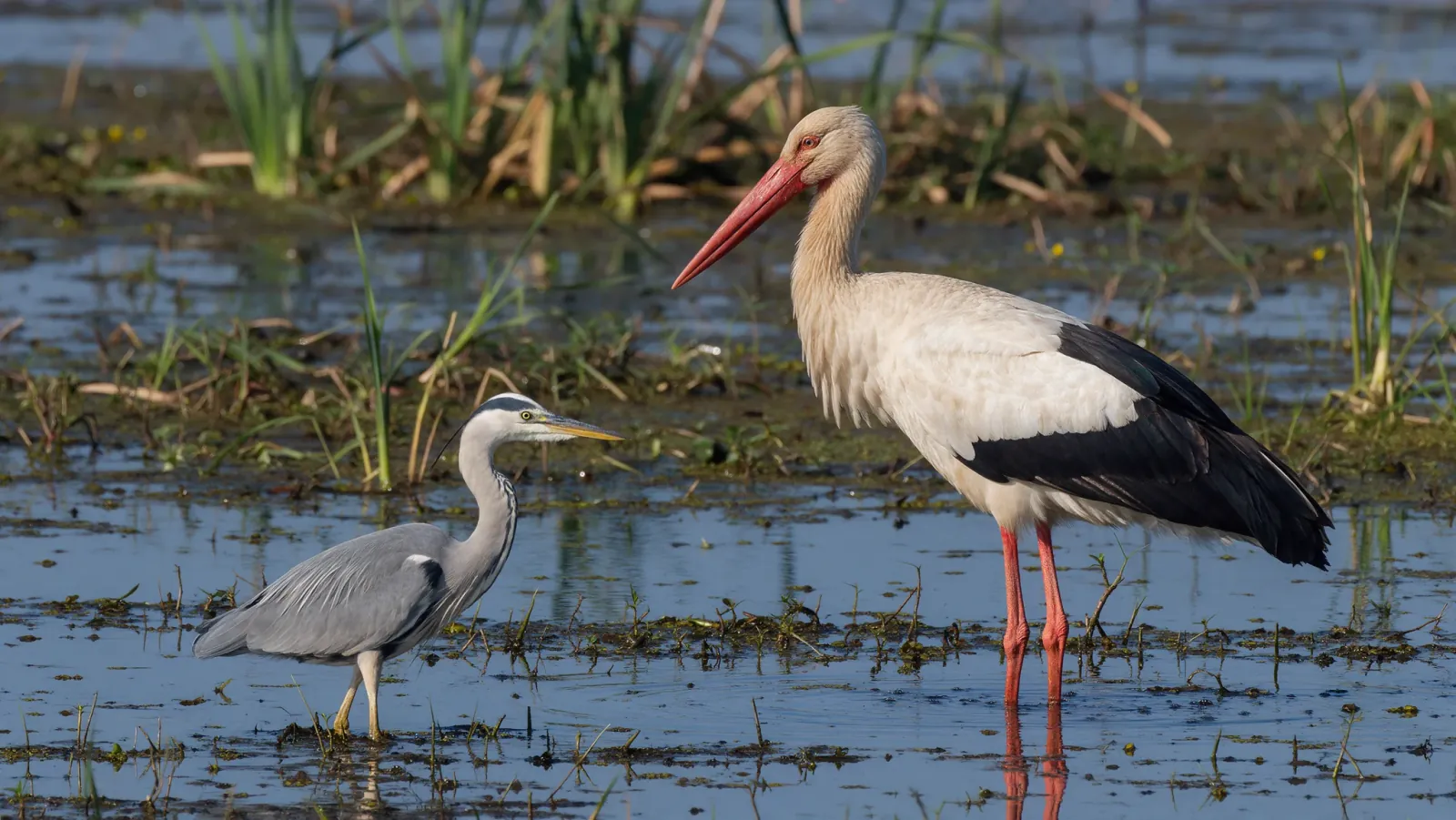
Two birds are often mistaken for storks. The crane has the long legs and the straight neck, but it belongs to a different family and it calls. The heron has the long bill and the patience, but it flies with its neck folded. Neither is a stork, and both are regularly reported as one. The true storks are told by the straight neck in flight, the clattering bill and the bare skin on the head and neck. A white stork on a Polish chimney and a marabou on a rubbish heap in Uganda are cousins, and they feed in the same slow, watchful manner.
Explore the gift