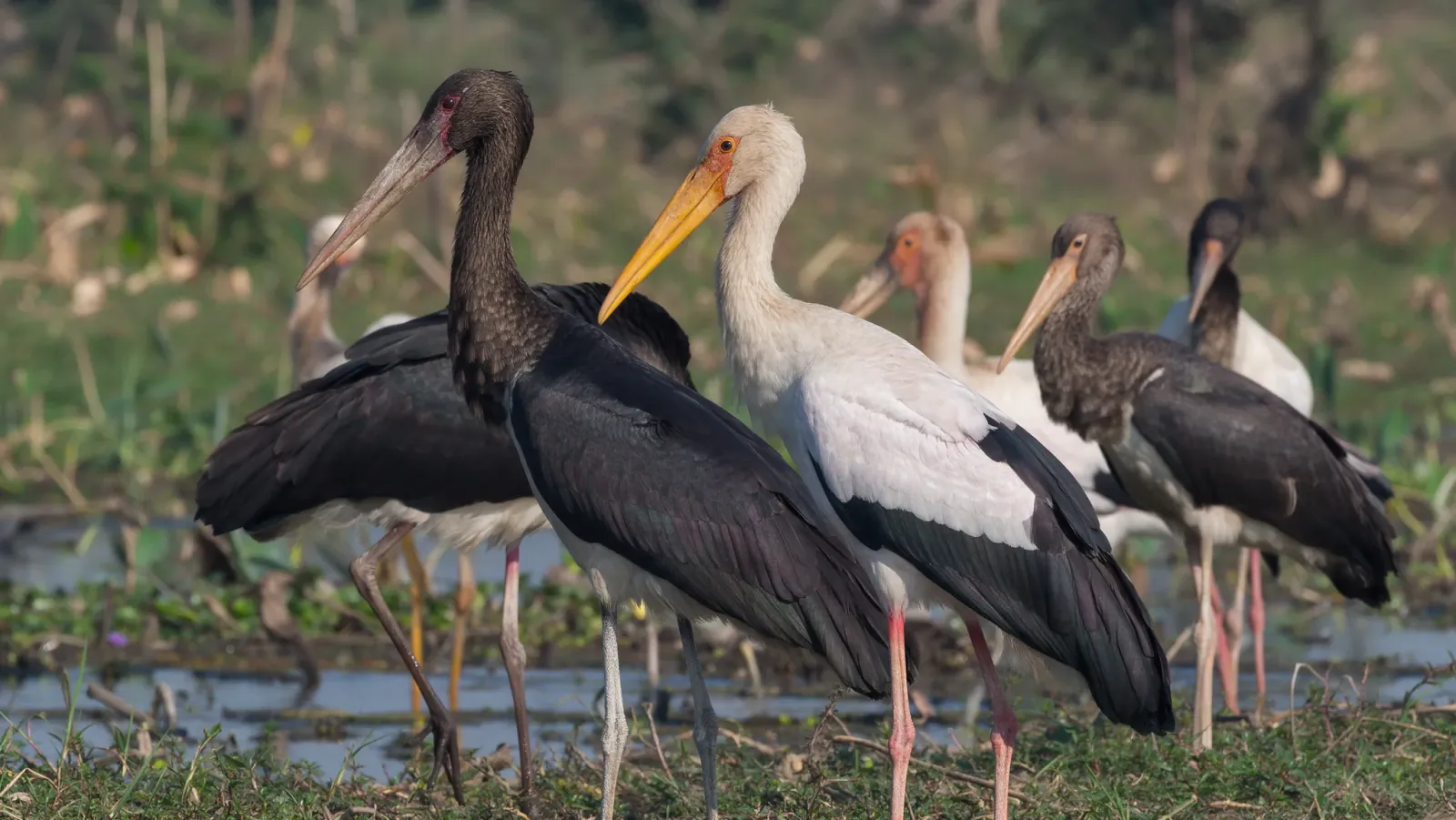
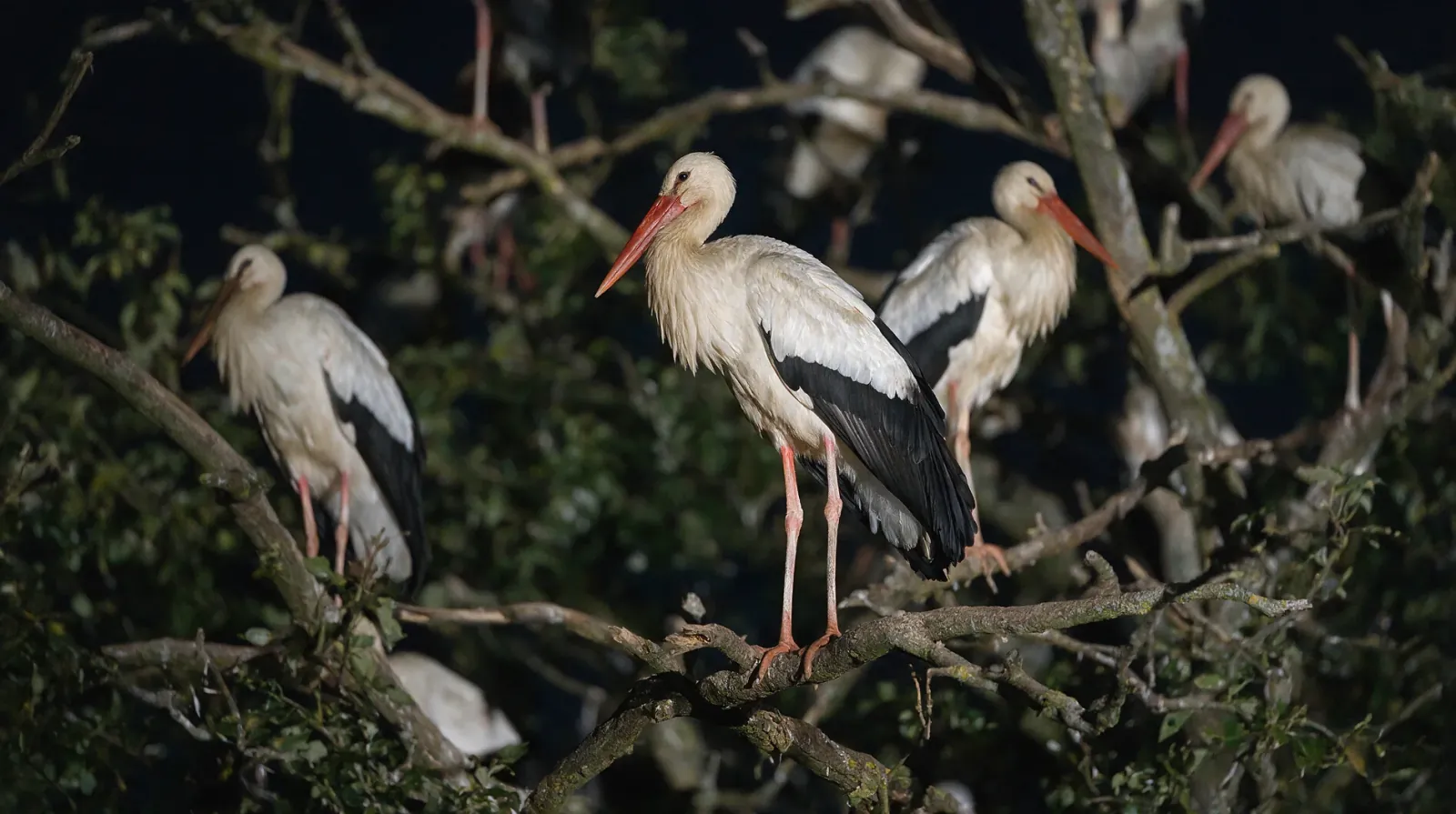
Storks, herons and ibises stand in the same shallows, and the family tree explains why they share a shape while living different lives. One flies with its neck folded, one sweeps the mud with a curved bill, and one holds its neck straight out in front.
The neck in flight
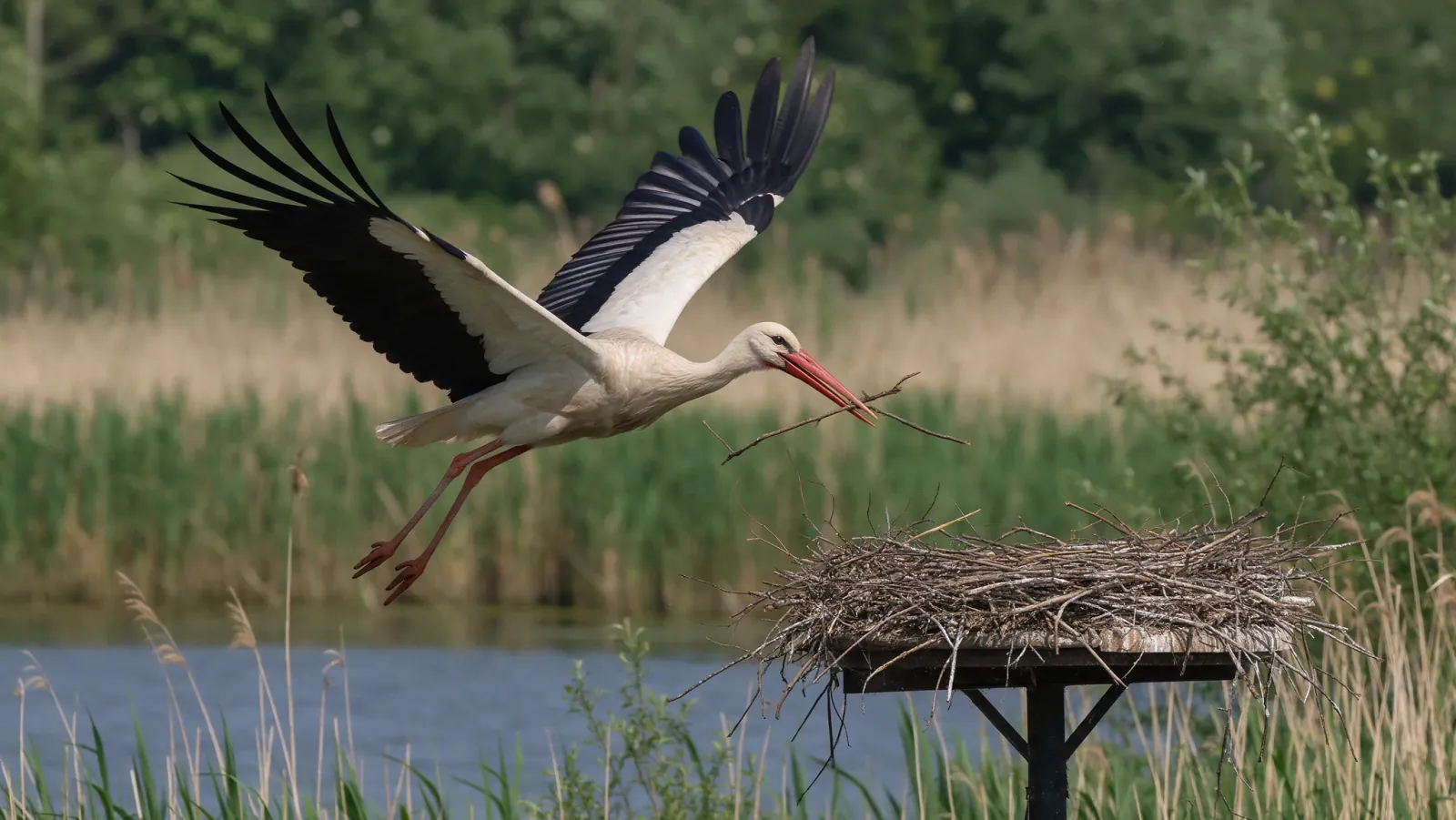
Storks and herons side by side are easy to confuse at first, and the confusion is fair: the two share a wetland, a diet and a general shape. Both are tall, long-legged and long-billed, and both spend their days stalking the shallows. In flight the difference is plain. A heron folds its neck back into an S and tucks it against its body. A stork flies with its neck held straight out. Neck out and legs trailing means stork; neck drawn back means heron. The folded neck comes from the way each bird hunts. Herons strike, and they hold the neck coiled so the head can shoot forward at a fish. In the air that coil becomes a loop drawn close to the shoulders. The rule holds almost everywhere, and once it is learned it is hard to unlearn. A heron with its neck folded looks nothing like a stork in flight.
Why the shape is the same
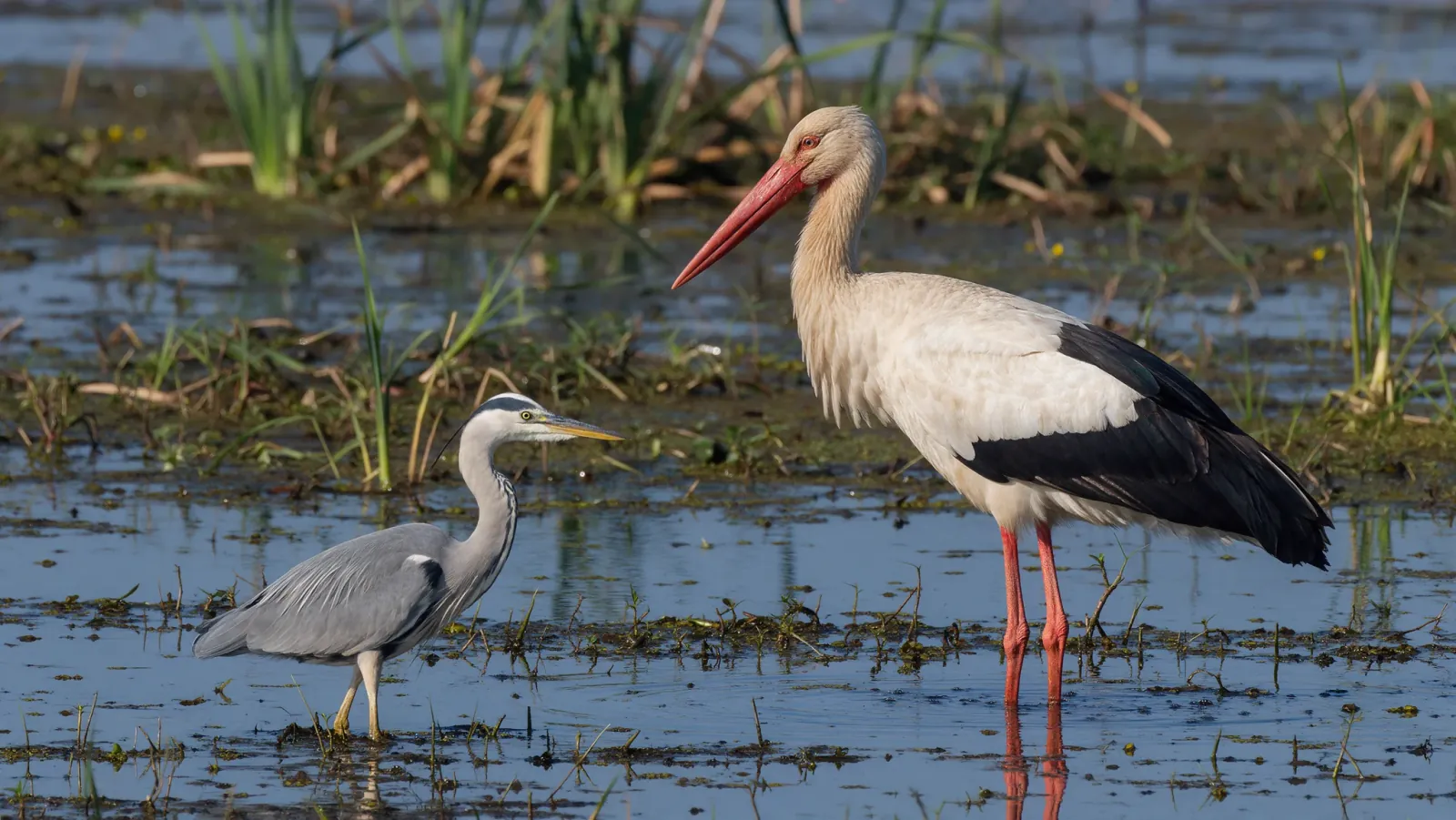
Both birds are built on one frame, and the frame answers the same ground: shallow water with food in it. A long leg keeps the body dry and the eye high, a long neck lets the head reach down without the body moving, and a long bill delivers the strike. The heron and the stork arrived at the same tools from different ancestors. That is why the shape alone cannot tell you which family a bird belongs to, while the neck in flight can. The likeness comes from shared habit, while the bones tell a different story. The grey heron and the white stork are the two most often confused. Both stand around a metre tall, both favour wet fields and riverbanks, and both are patient to the point of stillness. The little egret, smaller and all white, is often taken for a young stork until it too takes off with its neck tucked in. On a good morning both birds can be seen in the same hundred metres of ditch, each ignoring the other.
Close cousins in the shallows
Around the storks sit the birds they feed beside. Herons are close relatives, and so are ibises and spoonbills, all wading birds with long legs and long bills. An ibis hunts with a down-curved bill, a spoonbill sweeps with a flat one, and a stork probes with a straight one, and the bones beneath are alike. The resemblance sits in the skeleton, where colour cannot reach. These birds share an ancestry that reaches back a very long way. The spoonbill's flat bill is another version of the same probing tool. A bird watcher who knows one can see the family resemblance in the other at once. A flock of ibises can number in the hundreds at a good wetland.
Two bills, two jobs
The stork and the ibis sit close together on the family tree, in the broad group that also holds herons and spoonbills. Both wade, both probe wet ground, both nest near water and fly with their necks out. The difference lives mostly in the bill. A stork's bill is long and straight, and it stabs into the water, taking a frog or a fish in a quick strike. An ibis's bill is long and curved, and it probes the mud, sweeping the soft bottom until it touches something alive. The straight bill and the curved one do not compete. One strikes from above, one probes below, and both can feed in the same place. A straight bill is a spear, good for a quick strike at something that moves. A curved bill is a probe, good for feeling through mud where nothing can be seen. The two bills are two answers to the same problem: turning a shallow wetland into food. The stork takes what it can see; the ibis takes what it can feel. Their diets overlap more than their bills suggest. The stork works the open water and the wet grass; the ibis works the soft mud and the shallow edge. The two can feed side by side without taking the same mouthful.
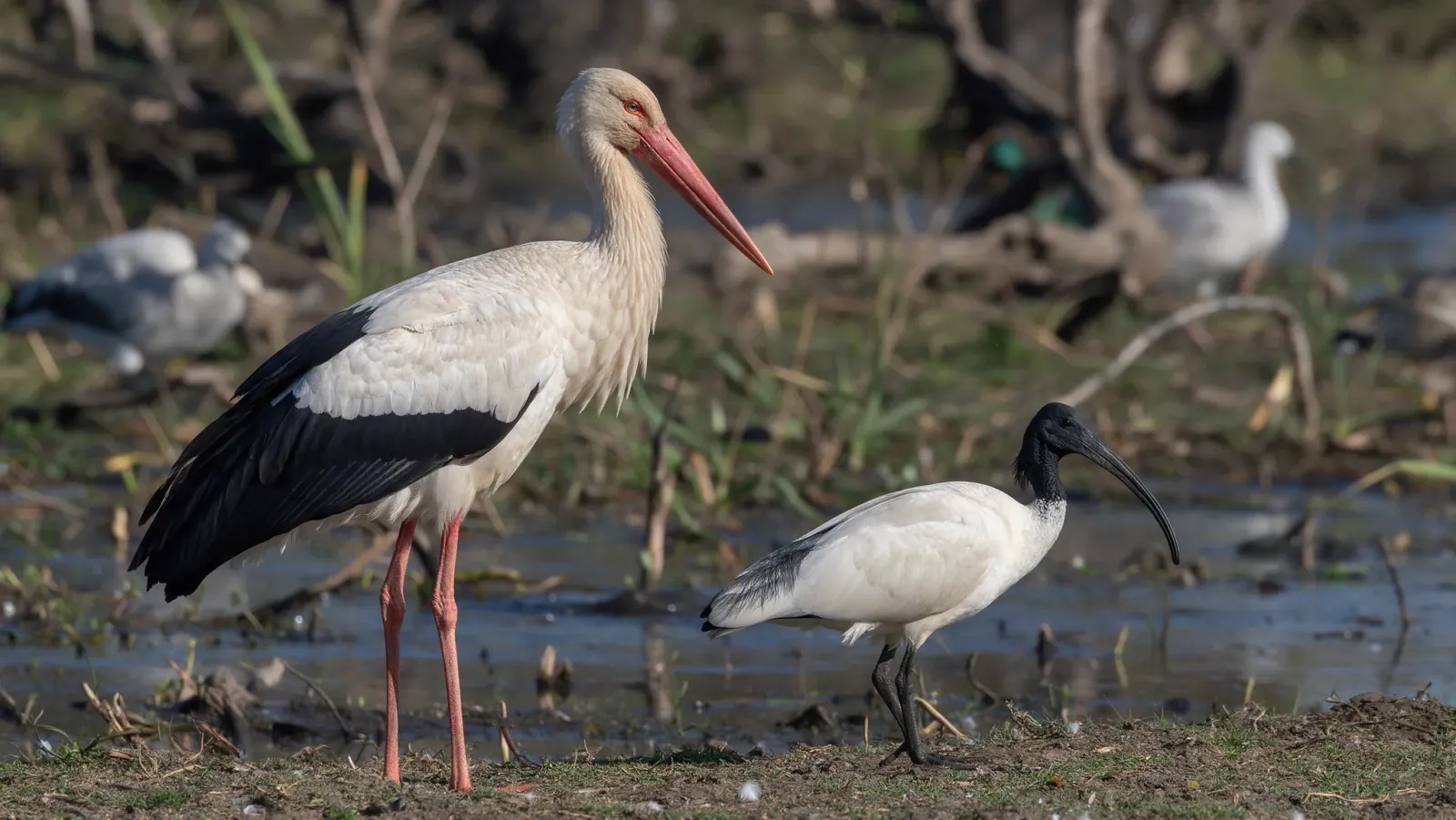
The lookalike that is not close
Cranes look a great deal like storks, and the two are often confused, but they sit on different branches. A crane belongs to a different family altogether. The likeness is a matter of long legs and a long neck, the shape of a bird that wades, and it does not mean the two are near kin. A shared shape can grow from a shared way of life. A crane and a stork can stand side by side and still be strangers. True kinship is a matter of bone and feather and the long history that shaped them. Cranes, which look much like storks, sit far away on the tree. The distance between them is easy to underestimate from a photograph.
Two different families
The likeness between stork and heron comes from habit, while the bones tell a different story. Storks and herons are separate families that solved the same problem in the same way. Both eat small creatures from shallow water, and both grew long legs and a long bill to do it. Two birds, two methods, one pool, and enough for both. A heron often stands still and strikes. A stork walks and probes, snapping as it goes. They divide the water quietly. The heron takes the fish that comes close; the stork takes what it flushes as it walks. A healthy marsh holds both because they want the same things in slightly different ways. At dusk the heron is still standing where it was at noon, and the stork has covered half the field.
What the tree explains
It explains why a stork clatters and a crane calls. It explains why the heron folds its neck in flight and the stork holds it out. It also explains why the same body plan turns up on every warm continent: the stork line is old, and it has been shaped by the same kind of ground for a very long time. The family tree is a map of habit as much as of blood. Two birds that feed the same way often end up looking alike, whatever their ancestry. A family tree is drawn from the things that do not lie: bones, feathers, the way chicks hatch and grow, and the record written into living tissue. Scientists sort birds by tracing shared features back to a common ancestor. Birds that look alike are not always close kin. The work is slow, and it has redrawn the tree more than once as new evidence has come in. A name in a field guide can be out of date within a decade. What stays steady is the bird itself, and the habits that place it in the marsh. New methods of comparing DNA have moved species between families and split old groups in two, and the stork family has felt the changes.
Explore the gift