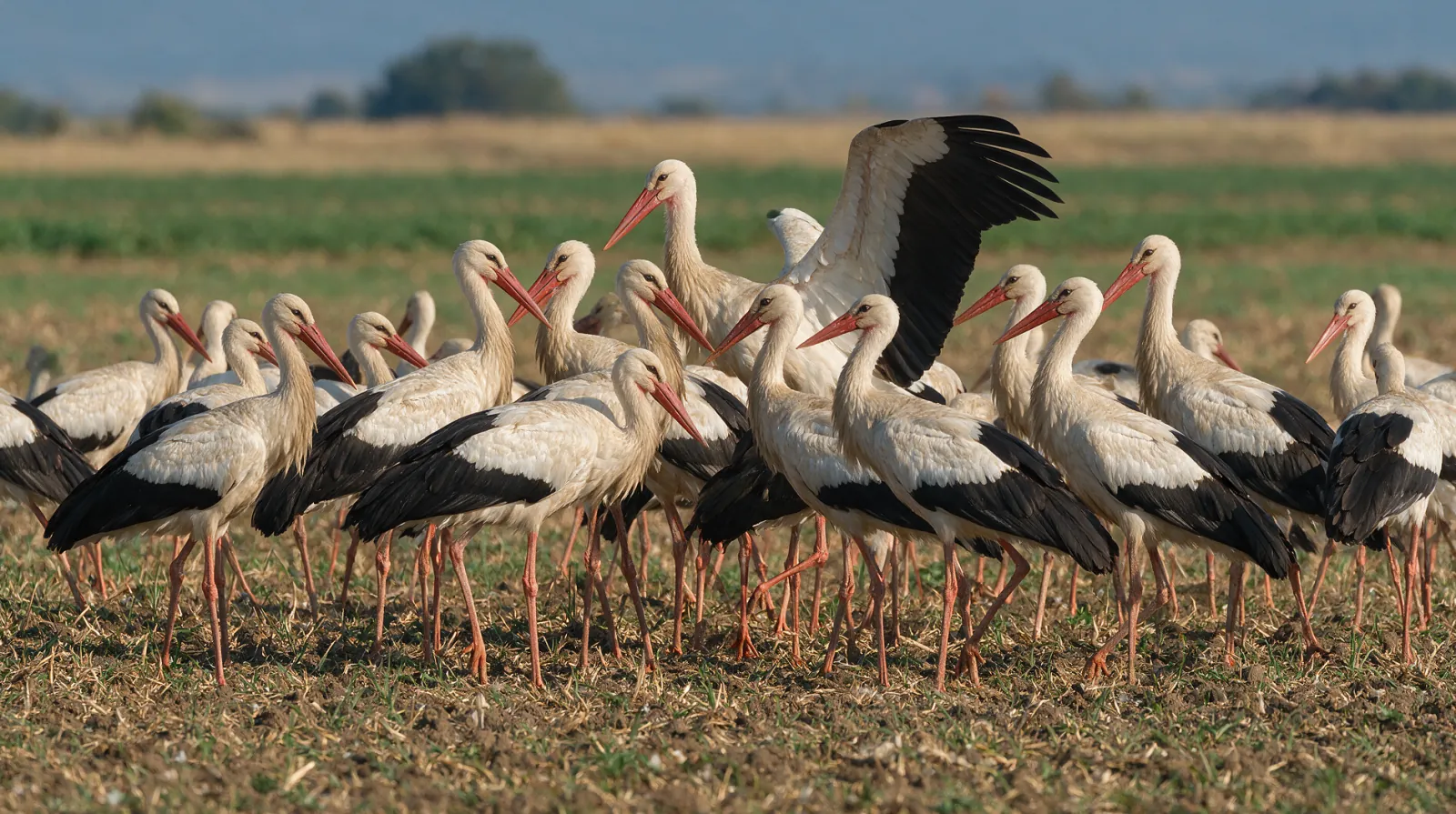
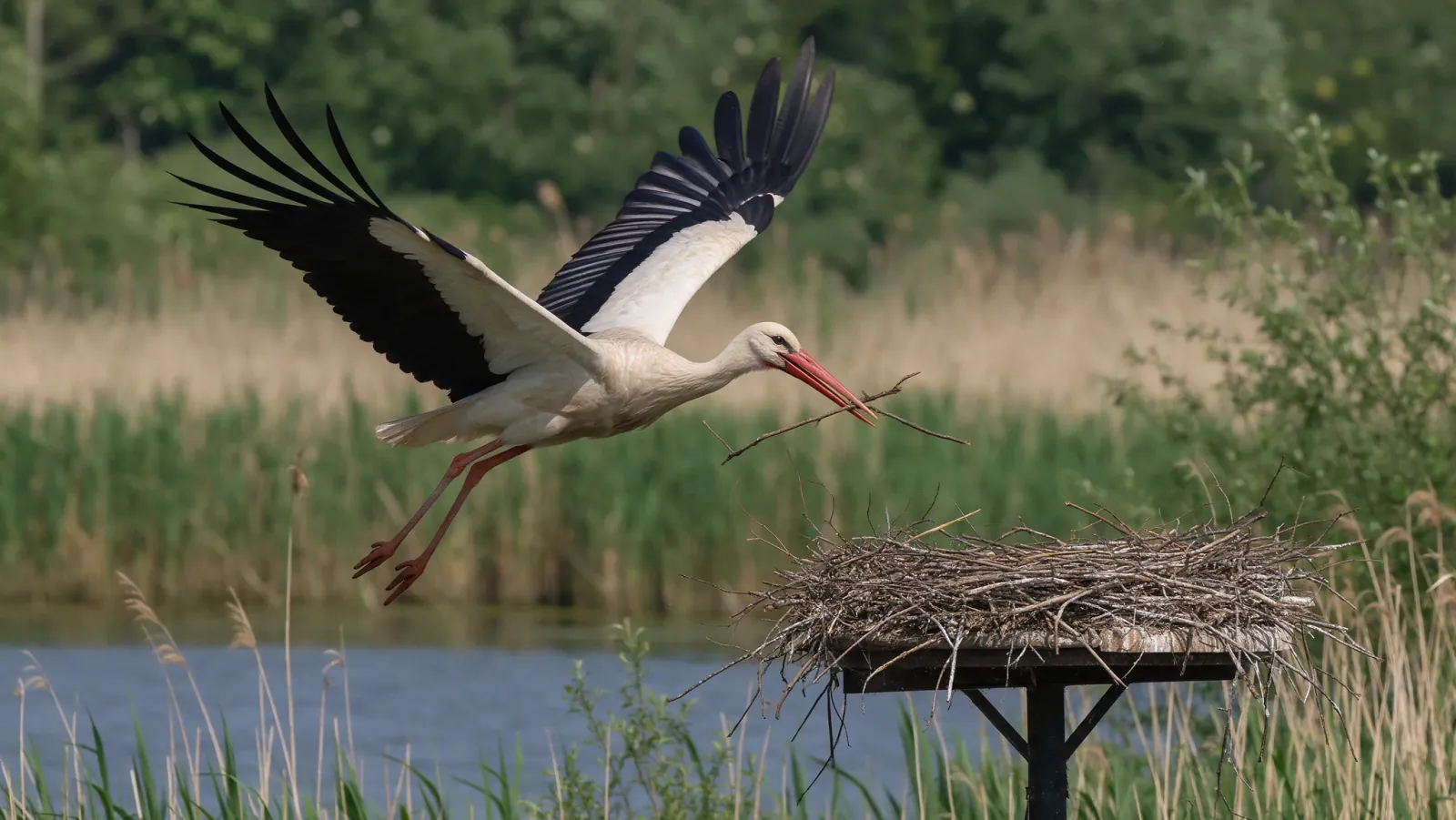
A migrating flock has no vote, no call for candidates, and no fixed leader. The birds fly, the hardest position makes itself known, and the front passes from bird to bird through the day. By dusk the same flock is on the ground, crowded into trees or reeds, and the question of who led has stopped mattering.
The cost of the front
The first bird meets air that nothing has disturbed. Behind it the air is broken and swirling, and a bird tucked into that wake can hold its position with less effort. The front is the most expensive place in the flock, and the bird that holds it pays for everyone behind.
Because the work is heavy, no stork keeps the front for long. The leader drifts back, another moves forward, and the flock goes on. A flying flock often looks like a V or a long line, though storks are less tidy about it than geese. The shape opens and closes as birds adjust, and over a thermal it dissolves completely while every bird circles on its own.
Trading places
Watch a flock for an hour and the order will change several times. A bird at the front slows, drops back along the line, and settles into the easier air behind. Another takes its place. At a thermal the whole arrangement is abandoned. The birds climb in a loose spiral, drift apart at the top, and gather again somewhere ahead.
The change is rarely dramatic. A bird simply stops working, lets the flock slide past, and settles into the easier air. There is no challenge and no signal a person would notice. Leadership here is a temporary job, given to whoever is doing the work just now.
What the young birds learn
Experience shows in small decisions. An adult that has made the journey before knows where the thermals rise, which valley leads to the crossing, and when the weather is about to turn. A young bird on its first flight south has none of that. It watches, follows, and copies the heading of the birds around it.
The front tends to go to the birds that have flown the route before, though a young stork can end up there by accident and be followed for a while. A first year bird sees which birds move forward and which drop back, how the line bends around a hill, when the flock leaves a thermal and when it stays. None of this is taught. The young bird copies what works and carries the habit into its second journey.
Why a roost fills
Every evening of the migration ends the same way: the flying stops and the flock comes down. As the sun drops, the ground cools and the thermals weaken. The birds leave the air in small groups, circling down over a patch of trees, a reedbed, a marsh or an open field.
A roost is safer for being full. Many eyes watch through the night, and a bird that would be exposed alone is protected among dozens or hundreds of others. The night is full of unknown sounds, and the flock meets them together. If something disturbs them, the alarm passes through the whole roost at once, and the birds lift in a rush of wings before settling again.
The birds look for ground with open air around it and a clear way out. Tall trees, reeds, an island, a quiet rooftop: all can serve. It helps to be near the feeding fields, so the morning starts without a long commute. The same roost may be used year after year by birds that pass this way.
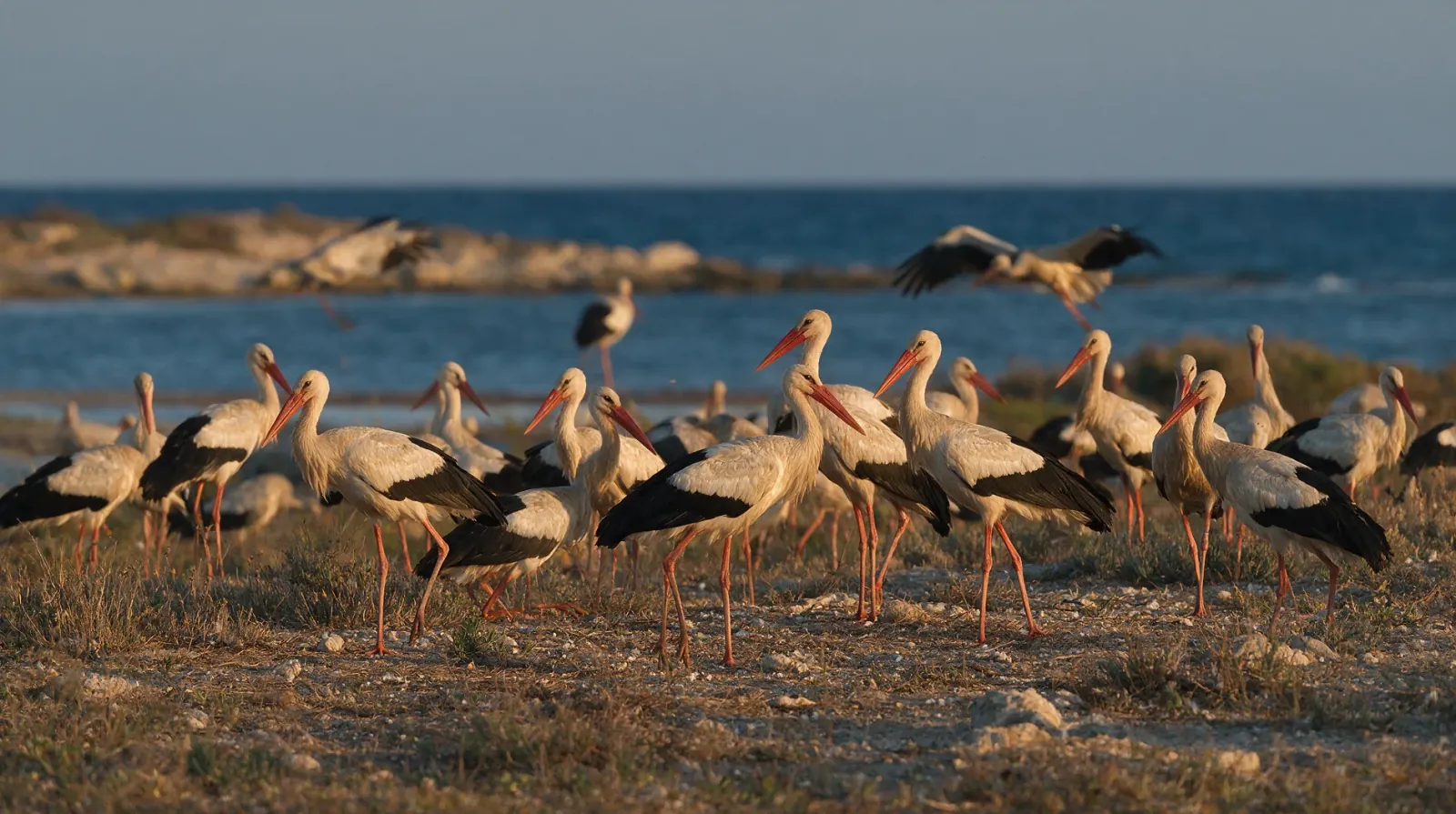
Roosts change with the land beneath them. In farmland the birds use tall trees, pylons and the roofs of empty buildings. In wetlands they stand in shallow water or among reeds. In dry country they may settle on open ground in a tight group, with no cover at all. A stand of poplars beside a quiet road can be as good as a marsh.
A roost is easy to miss if you pass it in the afternoon. It is only a stand of trees beside a field. At dusk it becomes the whole night's shelter for a flock that has hundreds of miles still to go.
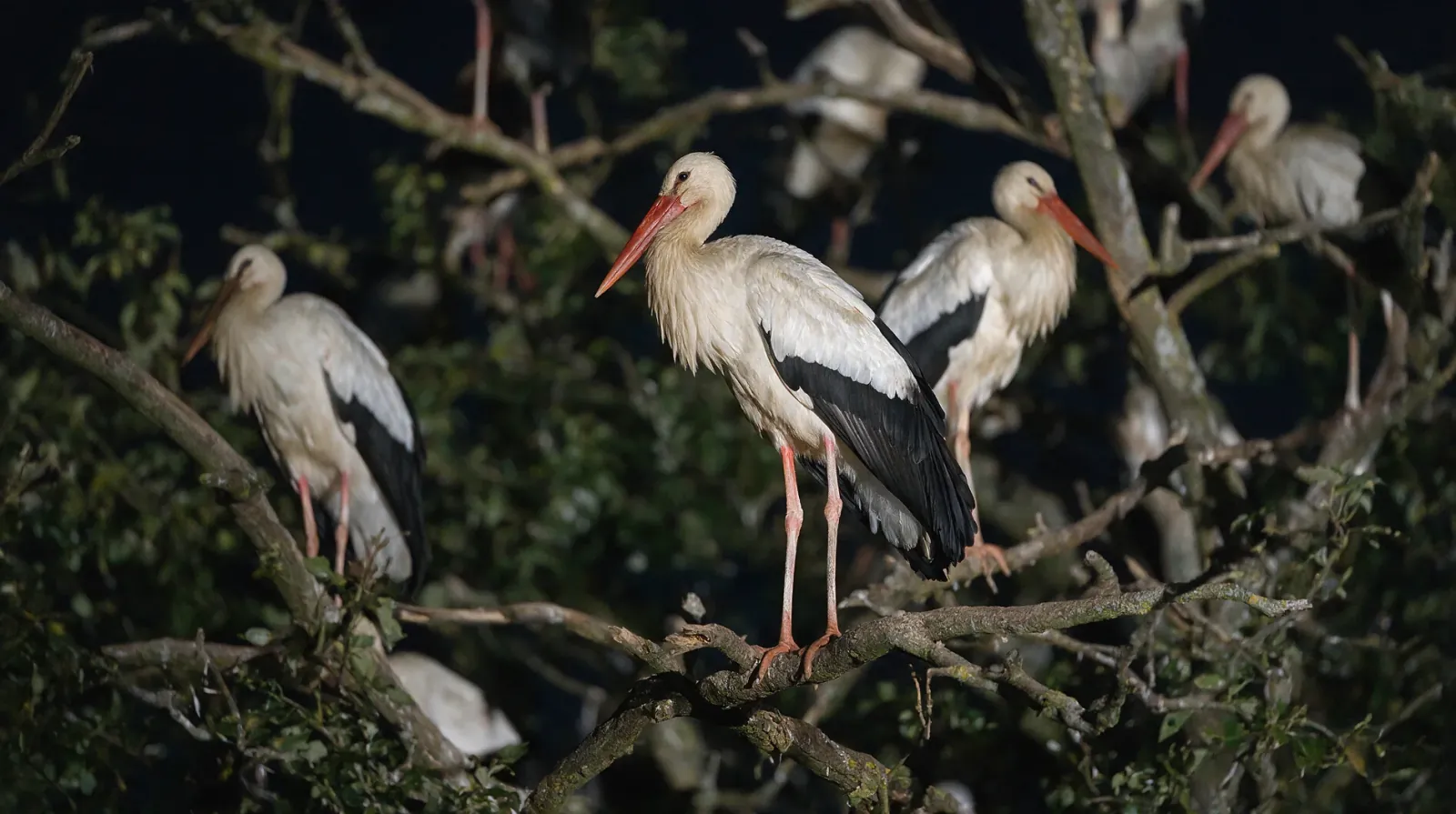
A roosting stork still has work to do. It preens, tucking its head to reach the feathers along its back. It sleeps standing on one leg, the other drawn up, and wakes at intervals. Storks are quiet birds, with no song, but a roost is not silent. Bills clatter, wings shift, a low croak moves through the trees. Then the sound dies down and the flock waits for morning.
They do not leave at first light. They wait for the sun to reach the ground and for the first thermals to form. Then the roost empties in waves, the earliest birds circling up and away while the others stand and preen below. Within an hour the trees are bare.
The first night south of the sea
After the crossing of the Mediterranean or the Strait of Gibraltar, the birds are over Africa. The hours of darkness are spent tired, close together, and often in country none of them has seen before.
A stork that has flown over water for hours arrives low and heavy, looking for ground. The first fields beyond the coast are a welcome sight, and the birds come down quickly, often before they have travelled far inland. The hours after landfall are about water and rest. The birds drink, if there is water, and stand in the shallows to cool their legs. They do not feed much at first. The effort of the flight is still in them, and the body needs to settle before appetite returns.
As the light goes, the flock looks for a place to sleep. The country is new, and the birds have to judge it quickly: trees, reeds, a quiet field, a rooftop. They settle close together, as they did on every other night of the journey. The first African roost is chosen by birds in a strange land, and they choose it the same way they chose all the others. Safety, height, a clear way out.
The country makes them individuals
The next morning is the first real meal on the far side. The birds spread out and begin to hunt in a country with different frogs, different insects, different wet ground. Storks are not fussy, and that helps. A bird that eats whatever moves in shallow water will manage.
By the second day the flock has begun to break up. Some birds move on toward the wintering grounds. Others stay near the coast for a while, feeding and resting. The crossing made them a crowd. The country makes them individuals again, and the ties loosen as each bird finds its own quiet corner.
The first night south of the sea is a quiet one. A tired bird, a strange tree, a sky it has never seen from this side. In the morning it will be hungry, and the country will provide.
Explore the gift