The stork moved from the roof into the materials of ordinary devotion. Carvers cut it into pew ends and pulpits, scribes painted it in the margins of psalms, and grandmothers stitched it into the blankets of new babies. Each material asked for a different kind of attention, and each kept the same bird in view.
A bird the carvers knew
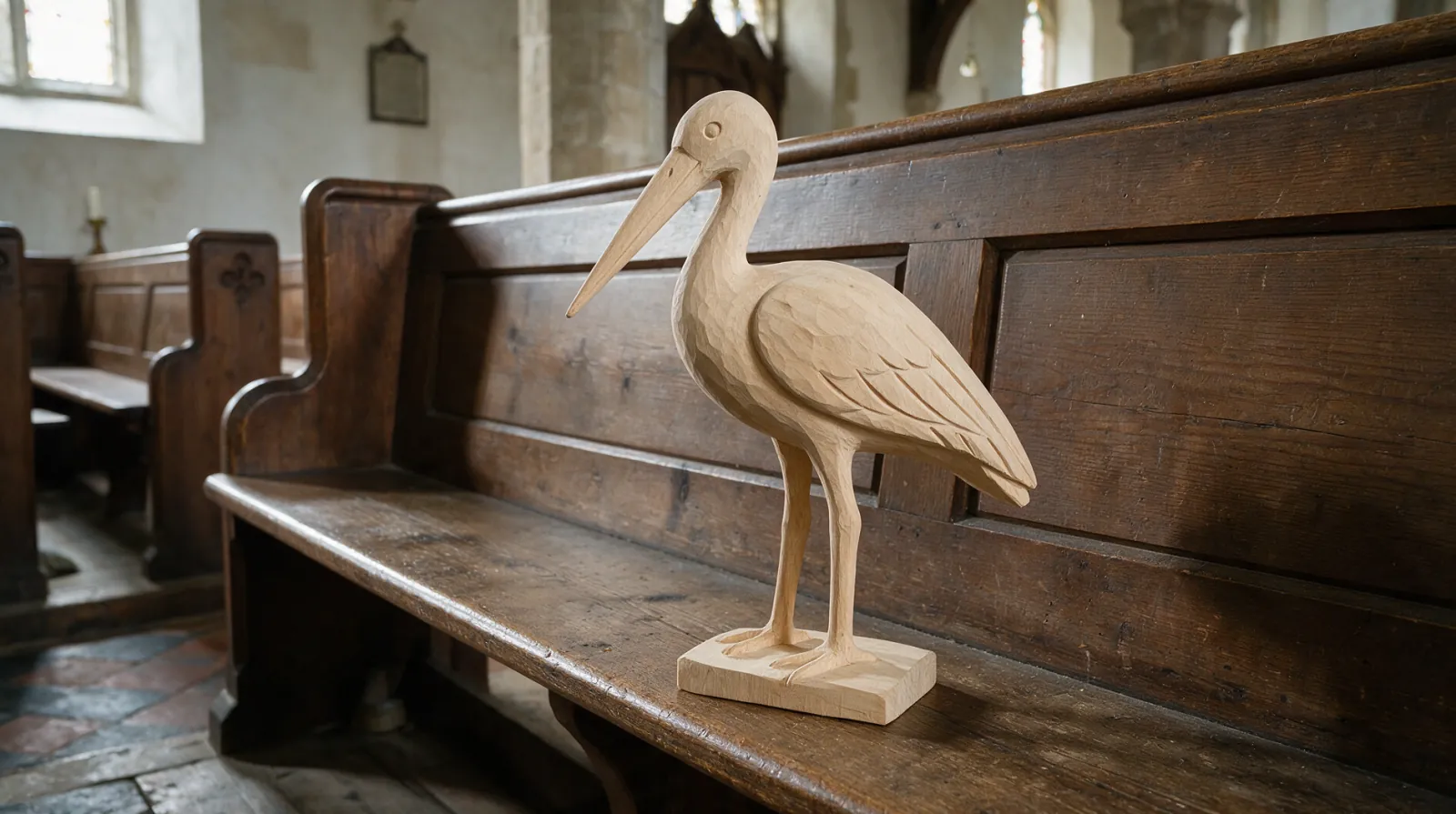
The bird nested on the churches and towers where the carvers worked, and its white body against a grey sky was a common sight through spring and summer. A craftsman could carve the stork from memory, its long legs, its folded wings, its straight bill, and the result was always recognisable. The carvings are accurate because the hands that made them had watched the bird their whole lives. No pattern book was needed for a creature that lived above the workshop door.
The bird found its way into the ordinary furniture of worship, the pew ends and armrests and the panels of the pulpit. There the stork sat among leaves and small animals, part of a larger pattern and always distinct. No one signed the carvings, and the men who made them are mostly forgotten. The storks remain, worn smooth by generations of hands resting where the wood was carved. A palm has polished what a chisel once cut.
No two of the carved storks are quite the same. One carver gave the bird a bent neck, another spread its wings, another set it low in the panel with its bill turned toward the pew. These were small decisions, made quickly at a bench, and they add up to a catalogue of how many ways a village and its craftsmen could see the same familiar bird and still find something new. The carvers treated it as a living thing, with a fondness that has outlasted their names.
What the wood meant
The stork carried a double meaning. In the folk mind it was a bird of luck and fertility, and in the church it was read as a sign of vigilance and care, a creature that returned faithfully, tended its young, and stood watch over its nest.
The carvers folded these meanings together. A stork in a choir stall was a reminder to be watchful and faithful, and a stork near the door was a blessing on all who entered. The same bird could teach a lesson and wish a household well. The exact meaning of each carving has faded, as old meanings do. Some storks were carved for the luck they promised, some for the care they showed, and the difference between the two is now hard to recover.
What remains is the wood itself, and the fact that so many villages thought the stork worth cutting into the furniture of their faith. The bird had moved from the roof to the pew, and from the field into the imagination of the place. A parish could forget the sermon and keep the bird.
The painted margin
Medieval scribes painted the white bird beside prayers and songs because it carried a meaning the monks trusted. In the margins of old manuscripts, among curling leaves and small creatures, the stork stood for kindness and care, and every reader of the page knew what it meant.
The stork came into the manuscripts with a reputation already made. Medieval bestiaries, the books that described animals and drew a lesson from each, told that the stork feeds and cares for its ageing parents. The story may or may not have been true of the real bird, and it spread through Europe and gave the stork a name for faithfulness. A creature that cared for the old was a perfect companion for a psalm about duty, mercy, or family. When a scribe wanted to mark such a verse, a stork could do it without a word.
On the page the stork is usually white, with black wing tips and a long red bill and legs, painted small enough to sit beside a line of text and clear enough to read at a glance. It stands on one leg or stretches its neck, tucked into a corner or along the margin beside the text. White meant purity, red meant life, and together they matched the mood of a page meant to be read slowly and kept for years. The paint itself was costly, and a stork in bright white and red showed that a patron had paid well for the book.
Marginalia were never random. A bird placed beside a particular psalm belonged to that psalm. Scribes put the stork beside verses about a mother or father, about the home, or about the shelter given to the faithful. The page said with a picture what the psalm said in words. The picture and the words worked together, so a reader glancing at the page saw the lesson before reading it.
The stitched blanket
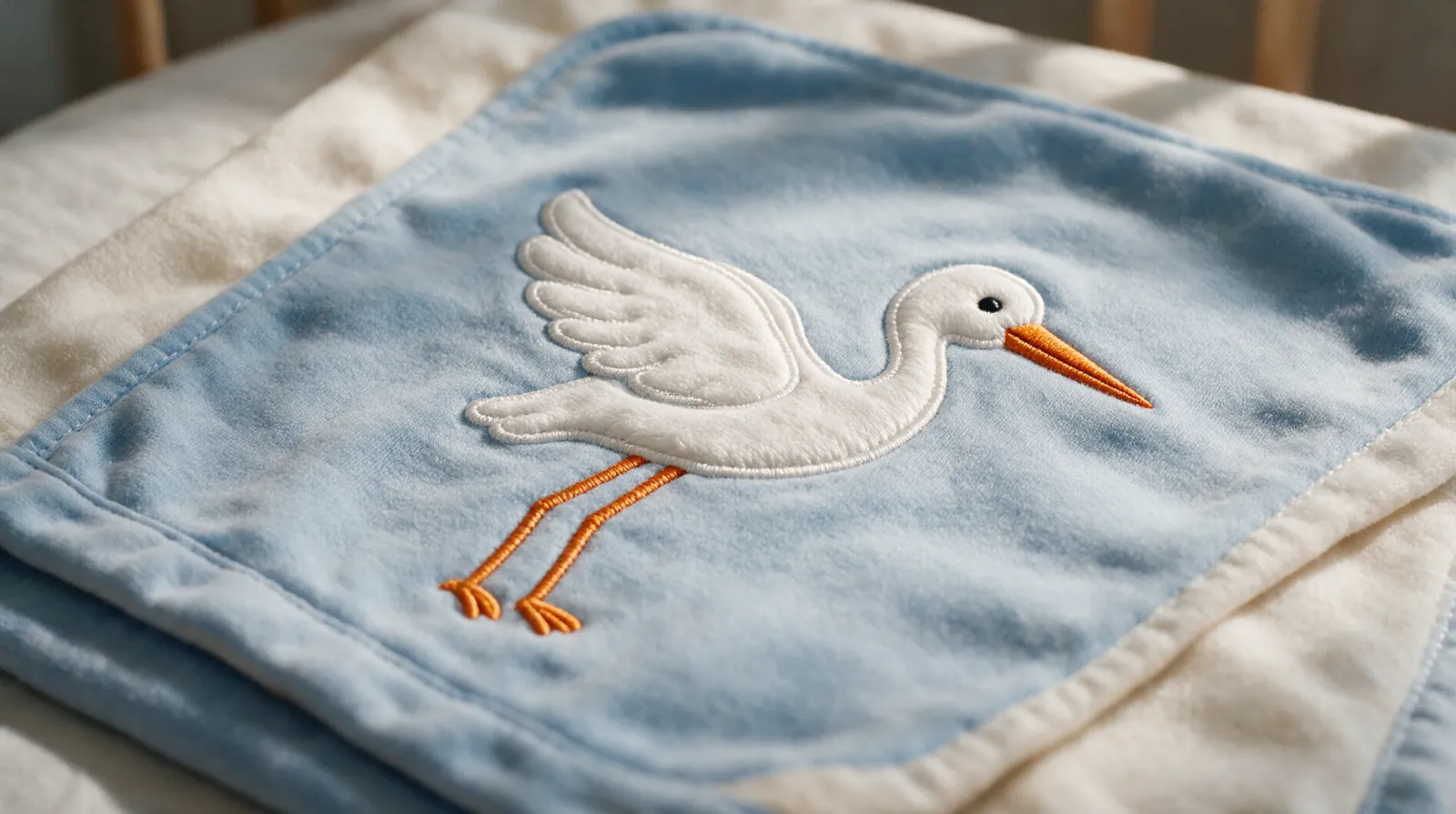
For generations, families in the villages of central and eastern Europe worked the stork into the blankets, sheets, and clothes made for a new baby, and the stitching was a blessing set down in thread. A mother or grandmother worked the stork into the cloth slowly, and with every pass of the needle she was saying something she could not put into other words: come safely, stay well, live long.
The stork was chosen because it already meant arrival and good fortune. A baby who slept under a stork slept under the same symbol that had welcomed the child in the first place. The blanket and the myth were doing the same work, wrapping the child in the idea that they were wanted.
The embroidered stork was usually simple. A long body, a long beak, wide wings, the white done in white thread against pale cloth and the wing tips picked out in black or red. No one needed it to look like a photograph. It needed to be recognisable, so that anyone who pulled the blanket up at night would know at once what they were looking at and what it meant. The bird had to be readable in the dark. A few strong lines were enough.
Often the stork was worked with other symbols, a flower, a star, a small heart, and the stork was the main thing. It carried the weight of the whole design, because it carried the baby in the story, and now, in the cloth, it carried the baby's sleep.
The myth made touchable
A blanket is a strange and perfect place to keep a myth. It is handled every day, washed, folded, passed from one child to the next. Unlike a story told aloud, it does not fade from memory. It stays on the cot, and the child grows up seeing the stork before they ever learn its name.
When the blanket was handed down, the story came with it. A second child slept under the same stork, then a third, and the stitch grew smooth with use. The bird in the cloth became a family record, a quiet heirloom that held a whole household's worth of welcomes.
The living stork and the stitched one still sit together in the modern nursery, one on the roof and one on the blanket, and neither has lost its meaning. The blanket may now be printed rather than embroidered, bought rather than sewn, and the wish underneath is the same. A keepsake carries that wish forward. The stork gift shares the same idea: a white bird sent to a house where a child has arrived.
The stork in the embroidered blanket is the myth made touchable. It is the story that could be held, tucked in, and smoothed flat. It asked, in every thread, for the one thing every parent has always wanted. That the child be carried safely, and that they always come home. The cloth is washed, folded, and put back on the cot.
Explore the gift