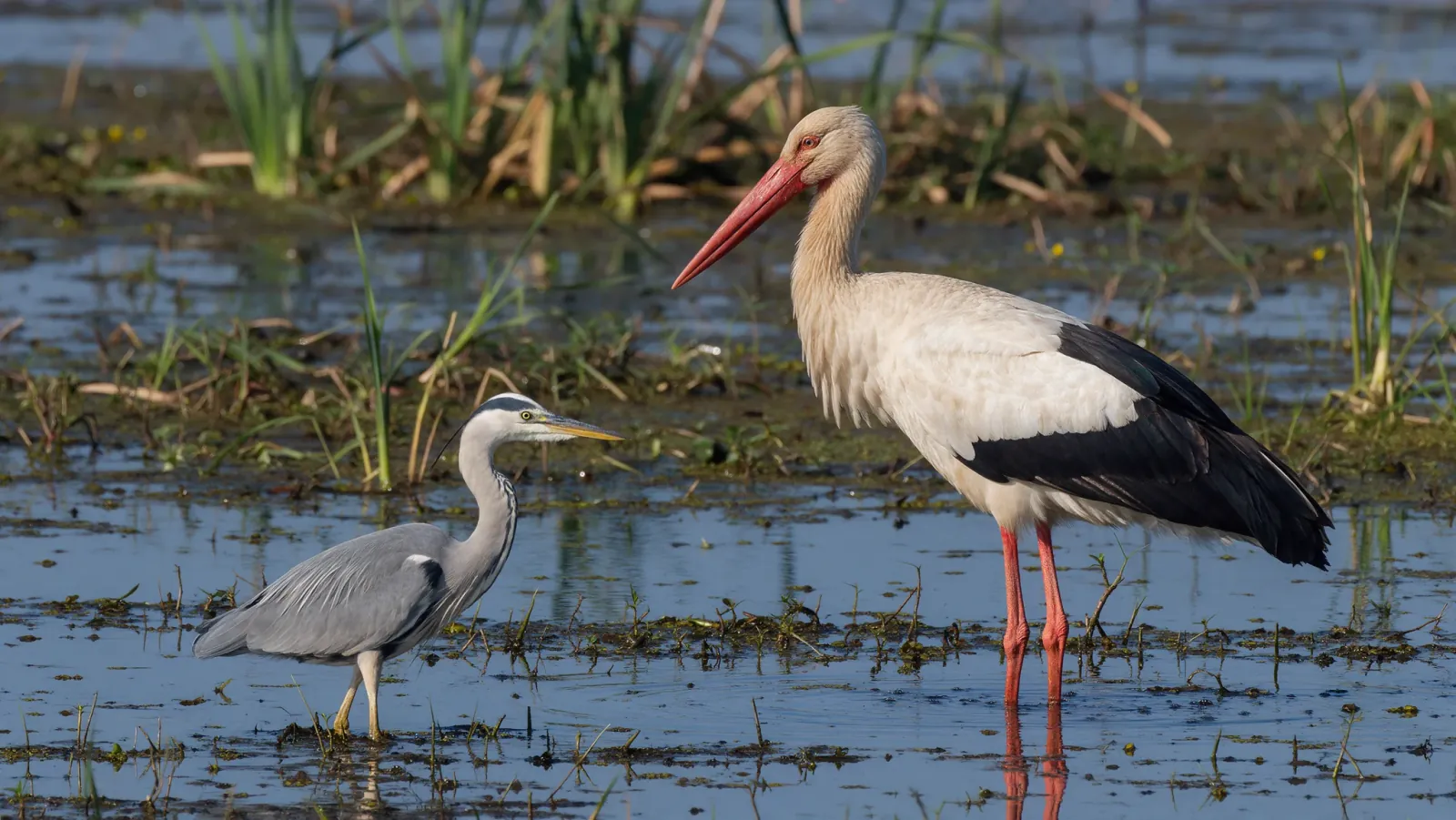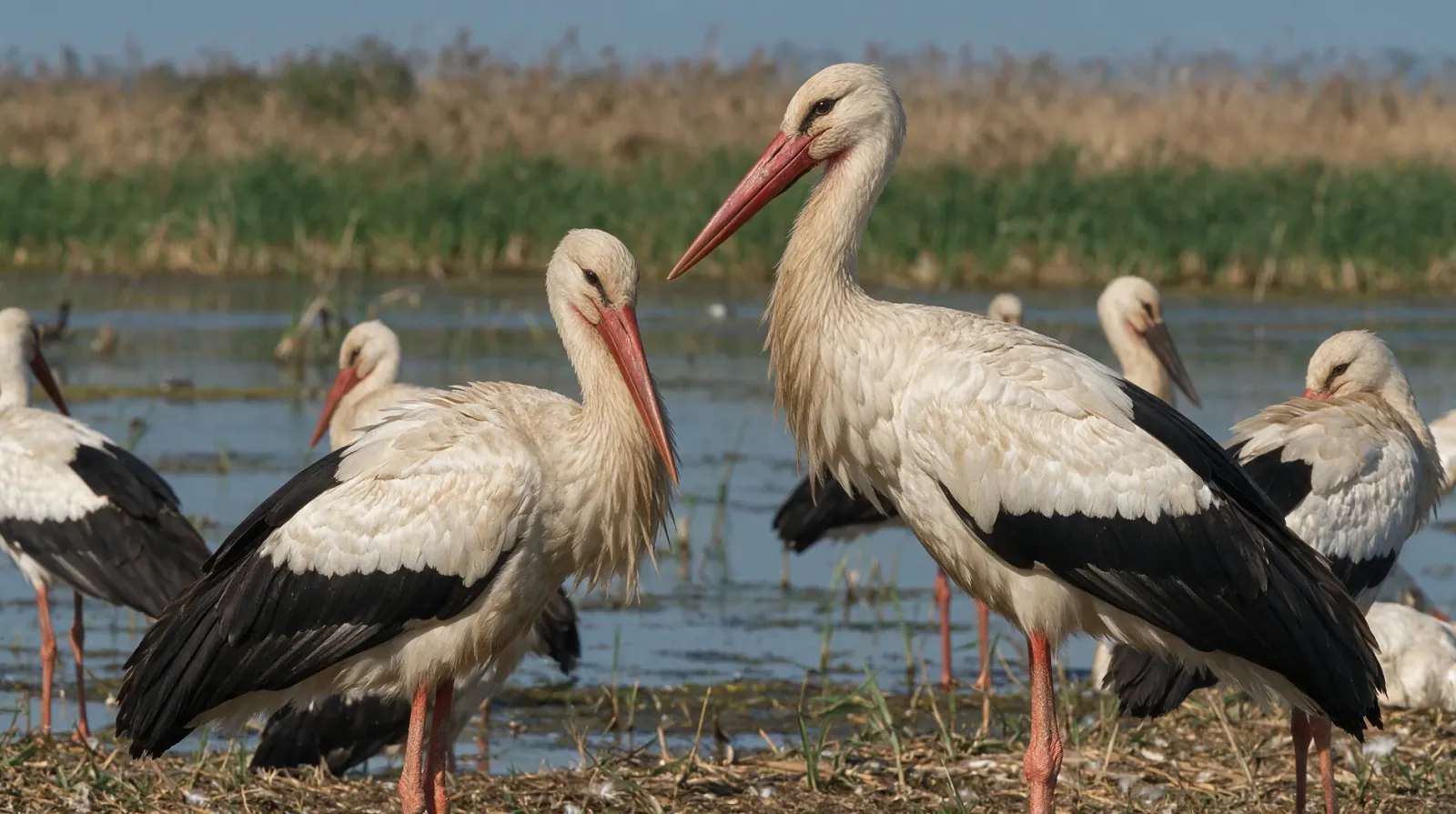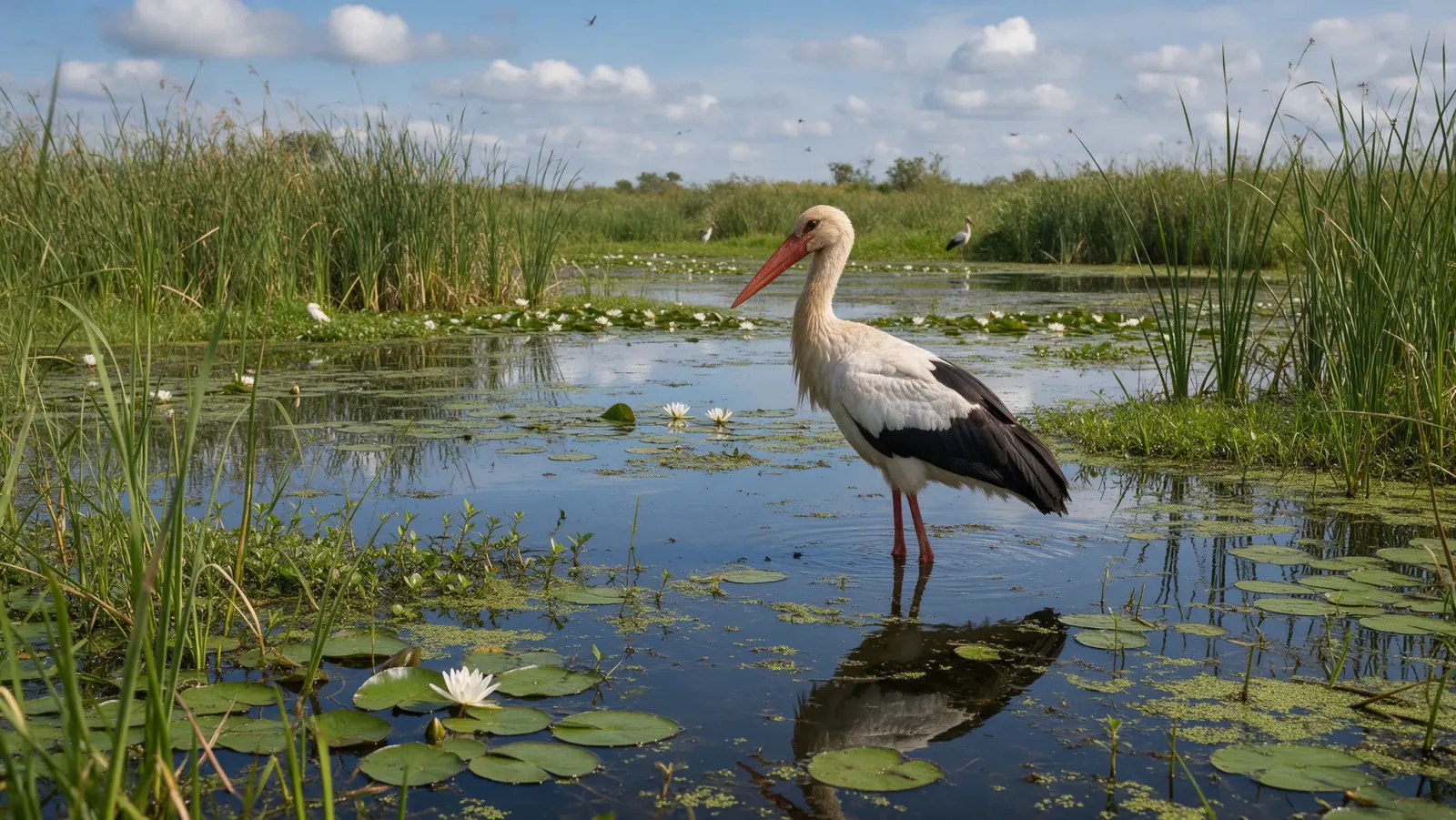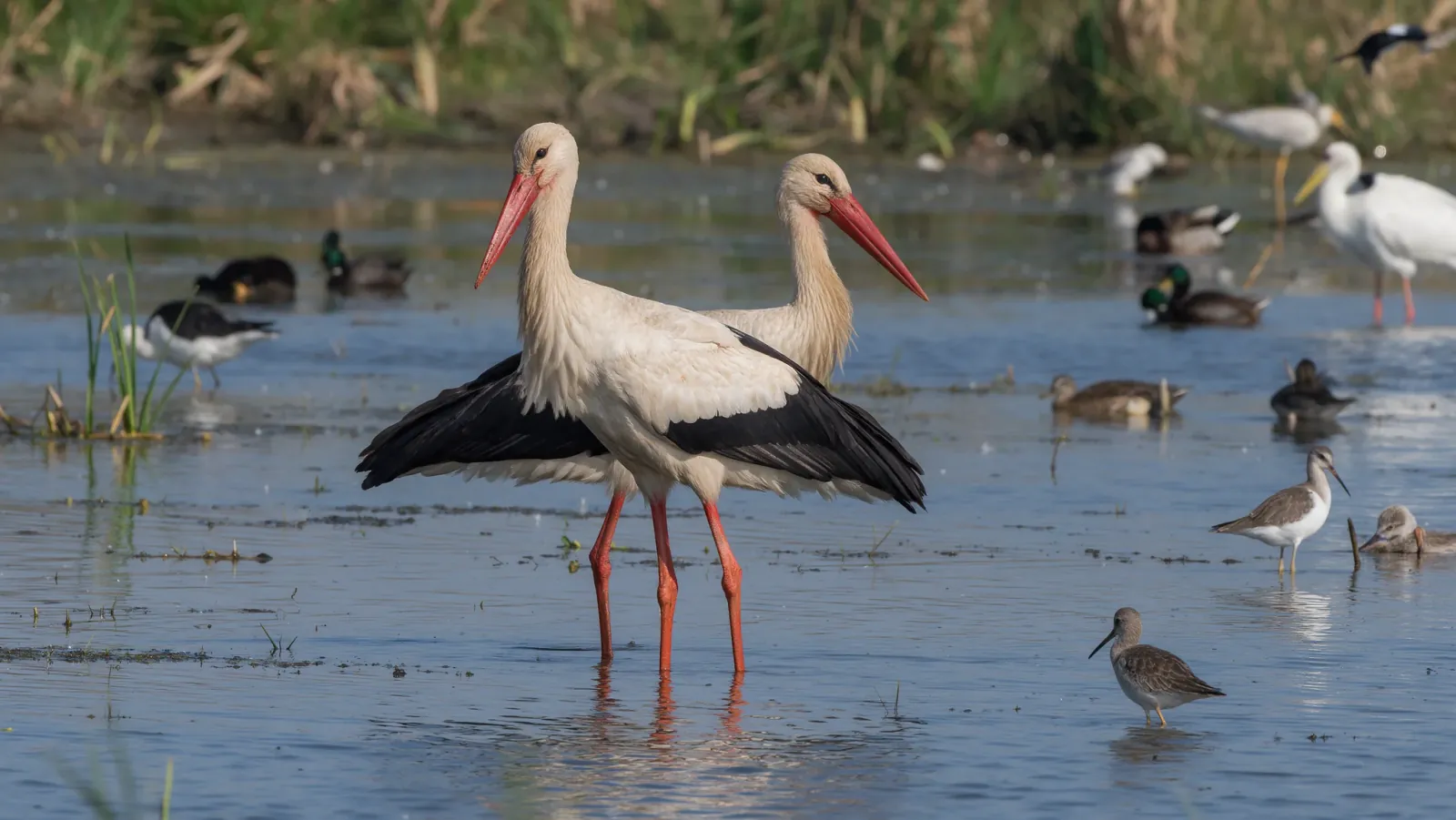
A white stork standing in shallow water is one life in a crowd. Its wetland neighbours are frogs under the grass, fish in the ditches, insects rising in the warmth, and herons at the far edge standing as if they grew there. Each takes a different portion of the flood. Watch one stretch of marsh for an hour in May and the arrangement starts to show.
The water sets the day
Water level decides almost everything in a marsh. When spring rain keeps the meadow ankle deep, the shallow margins spread wide and the hunting is good. When a dry spell pulls the water back into the ditches, the same ground turns to cracked mud and the birds move on. A stork reads this quickly. It walks the receding edge, where prey gathers in pools the size of a coat, and ignores the dry middle.
Farmers and reserve managers who hold water back through spring give the whole community a longer season. A ditch drained in one field can empty the birds from a neighbour's field by June. The water is the calendar, and every bird in the marsh reads it.
Three ways to fish a marsh
Several herons can share one marsh because they do not fish the same way. A grey heron is tall and grey, with a long neck folded into an S. It hunts by standing still at the water's edge, sometimes for many minutes, then striking with a fast, straight thrust. It takes fish, frogs, voles and even small birds. The heron's patience lets it use water too deep for a stork to wade.
A purple heron is slimmer and darker, with a long, thin neck and a striped head. It prefers the cover of reeds and is far harder to see. It stalks rather than waits, moving slowly through shallow water and vegetation, and it nests in reed beds rather than in tall trees. A bittern is brown and streaked, and it lives almost entirely inside the reeds. Its trick is to stand with its bill pointing at the sky, so that its streaks line up with the vertical stems and it seems to vanish. In spring the male booms, a sound like breath across a bottle.
The little egret is white, smaller than the grey heron, with black legs and yellow feet. It hunts in shallow water by shuffling its feet to stir up prey, then stabbing at whatever moves. That technique works in water too shallow for a heron to stand in and too open for a bittern. The egret uses the very edge the stork walks, and the two can feed within metres of each other without competing, because one stirs and one watches.
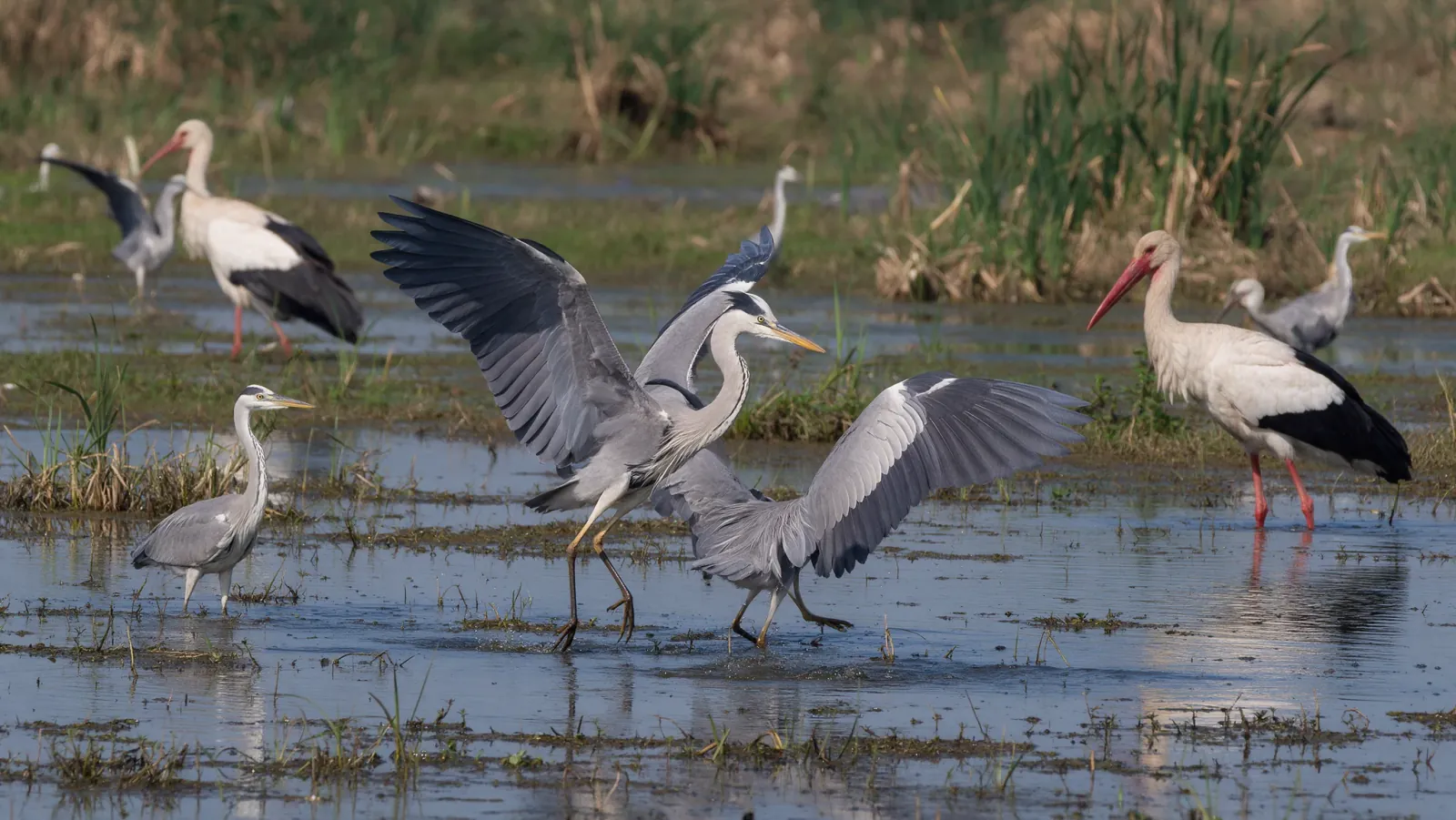
Water level changes the balance between these birds through the year. In a wet spring the shallow margins spread and all of them feed well. In a dry summer the water pulls back into ditches, and the birds that need open shallows move on while the grey heron stays at the deeper water. Each species is a reading of the same water at a different depth.
Frogs, fish and the small trade
The frogs are the loudest neighbours and the most reliable meal. They breed in still water, and their tadpoles graze the algae that grows on stems and stones. Fish do similar work in the deeper ditches, and both end up in a stork's bill. This is the plain economy of the place: sunlight feeds algae, algae feed tadpoles and small fish, and the stork collects the profit in a single strike.
When frogs are scarce the bird turns to insects or voles. When the fish are gone the herons suffer first because they cannot walk the grass. Dragonflies, beetles, caddisflies and the midges that hatch in clouds are the marsh's quiet workforce. They pollinate the flowers at the edge, they feed the frogs, and they become food for the stork in the weeks when chicks need constant delivery. A meadow cut in late summer and left rough over winter holds far more of them than a lawn.
The first ten minutes
A marsh hides its birds from anyone in a hurry. The reeds are tall, the water reflects the sky, and the birds are brown and grey and built to disappear. The watcher who walks fast sees a few herons fly off and nothing else. When a person arrives, the birds react. A heron lifts off, ducks move to the far side, a bittern freezes. The first ten minutes are the marsh resetting itself after the disturbance.
Sit still and the process reverses. A moorhen comes out, a lapwing returns to its patch, and a snipe starts probing the mud. Most of the best viewing happens after the watcher has stopped being an event. A hedge, a bank, a hide or a parked car all work, because each breaks the human outline. The edge of a marsh is better than the middle, and the downwind side is better than the upwind one.
Dawn, dusk and the way a bird feeds
The marsh has two busy periods. At dawn the birds that roosted nearby move out to feed, and the sound is at its height. At dusk they return, and the light is low and the silhouettes are clear. Midday is quiet, especially in summer, when the heat pushes activity into the shade. The best hours are the ones that require an early start or a late walk home.
A distant wader is often a silhouette, and identifying it can be less useful than watching what it does. A bird probing deep in the mud is after worms. One sweeping its bill side to side is filtering water. One running and stopping is hunting insects on the surface. The way a bird feeds tells you what kind of water it needs, and that is more interesting than a name.
Watching without disturbing
A watcher who flushes a bird has cost it energy it cannot easily spare, especially in winter or on a nest. A bird pushed off its feeding patch once may not come back that day. Staying on the path, using a hide, keeping a dog on a lead and not playing calls all reduce the cost. The aim is to see the marsh as it behaves when nobody is there. Arriving before dawn or staying until dusk also puts the watcher in the marsh at the hours when birds move between roosts and feeding areas.
Some birds are as curious as they are wary. A young heron may stare at a still watcher for minutes. A stork on a nest will watch a person on the road and decide, calmly, that the distance is enough. Others are gone at the first movement. Each species has its own tolerance, and the watcher learns the map of it. The reward is a bird that carries on hunting, feeding chicks or preening, unaware that it is being watched. The whole marsh, from the water to the heron to the stork, is one connected system, and standing still is the cheapest way to see it.
Explore the gift