A painted stork, a milky stork and a greater adjutant all feed in the warm wetlands of Asia, and no one would mistake one for another. Two are pale birds of the shallows. The third is a giant scavenger that stands on rooftops above a market.
Pink on the wing coverts
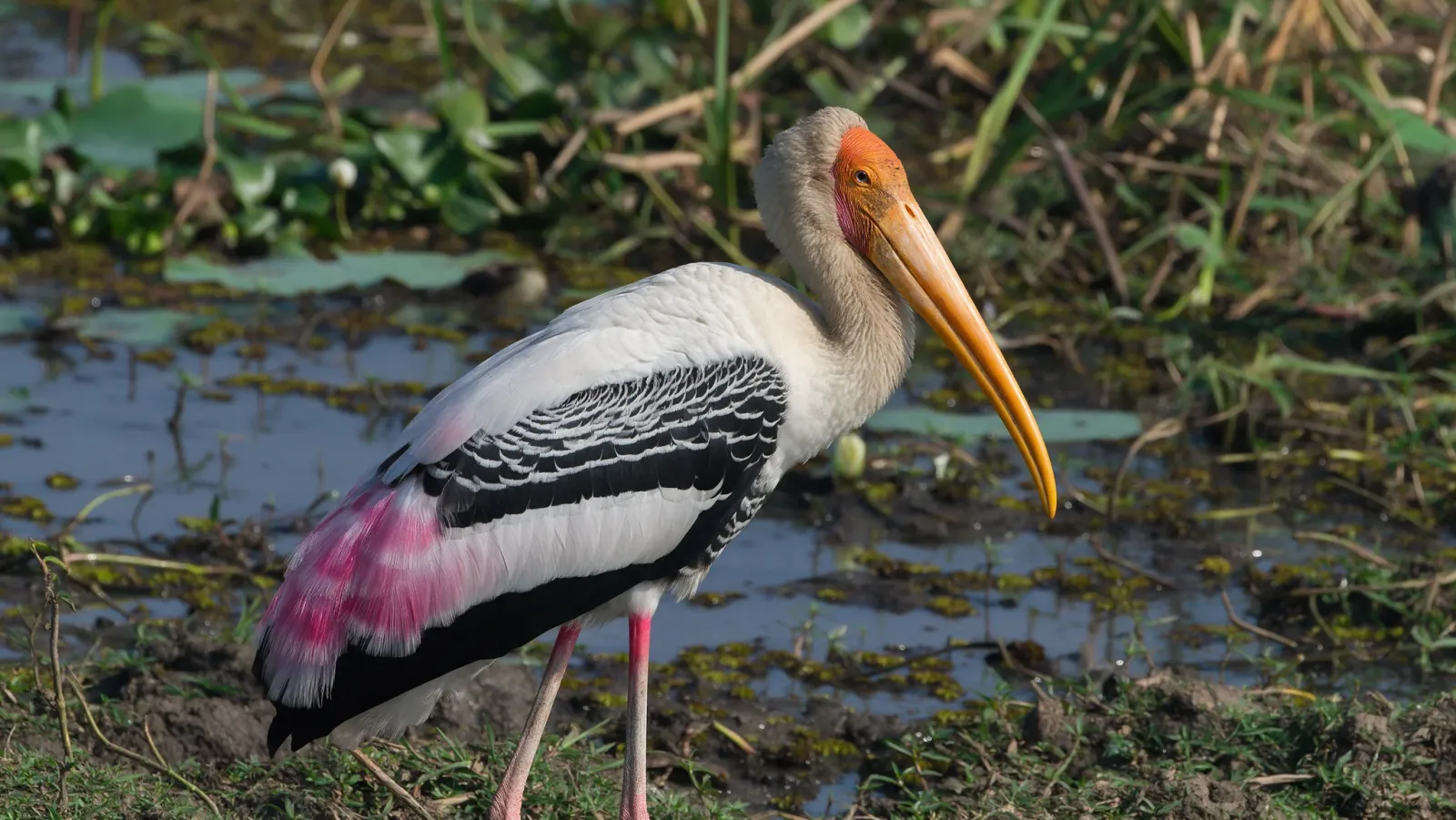
The painted stork is a large Asian wader whose white wing feathers shade into soft pink, the colour that gives the bird its name. The body is white, the flight feathers black, and the wing coverts are washed with pink that deepens in the breeding season. The bare face is orange-red, the legs are pinkish, and the long bill is yellow and slightly downcurved. A dark band crosses the chest in breeding adults. The pink sits on the wing coverts, a soft wash that stops short of the black flight feathers. The young are paler and browner, without the chest band, and they take a few years to reach the full colour. Seen in green water against a bare tree, a breeding adult is one of the quiet beauties of the subcontinent.
A bill that feels for fish
The painted stork wades with the bill open and the tip in the water, sweeping it side to side or holding it still. When a fish touches the inside of the mandibles, the bill snaps shut by reflex. This works in water too muddy to see through, and it lets the stork feed at dusk and dawn when light is poor. The bird often stirs the bottom with a foot to flush prey toward the open bill. A painted stork can catch a fish it never saw. It takes small fish, frogs, crustaceans and aquatic insects, feeding in loose groups where the water is shallow and the fish are concentrated. The bill closes in a fraction of a second, and the bird swallows without lifting its head far. The milky stork of Southeast Asia hunts the same way in the tidal mud beside mangroves, following the tide as it pulls back. It takes small fish, prawns, crabs and insects, and it feeds most actively at the changing of the tide, when the small life of the flat is on the move.
The colony in the trees
Painted storks nest in trees, often with herons, egrets, cormorants and spoonbills, and a colony can be crowded and loud. Both birds build the stick platform and share incubation, and the chicks are fed by regurgitation. The colony usually stands near water, and the birds fly out each morning to feed and return through the day. The same trees are used year after year. Some colonies in Indian towns are watched over by local people, and the birds have become part of the place they nest in. The season begins with the rains, when the water spreads and the fish gather in the shallows. Pairs greet each other at the nest with bowing and bill clattering, and the whole colony fills with sound. Two to four eggs are laid, and both birds take turns sitting. The stronger chicks take most of the food, and the weakest often do not survive. By the time they fledge, the young are the size of their parents and nearly as noisy. Painted storks depend on shallow wetlands: marshes, lakes, village tanks, flooded fields and the edges of rivers. They follow the water as it rises and falls, and they need trees near enough to nest in. Drainage, pollution and the filling of tanks have reduced the bird in parts of its range, and a colony can vanish when a nesting grove is cut.
The milky stork of the mangroves
The milky stork is a pale, cream-white bird of Southeast Asia, closely related to the painted stork and tied to mangrove forest and the tidal mudflats beside it. The plumage is white with a faint cream or yellow tinge, the bare face is orange-red, the bill is long and yellow, and the legs are reddish. It nests in colonies in the mangroves, building stick platforms in the crowns, and it feeds on the flats the forest shelters. The roots hold the mud together, break the force of the tide and keep ground predators away from nests that sit a few metres above the water. Cut the trees and the flat goes with them, and the bird has nowhere to feed or nest. The strongholds are in Indonesia and Malaysia, with colonies watched and guarded in a few places. Much of the region's mangrove has been cleared for ponds and building, and the bird has declined with the forest. At low tide the adults fly out to feed; at high tide they stand beside the nests, waiting for the water to turn. The bird is protected in a few reserves, where the mangrove is left standing.
The adjutant's stiff walk
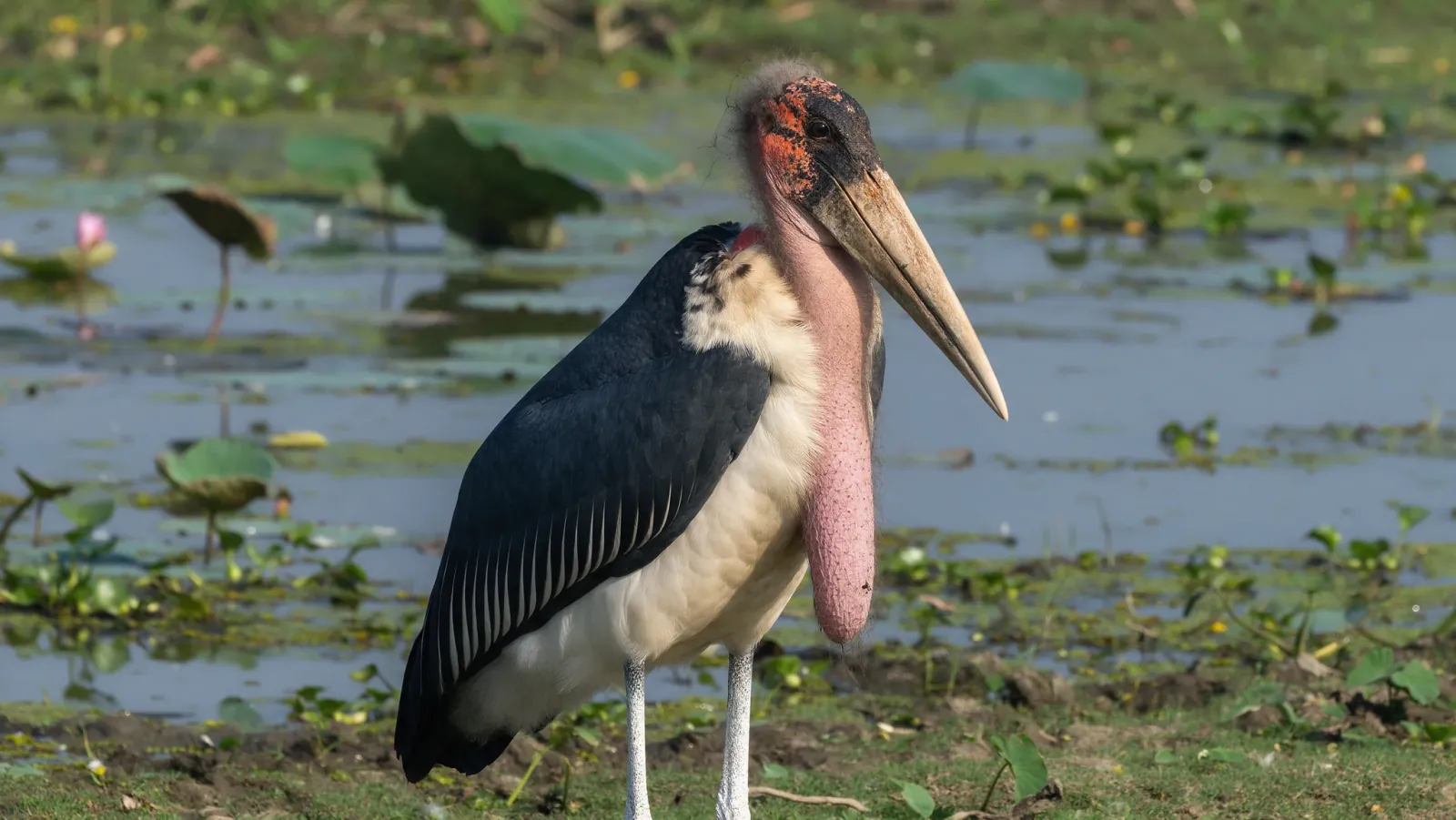
The greater adjutant is a huge Asian scavenger, dark above and pale below, with a bare head, a hanging throat pouch and a walk so stiff that British officers in India named it after a marching adjutant. A full-grown bird stands around a metre and a half tall, with a massive, slightly tapering bill and a bare, pale head. The body is dark grey-brown above with a paler belly, and in flight the bird shows a long neck and trailing legs. It soars on broad wings, often at great height, with deep beats between long glides. Few birds in Asia stand as tall or look as old. The pouch is inflated during display, when the bird throws its head back and the loose skin swells and swings. The bare head and neck keep carrion off the feathers, and the skin flushes when the bird is excited. At a nest, two birds greet each other with bills pointed at the sky and a hollow rattle that carries across the colony. On the ground the bird moves with a measured, upright stride, and it can stand motionless for a long time beside a carcass or a rubbish heap.
A scavenger in town and marsh
The adjutant feeds at carcasses, at rubbish dumps and in shallow wetlands, taking fish, frogs, reptiles, small mammals and anything dead it can swallow. It also takes insects and the eggs of other birds, and it will gather with vultures at a kill. In parts of South and Southeast Asia it nests in tall trees in villages and towns, often in small colonies, and it is tolerated because it clears waste away. The nest is a big platform of sticks, reused year after year, and the birds add to it each season. In a few towns the adjutant is a familiar figure, standing on a roof above the market. The greater adjutant once ranged across much of South and Southeast Asia. Wetlands have been drained, nesting trees cut and feeding sites lost, and the population is now small, concentrated in a few places where colonies are guarded. The species is endangered, and its remaining strongholds are watched closely. It raises only a chick or two in a good year, so a colony grows slowly even when food is plentiful. At a colony in the evening, the adults come in one by one, heavy wings cupped against the air, and each lands beside its nest with a clatter of the great bill. The young stay on the nest for months, and the noise of them begging carries down the street.
Explore the gift