A black stork, a woolly-necked stork and a saddle-billed stork all keep their distance from people, and each does it in a different kind of quiet. One hides in old woodland, one in the shade at the edge of a river, one on a stretch of African water with no boat in sight.
A bird of old trees
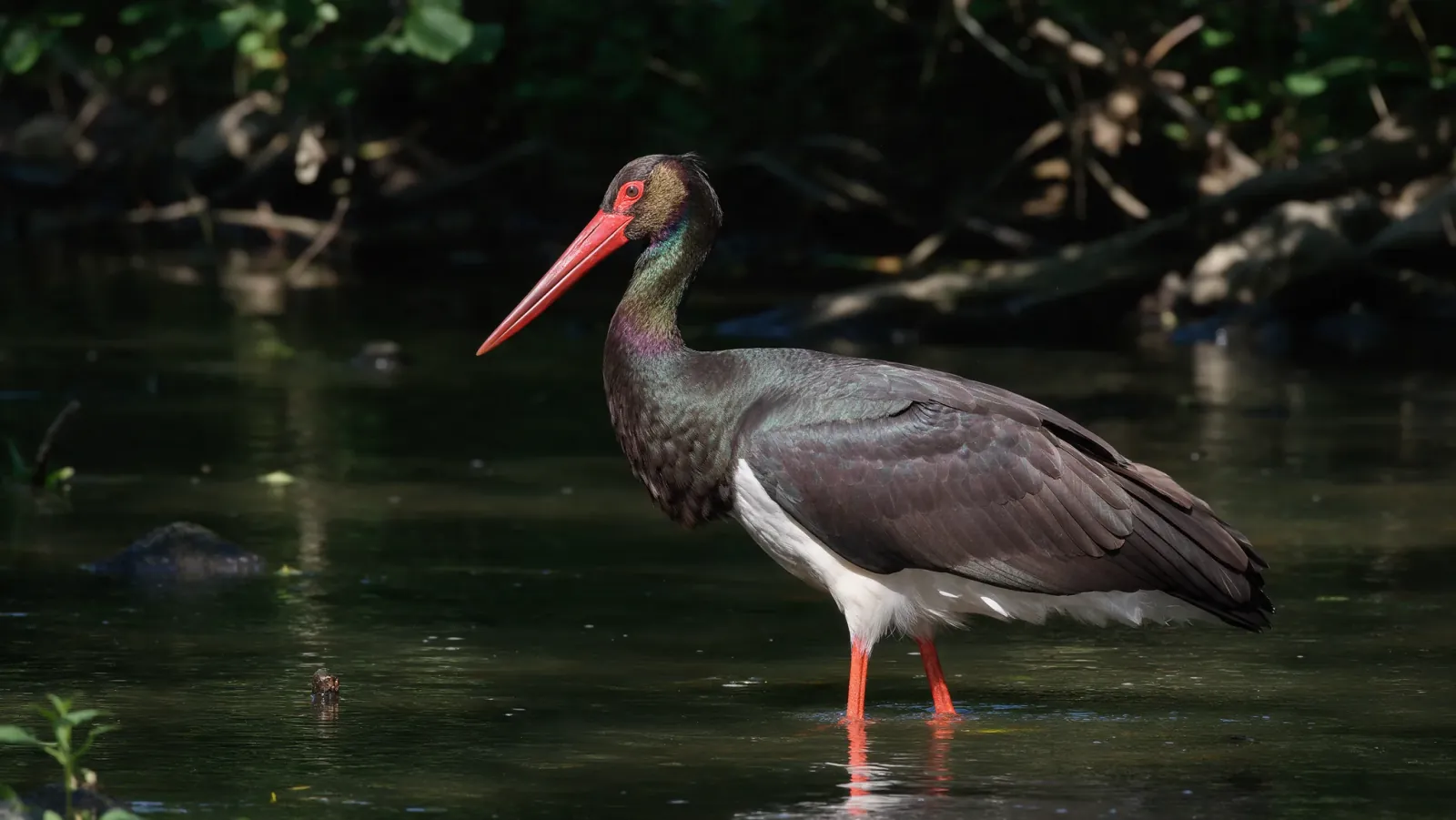
The black stork has a black head, neck and back with a green and purple sheen, a white belly, a red bill and red legs. The sexes look alike; the young are browner, with duller legs and a grey-green bill. It nests high in an old tree instead of on a chimney, in mature woodland with water running through it. The platform of sticks sits on a broad branch or in a fork, often within reach of a stream or a pool. The same nest is repaired and reused for years, and a pair defends a stretch of river instead of gathering with neighbours. A pair wants distance: one quiet wood, one stretch of water, no crowd. The nest is high and hidden by leaves in summer, and the birds drop in through a gap in the canopy rather than crossing open ground. In spring the two birds repair the nest together, one standing on the rim while the other works.
Hunting in the half-light
The bird feeds in wooded water where the light comes through in patches: small fish, frogs, newts, insects and their larvae, taken with a quick stab of the bill. It also takes eels and small snakes, and it will work a stream for a long way, pool after pool. It stands at the edge or wades in the shallows, and it uses shade the way the white stork uses open field. In spring it will hunt wet meadows and marshy clearings, but it likes cover nearby and flies up into the trees if disturbed. The dark plumage works against dark water, and a bird against a sunlit field shows as a dark shape with a pale belly, already moving away. In flight the neck is stretched out and the legs trail behind, and the broad wings show black above and pale below, with the long toes spread past the tail. Its migration is a quiet one. Birds leave from August, singly or in loose groups, and cross at the same narrow points the white storks use, Gibraltar in the west and the Bosphorus in the east. They soar on thermals, and they do not gather into great flocks. A migrant may be the only one of its kind in the sky. In spring it returns to the same wood, and for a while the only sign of it is a dark shape dropping between the trees. The young stay on the nest for around two months. After they fledge they linger near the wood, following the adults to the water and learning where the pools hold fish, and by late summer they are gone.
The woolly collar
The woolly-necked stork is a bird of the forest edge, easy to know by the loose white feathers around its neck and the dark, glossy body beneath. It lives across parts of Africa and southern Asia, always near water, and it favours the places where trees meet wet ground. A forest pool, a shaded riverbank, a rice field edged with woodland: these are its country. Around the neck the feathers are soft and pale, a loose white wool that stands out against the black body and the glossy wings. In the breeding season the collar is raised and shown, and the two birds of a pair greet each other with bowing and bill clattering. The collar is part of the display, a signal made of feathers rather than sound. The bird is wary, and it keeps to cover. It is usually seen alone or in pairs, and it leaves quietly when people come near. Its call is a soft clatter, quieter than the white stork's, and it is heard mostly at the nest. Its food is frogs, insects, small fish and the creatures of wet ground, taken with a quick snap of the long bill. It hunts slowly, placing each step with care, and it can stand motionless at the edge of a pool for a long time.
The saddle on the bill
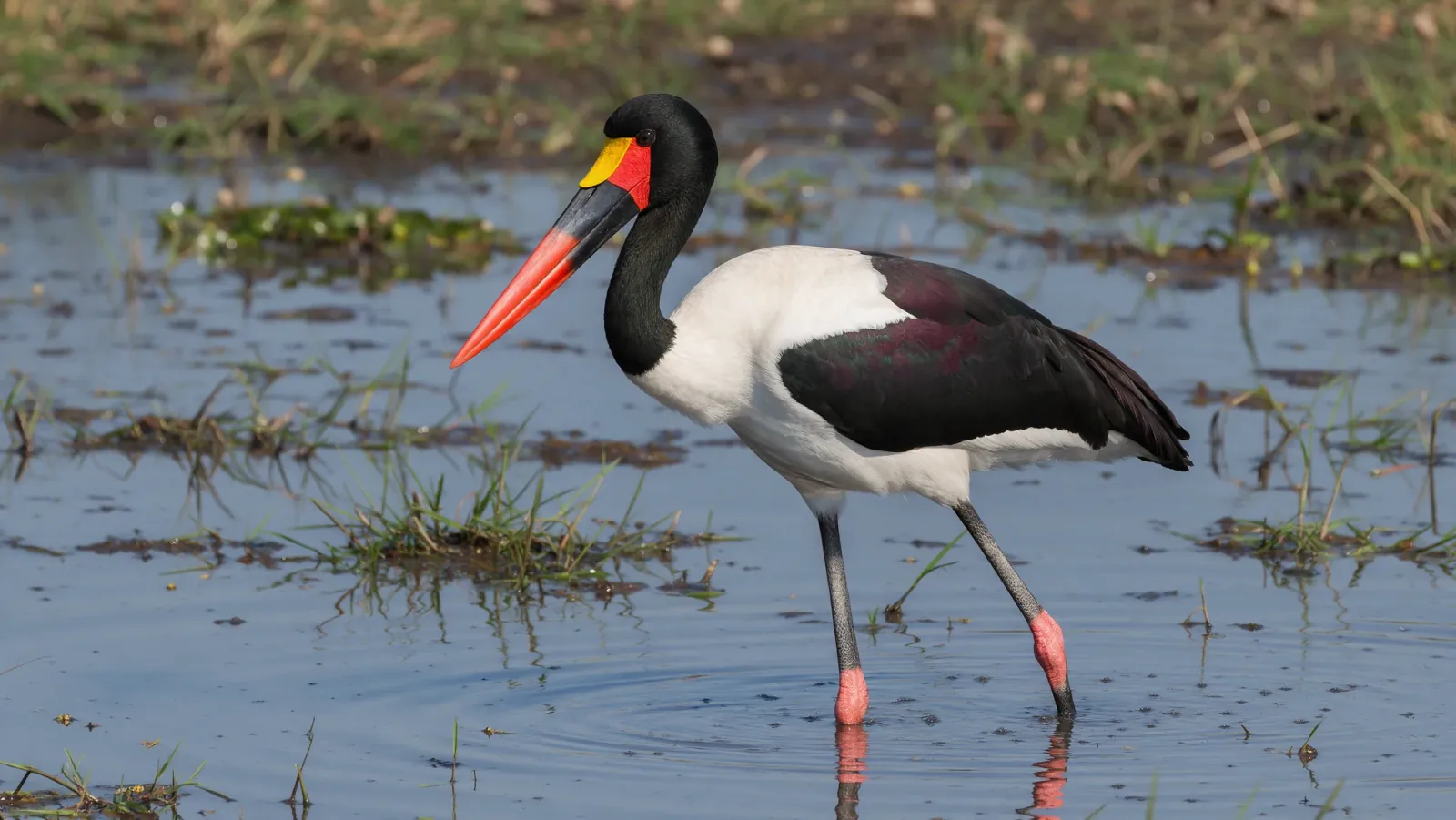
The saddle-billed stork is a tall African wader with a black and white body, long dark legs and a bill that looks hand-painted: black, banded with red, and topped by a yellow shield. That shield is a raised plate at the base of the upper bill, and it grows with age. The female has a yellow eye, the male a dark one, which is the surest way to tell a pair apart at a distance. The bill works like a spear, driven down at fish, frogs and crabs in the shallows. It is clattered in greeting, though the bird is generally quiet. The head, neck and back are glossy black, the belly and underwing white, and in flight the bird shows a long neck, trailing legs and a broad black-and-white wing. Young birds are duller, with a greyish bill and browner plumage. The bare skin at the bend of the leg is pinkish, and it shows when the bird walks.
A river with no crowd
One saddle-billed stork or a pair will work a long stretch of river, walking slowly in the shallows with the bill angled down. The bird stands still for minutes at a time, then strikes without warning. Its prey is mostly fish, along with frogs, crabs and the occasional small reptile. It hunts by sight, and clear, slow water suits it best. A saddle-billed stork needs a river with fish in it and a bank quiet enough to stand on. Where the water is muddy or fast, it moves on. The nest is a platform of sticks in a tall tree, often one standing alone near water, and the pair returns to it season after season. Two or three eggs are laid, both birds incubate, and the chicks are fed on fish brought from the river. A bird on the nest is wary, and it will leave if people come too close. The woolly-necked stork nests in much the same way, in a tall tree near water, with two or three eggs and both parents incubating. A pair may return to the same nest for several seasons.
Quiet lives, easily lost
A bird that keeps to itself is easy to miss and easy to lose. The woolly-necked stork's forest and wetland homes shrink wherever water is drained and trees are cleared, and a bird that needs both together has fewer places to stand than it once did. The black stork needs mature woodland with water running through it, and that combination is not everywhere. Drainage, dam building and disturbance at nest sites have reduced the saddle-billed stork in parts of its range. A solitary bird can slip away without a fuss, and its absence can go unnoticed for years. All three still stand in shaded pools and quiet rivers, stepping through the water with the same old patience. A patient watcher on a quiet African river may still see a saddle-billed stork in the current, bill held ready, waiting for a fish to come close.
A shared shape
All three birds are built on the stork plan: long legs, a long neck, a long bill, and a flight with the neck held out. The differences come from where each one works. The black stork needs trees over water, the woolly-necked stork needs cover at the edge of wet ground, and the saddle-billed stork needs a river with fish and a quiet bank. Each bird is a variation on the same patient hunter. None of them gathers in the noisy colonies that some other storks prefer. The woolly-necked stork is found in Africa south of the Sahara and in parts of South and Southeast Asia, and it lives much the same way in both places. It is still there in the shaded pools and wet forest margins, stepping through the water with the same old patience.
Explore the gift