Once a year a stork replaces its worn feathers with new ones. The process is called the moult, and it is gradual enough that the bird can fly throughout. Old feathers loosen and fall, new ones push up in their place, and the coat is renewed a few feathers at a time.
A feather from a follicle
Growth starts in a small pit in the skin. By the time the feather is fully formed, it is dead tissue, a hard shaft of protein the bird carries like clothing. When it wears out, a new feather begins in the same pit and pushes the old one out.
The new feather arrives rolled inside a sheath, soft and filled with blood while it grows. When it reaches full length, the blood supply stops, the sheath flakes away, and a clean strong feather remains. The replacement is built from the inside out.
A feather is a precise structure. A central shaft carries many small branches, and each branch carries still smaller hooks that lock it to the branch beside it. The hooks turn the loose branches into a smooth, stiff surface. A growing feather has to build that surface inside a sheath and then unfold it, and the bird has no second chance at the shape.
A few at a time
A white stork moults in stages. A bird that dropped every flight feather at once would be grounded for weeks, unable to hunt or escape. So the feathers are shed and regrown in a slow sequence, a few from each wing at a time, so the bird always has enough wing to fly.
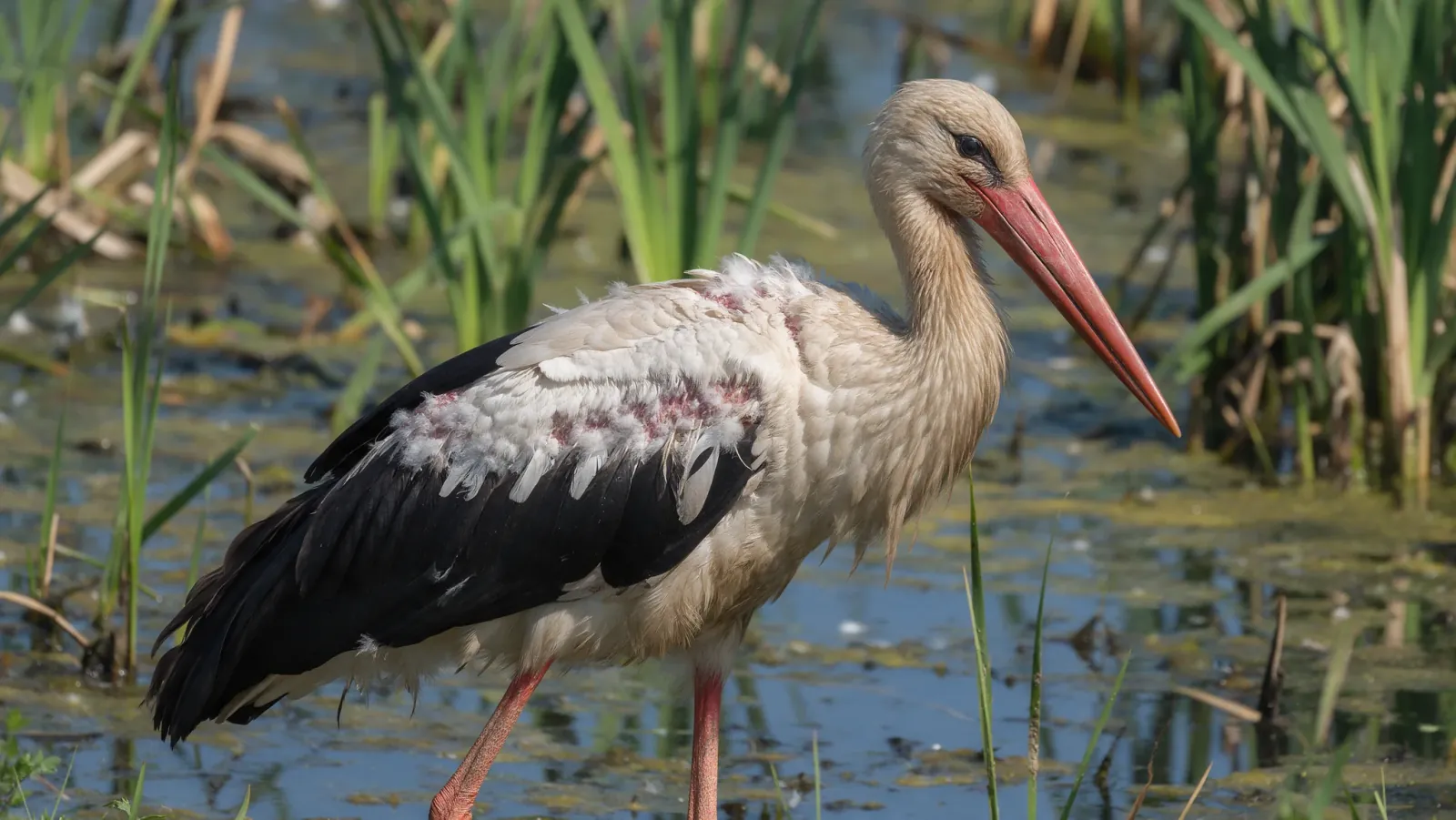
The moult takes many weeks. The bird is never grounded by it, only a little shabby at the edges. A close look at a moulting stork shows old faded feathers beside new dark ones, two generations sharing the same wing.
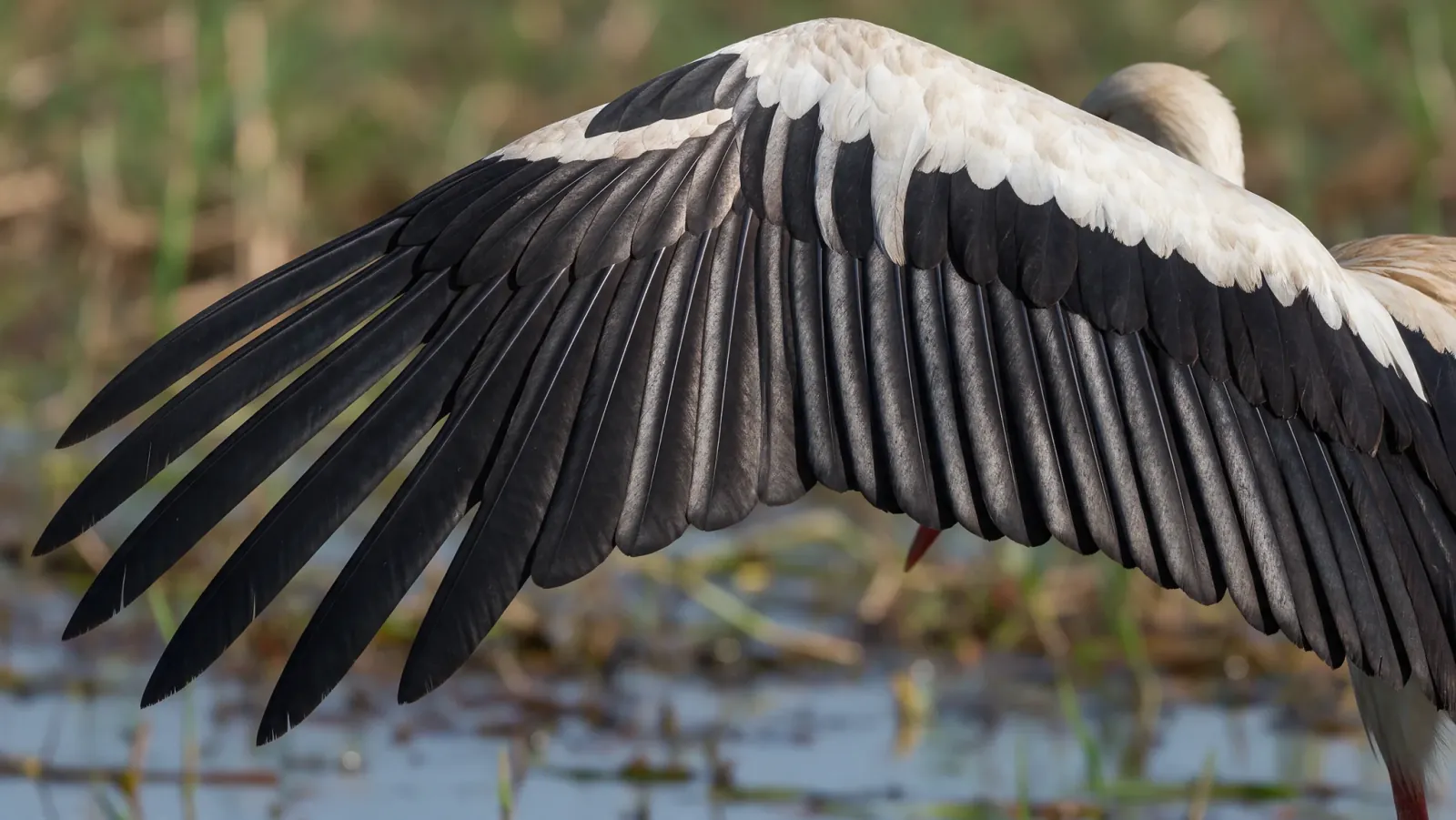
The same slow sequence runs through the rest of the coat. The small feathers of the breast and back are replaced gradually, so the bird keeps its outline and its warmth. The tail feathers follow the same pattern. A stork in moult can look uneven from behind, with old feathers beside new, and the pattern resolves over the weeks.
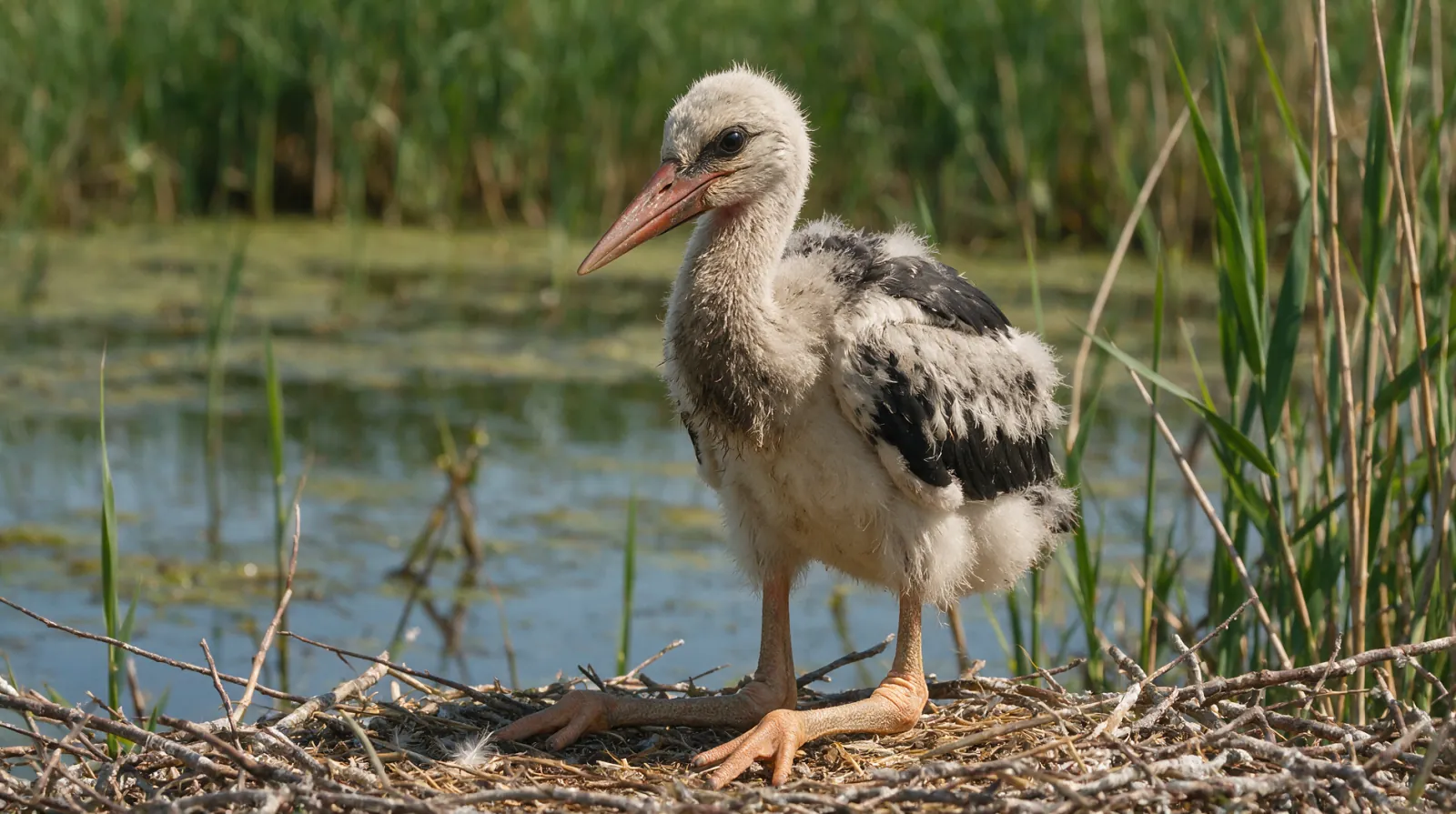
Chicks go through their own change. The down of the nest is replaced by juvenile feathers, and those are replaced again as the bird matures. A young stork may look patchy in its first autumn, with down still clinging at the edges of a new wing. The change is almost invisible from one day to the next. Across a season, the whole bird has been remade.
Melanin and wear
The white stork is remembered as a white bird, yet its most important feathers are black. The long flight feathers of the wing are deep black. They show as a dark band across the folded wing and as black tips when the bird spreads its wings.
The flight feathers are the longest and stiffest feathers a stork owns. They run along the outer edge of the wing and form the surface the bird presses against the air with every beat. The primaries at the tip cut through the air first. The secondaries behind them smooth the flow over the rest of the wing.
These feathers take the load of flight and the worst of the weather. Rain, sun and the constant bending of the wing wear on them. They are the first to fade and fray. A stork cannot spare a single one.
The black colour comes from melanin, a pigment that does more than colour a feather. It strengthens the structure. A feather filled with melanin is harder and more resistant to wear than an unpigmented white one. The darkest feathers sit where the work is hardest, at the tip and along the trailing edge. That is exactly where a bird would want its strongest material. The white stork wears its reinforcement in black.
Black pigment also absorbs sunlight, and a bird covered entirely in black would take on more heat than it needs. The white body reflects the sun, and the black is kept to the feathers that carry the load. The division is practical. White where heat matters, black where strength matters.
Why the coat must be renewed
A feather is a working tool, and tools wear out. Sunlight fades it, wind frays it, and daily rubbing against the nest thins it. A coat of old feathers no longer holds warmth or sheds rain as it should, and a bird flying on ragged feathers flies less well.
The moult is the repair. It replaces worn feathers before the demands of the next season arrive, so the stork meets migration and breeding in a strong coat. The bird is remade before it is asked to do the hardest work.
The timing follows the bird's calendar. A stork needs full, strong plumage for the long flight south and back, and it needs it again for the cold, wet weeks of nesting. The moult fits into the months between. For a white stork, that means the change runs through the quieter part of the year, after the chicks have fledged and before the journey begins.
The bird is never without a working wing, and the new feathers are ready when the thermals start. A moulting stork may look duller for a few weeks while the new feathers grow and the old ones fade. The change is most visible in the wing, where the gaps and the new dark tips sit side by side. Then the coat closes, and the bird leaves.
A signature in the sky
On a standing stork the black feathers are mostly hidden, folded against the body, and the bird looks almost entirely white. A dark patch shows at the back of the wing, and the tail is white. The full black band appears only in flight or when the bird spreads its wings to dry.
The pattern is one of the clearest ways to know a white stork at a distance. White body, long white neck, dark flight feathers on the open wing. Against the sky, the bird reads like a signature.
The dark band is easiest to see when the bird banks. In a turn the open wing shows the full spread of black, and the white body turns above it. The pattern is a quick way to name the bird from a distance, and it works even when the light is poor.
The amount of black stays much the same from bird to bird, though the exact edge of the dark band varies. That small variation is one way a watcher can recognise an individual, along with the pattern of the bill and the way the bird stands. A white stork on a roof in spring, preening in the sun, shows only a dark edge at the back of each wing. Then it opens its wings, and the whole working surface appears, black and broad, built for the long road.
The black flight feathers are the stork's travelling clothes. The bird crosses a continent and back each year, gliding for long hours on the tips of these feathers. The dark pigment helps them last the journey. When the stork lands and folds its wings, the black tips tuck out of sight, and the bird looks calm and white again.
The moult and the dark feathers belong to the same story. One replaces the coat, and the other makes the hardest-working part of it strong. A stork on its way south is flying on feathers grown in the weeks before.
Explore the gift