A marabou at a carcass, a jabiru in a flooded field and a yellow-billed stork in a warm African pool are three answers to the same question: how a large bird makes a living in shallow water. One waits for the work of predators, one stands still for minutes at a time, and one walks with its bill half open.
Built for carrion
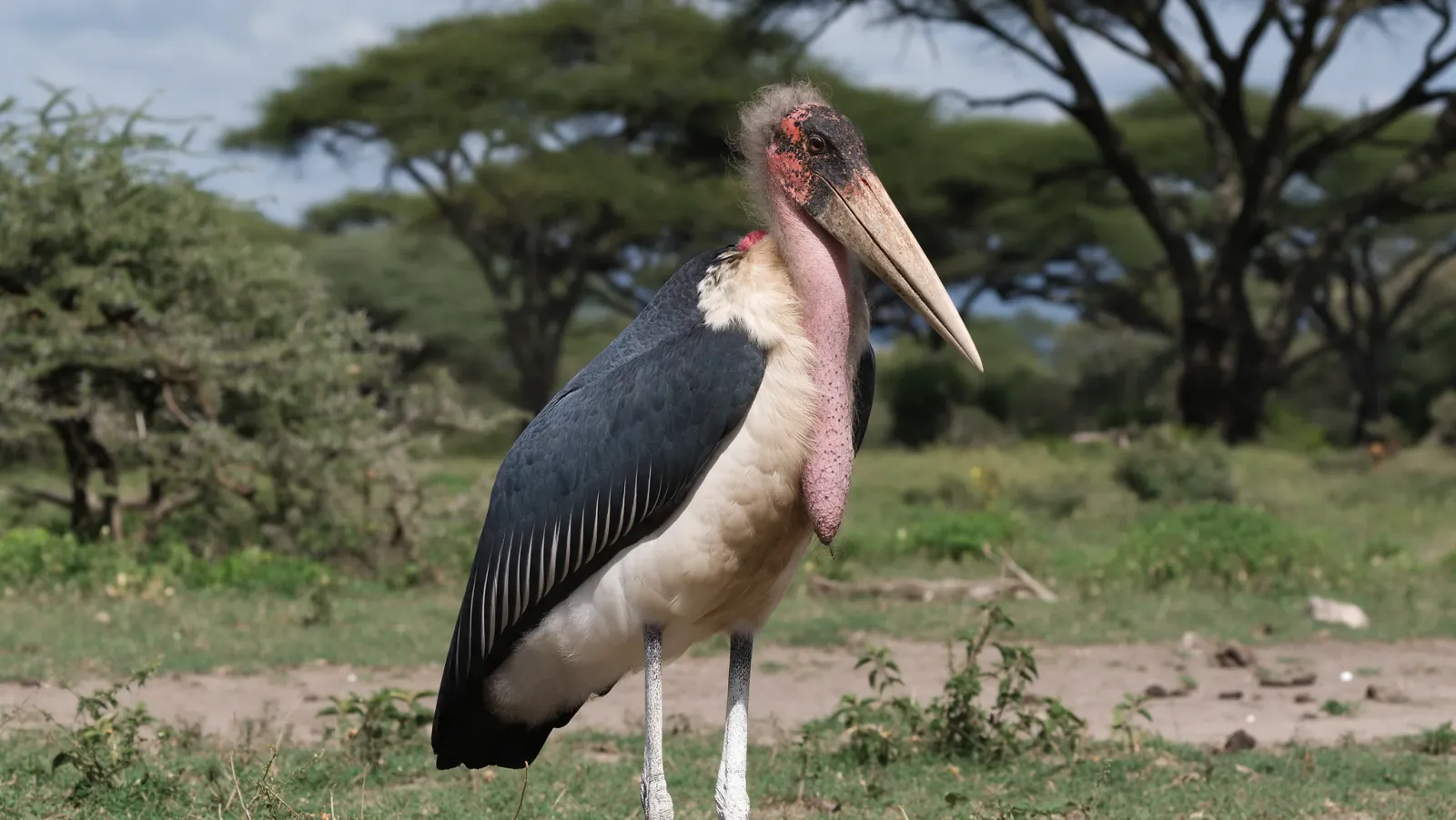
The marabou stork is the scavenger of the African savanna, a huge dark bird with a bare pink head, a heavy wedge of a bill and a pouch of loose skin at its throat. It stands about a metre and a half tall and walks with its head sunk into its shoulders, which is why it is sometimes called the undertaker bird. Feeding on a dead animal is messy work, and the bare head and neck keep the mess off its feathers. The bill is long, thick and strong enough to tear hide and open a carcass that vultures have already begun. The bird swallows chunks whole, bones included, and its stomach deals with what would make other animals ill. Its bulk wins it a place at any kill. It often waits at the edge of the crowd for the moment a better-placed bird steps back, and then takes the tough parts of the carcass, the hide and the tendons. The pouch under the chin is called a gular sac. It hangs loose, can be inflated, and is used in display. The pouch swings a little as the bird walks, and it is usually the first thing a person notices.
Following the herds and the towns
On the savanna the marabou follows the great herds and the predators that hunt them, arriving at a kill with the vultures and waiting its turn. Between kills it takes whatever it can: insects, fish, frogs, small mammals, birds' eggs, and the scraps around human settlements. It will wade in shallow pools for fish and frogs, and it drinks often in the heat of the day. Marabous have another cooling habit: they dribble excrement onto their own legs, and the evaporating water lowers their temperature. In East African towns it nests in street trees and stands on roofs, unbothered by people. The bird has turned human waste into a dependable food supply. The nest is a platform of sticks, sometimes a metre across, and a colony can hold dozens of pairs close together. Both birds incubate, and the chicks are fed on regurgitated scraps. In the air the marabou is a broad-winged glider with a wingspan of well over two metres, riding thermals high above the plain with its legs trailing. The wings that look clumsy at rest carry one of the largest flying birds in the world. A marabou at rest often stands with its bill laid on the pouch, or with one leg tucked, and it can hold the pose for a long time while the heat builds and the vultures circle.
The tallest bird of the Americas
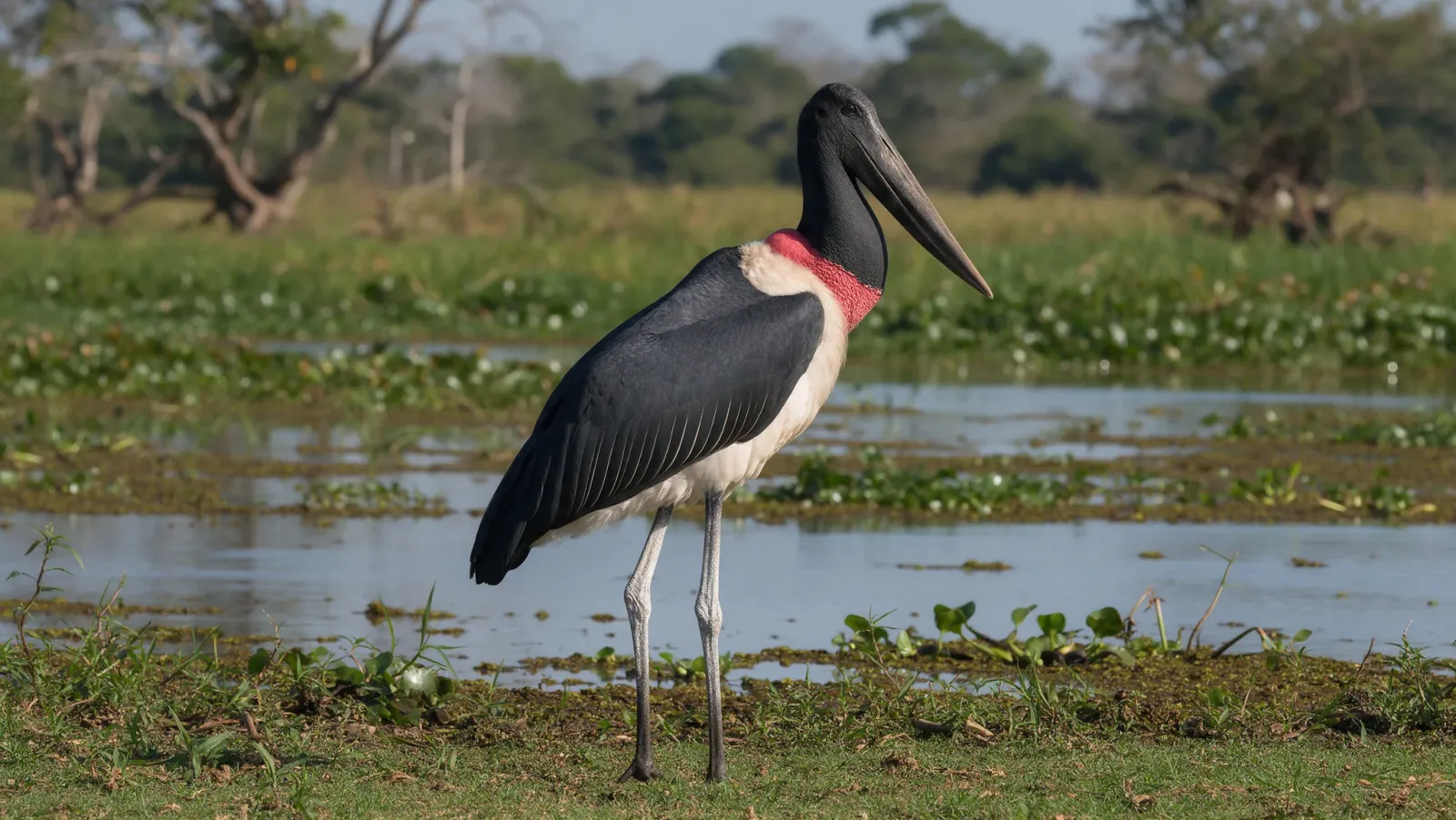
The jabiru is a huge white stork of Central and South America, with a bare black head and neck, a red band at the base of the throat, and a long black bill. It is the tallest flying bird in the Americas. The name comes from a Tupi word for swollen neck, and the bird lives in marshes, savannas and rivers from Mexico south to Argentina. An adult stands around a metre and a half tall, taller than the herons and egrets it shares the marsh with, and its wingspan is broad enough to make it look like a small glider overhead. The body is white, the head and neck bare and black, and the bill is heavy, black and slightly upturned. Its height comes from long legs and a long neck, and it can see over reeds that hide other birds. A standing jabiru holds itself very upright, and it often tucks its bill down against the neck when it rests. The bare black skin on the head and neck stays clean while the bird reaches into water and mud after prey. Feathers there would collect slime and take a long time to dry.
A life in the shallows
The jabiru wades in shallow water and flooded grassland, standing still for long periods before striking. It eats fish, frogs, snakes, snails, insects and small mammals, and it will take the eggs and young of other waterbirds. Its bill is strong and its strike is fast. The bird hunts by standing and waiting, and it can hold a pose for many minutes. It usually feeds alone, spaced well apart from others of its kind. In the heat of the day it often stands with its wings slightly open, letting the air move through the feathers. The nest is a large platform of sticks in a tall tree, often an isolated one, and the pair reuses it in later years. Two or three eggs are laid, and the chicks are fed at the nest for months. As the floods retreat, the jabiru follows the water, moving to rivers, pools and the edges of drying marshes. The bird lives by the flood pulse, and its year turns on the rise and fall of the water.
A bill made for feeling
The yellow-billed stork is a bird of warm, shallow water, and the bill that gives it its name is the tool that shapes its day. It belongs to the same family as the white stork of European rooftops, and it lives across Africa, in pools, marshes and the slow edges of rivers. The bird stands in water up to its belly and lowers the bill until the tip is just below the surface. The mandibles are parted a little, and the inside is sensitive to the touch of something alive. Fish move unseen in cloudy water, and the stork cannot see them either, so it feels for them. The moment something brushes the bill, it closes by reflex, faster than a decision. Adults have a bright yellow bill; young birds carry a duller, greyer one. A stork can catch a fish it never saw, and it does it again and again through the warm hours of the day.
The walking feed
Most of what the yellow-billed stork takes is small: fish fry, frogs, insects and the tiny life of a healthy wetland. The bird moves slowly, one step at a time, and the stillness between snaps is part of the hunt. When it stirs the water with a foot, small creatures dart away and the open bill is waiting. The bird feeds on the move, pacing the shallows while a heron waits. It rarely feeds in deep water, and it moves to the edge as the level drops. Its long bare legs let it walk where the water deepens without wetting its feathers, and its long neck gives it reach into places shorter birds cannot go. In flight it holds its neck out and its legs trailing, a straight line across the sky that marks it as a stork. It nests in colonies, often in trees near water, and shares those places with egrets, herons and other wading birds. When the sun is high, the adults stand over the small chicks and shade them with their wings. The clatter carries across the colony, and the chicks answer with their own small clatter. The young learn the feeding method by watching, and by the time they leave the colony they are already feeling for their food the way their parents do, head down and bill open.
Explore the gift