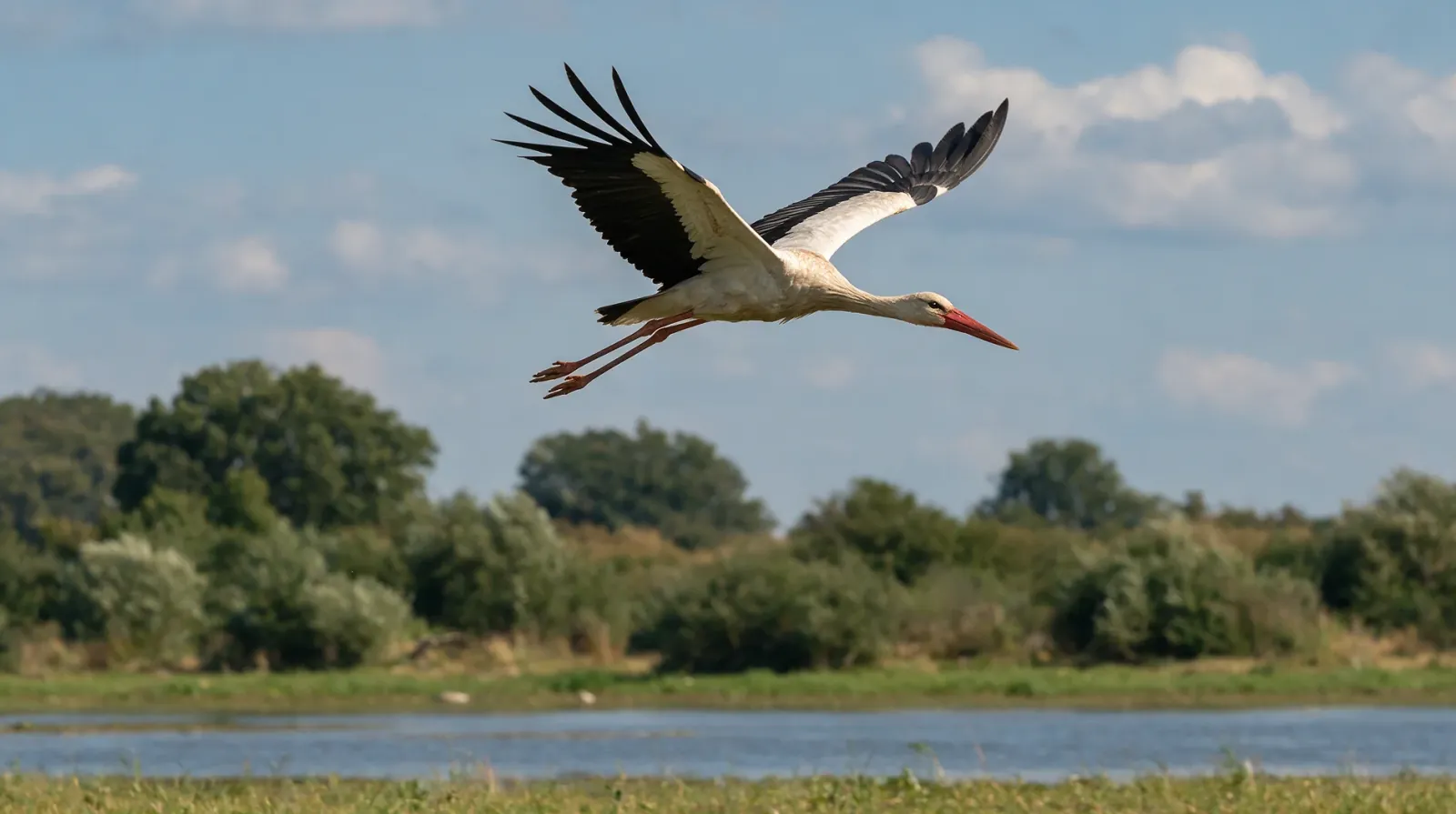
A young white stork leaves the nest in its first summer and flies south without a map, a guide, or a memory of the way. The map it carries is partly inherited and partly learned, and the two are difficult to separate. What looks like instinct in an old bird began as a direction and a few lucky decisions.
A heading that comes first
A stork raised alone, with no adult to follow, will still set off in roughly the right direction when autumn comes. The pull is toward the south, and it appears in birds that have never seen a wintering ground. This inherited heading does not show the route. It gives the bird a direction to start in, and the rest is worked out on the way.
That is enough to begin a journey of thousands of kilometres. The bird does not need to know where Africa is. It needs to fly south, and to keep flying south when the land below is new and the weather is against it.
A bird that flew exactly south from Poland would end up in the sea or against a mountain. The inherited bearing is a starting instruction. The details are filled in by what the bird sees and by the birds it meets, and the two kinds of knowledge are hard to tell apart in an adult.
Two compasses
Storks migrate by day, and they read the sun. A bird can allow for the sun's movement across the sky, keeping a steady heading as the hours pass. They also respond to the earth's magnetic field, which gives them a bearing when the sky is overcast and the sun is hidden. Two compasses, one of light and one of magnetism, keep a young bird pointed south even when the land below is new.
A compass gives direction without a picture of the country. It tells the bird which way to go. The two senses work together with what the bird can see, and a stork crossing a coast it has never met will bend its route around the water rather than fly out over it. The bearing is rough, and the bird corrects it as it goes.
On a grey day the magnetic sense takes over, and a bird can hold a heading through cloud that hides both the sun and the ground. Over a featureless plain or a stretch of desert, that is the difference between a route and a drift. The compass does not explain the country. It keeps the bird moving while the country is read.
The map that is learned
The compass shows which way to go. Experience shows what is there. Older birds carry the shape of the route: a coastline that runs the right way, a strait that must be crossed, a river valley, a mountain pass, a stretch of desert that has to be crossed in one push.
These are learned by flying them, once and then again, and remembered from year to year. An adult stork returning to the same nest has flown the whole route many times. It knows where it stopped and where the food was. Each year adds detail to the map, until the route is less a set of instructions than a remembered road.
A stork that has made the journey once is a different bird on the way back. It recognises the coast it followed, the strait it crossed, the marsh where it fed. The second journey is easier because the map now has places in it rather than only a direction.
Following the crowd
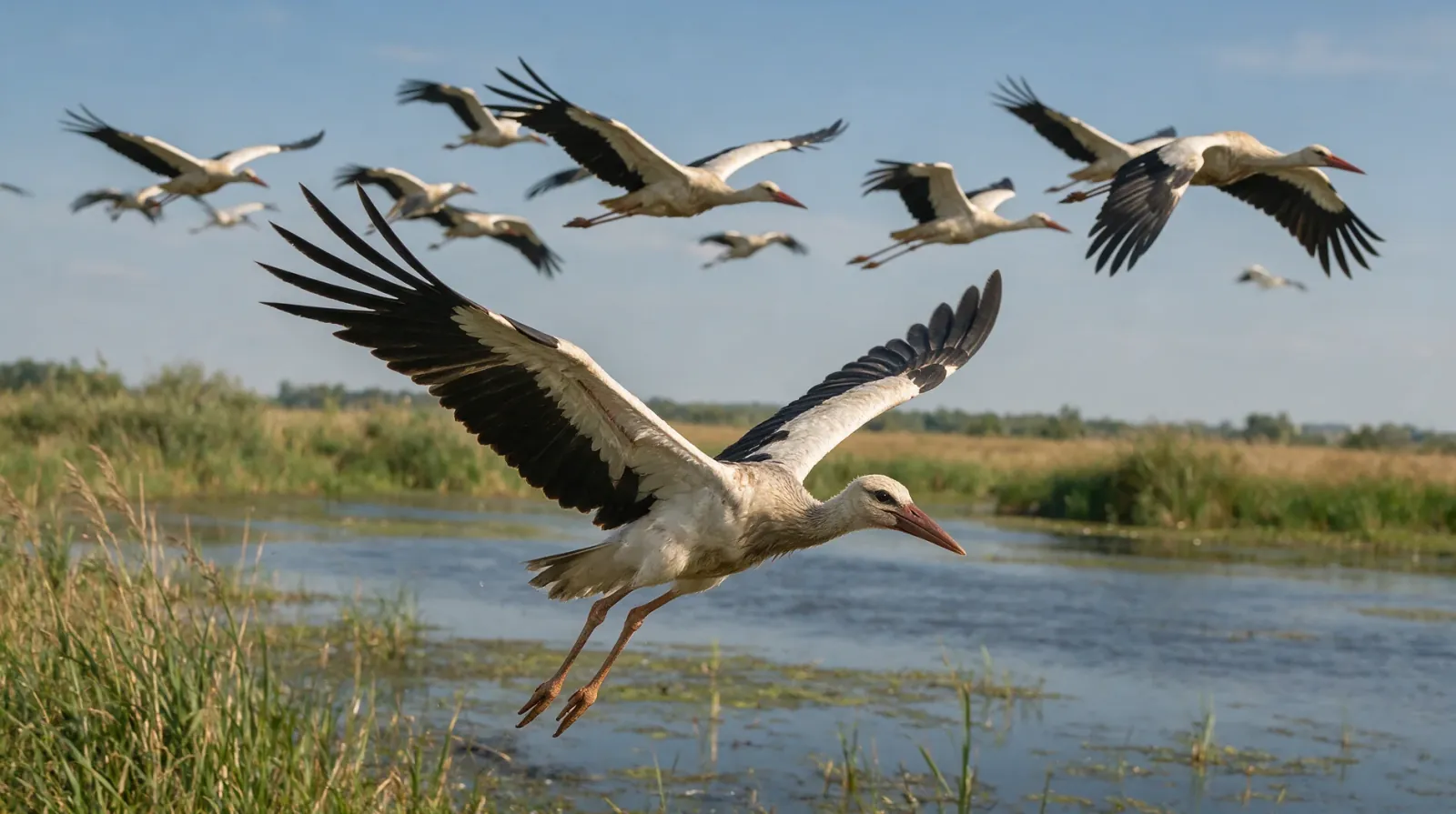
Most young storks do not travel alone. They join flocks in late summer and fly with birds that have made the journey before. In the middle of a flock, a first year bird can rely on the experience around it, and the whole group moves with a confidence no single young bird has.
A young stork that follows a flock also learns the stops. It sees where the birds come down in the evening, which wetlands they choose, how long they stay. Those places become part of its own route. Years later, the same bird will return to the same marsh without hesitation, and the knowledge will look like instinct to anyone watching. The flock is a school as well as a vehicle, and the lesson is the route itself.
A coastline can lead a young bird the wrong way, and a storm can scatter a flock over country it never meant to cross. Some juveniles end up far outside the normal range, and a few are found in countries where storks are rare. Many correct their heading and continue. The ones that cannot find a way often do not survive their first year.
The young that leave alone
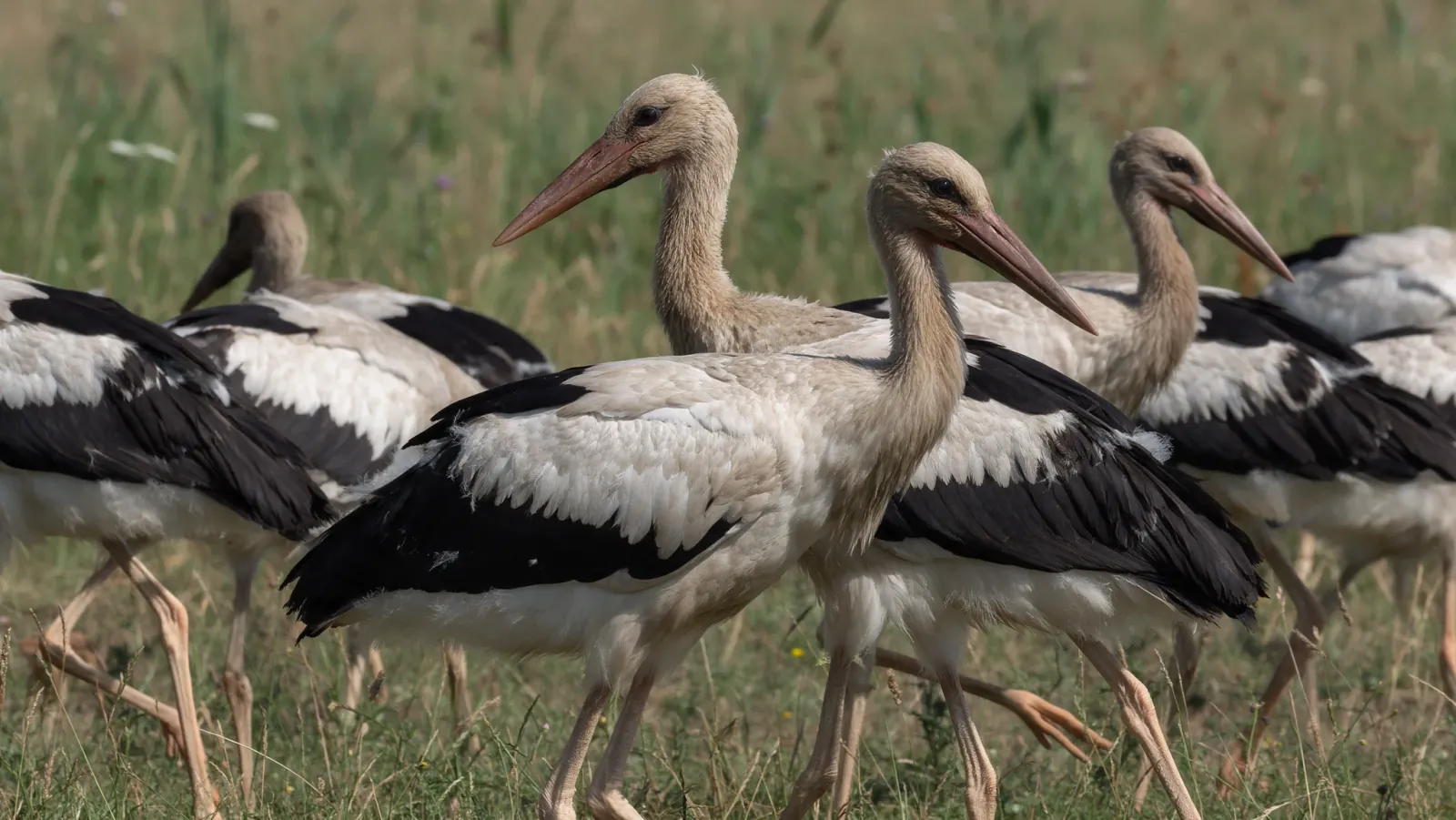
The adults usually go first, while the young are still finishing their practice flights around the nest. By the time the young birds are strong enough to leave, the adults are already far to the south. The young set off together, a loose flock of birds that all hatched in the same summer, all heading for a country none of them has seen.
They carry less fat than the adults, because they have not had a full season of feeding to build it up. A thin young stork must stop more often to feed, and every stop is a day lost and a risk taken. On a hard crossing the difference between a fat adult and a lean juvenile can decide which birds reach the far shore.
The first migration is the most dangerous flight a stork will ever make. The birds are strong but inexperienced, and the journey asks a great deal of them. A young stork that starts too late, or meets bad weather over the water, may not finish the journey. The ones that do are the ones that learned fastest, and they carry that first year's route into every migration after.
When the map goes wrong
Storms blow migrants off course, and storks sometimes turn up far from their usual route. A bird with a working compass can correct, even over country it has never seen. It heads in the right general direction until familiar land appears, or until it finds a coast that leads where it needs to go.
The map works as a set of rules about what to do next. Follow the coast. Cross where the water is narrow. Climb when the ground warms. Wait when the wind turns. A bird that is blown inland over a strange country can still reach the sea and follow it, and a bird that loses its flock can join another.
Older birds are better at reading the air at height, and a young bird can learn that too by watching. A flock that climbs through a slack layer and finds a following wind above it is teaching the birds behind, whether or not they know it.
The arrival is not a single moment. A young stork may wander for weeks before it settles, moving with the rain and the food. By the time it stops, it has seen more of Africa than most birds see in a lifetime, and it remembers none of it in the way a person would. The body keeps the route.
The first journey and the second are different. A young stork has a compass, a direction, and the example of the flock. The second journey has memory as well. By the time a stork is old, the route is worn into it the way a path is worn into grass. The young bird starts with a direction and a compass. The journey supplies the rest.
Explore the gift