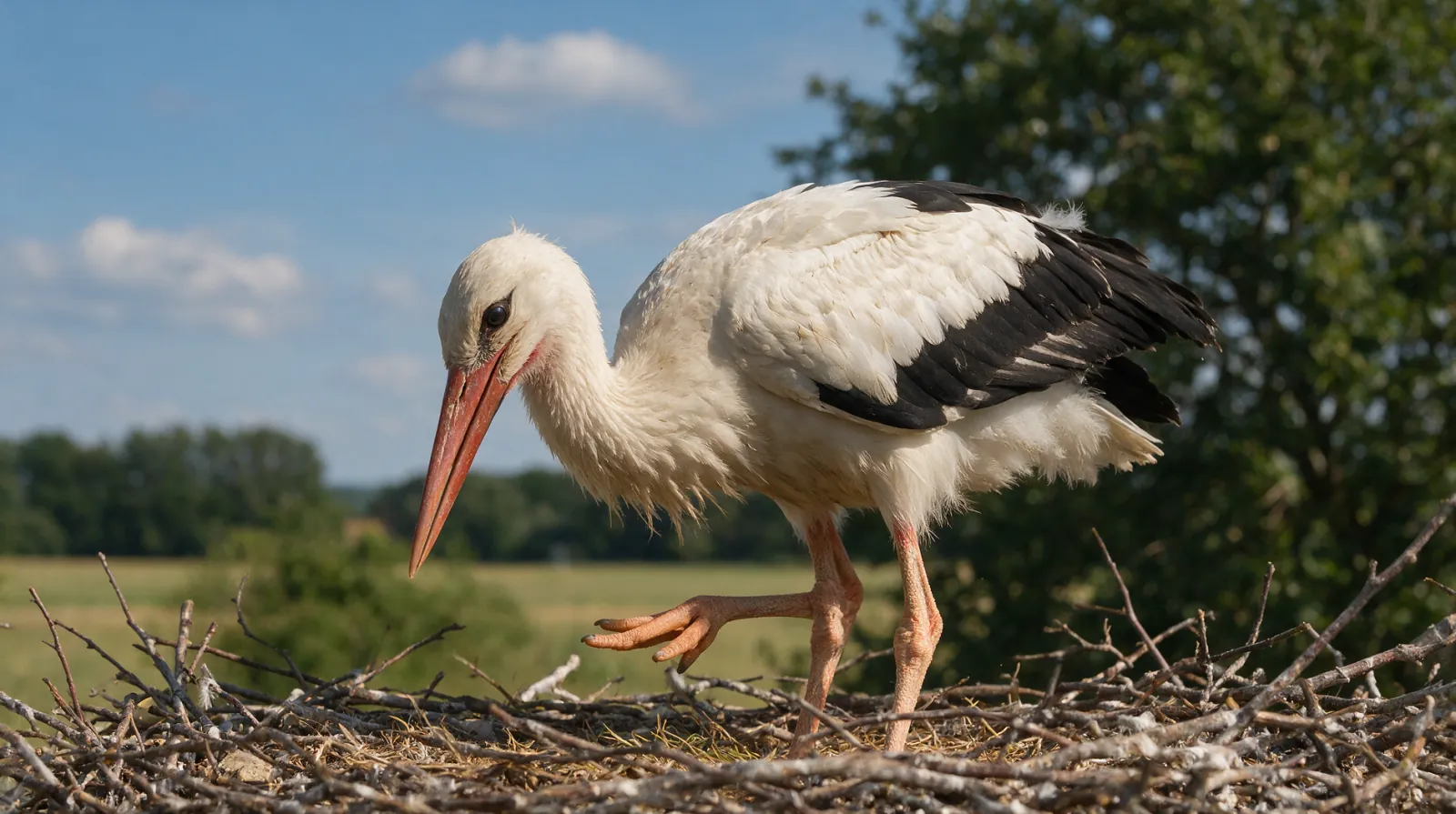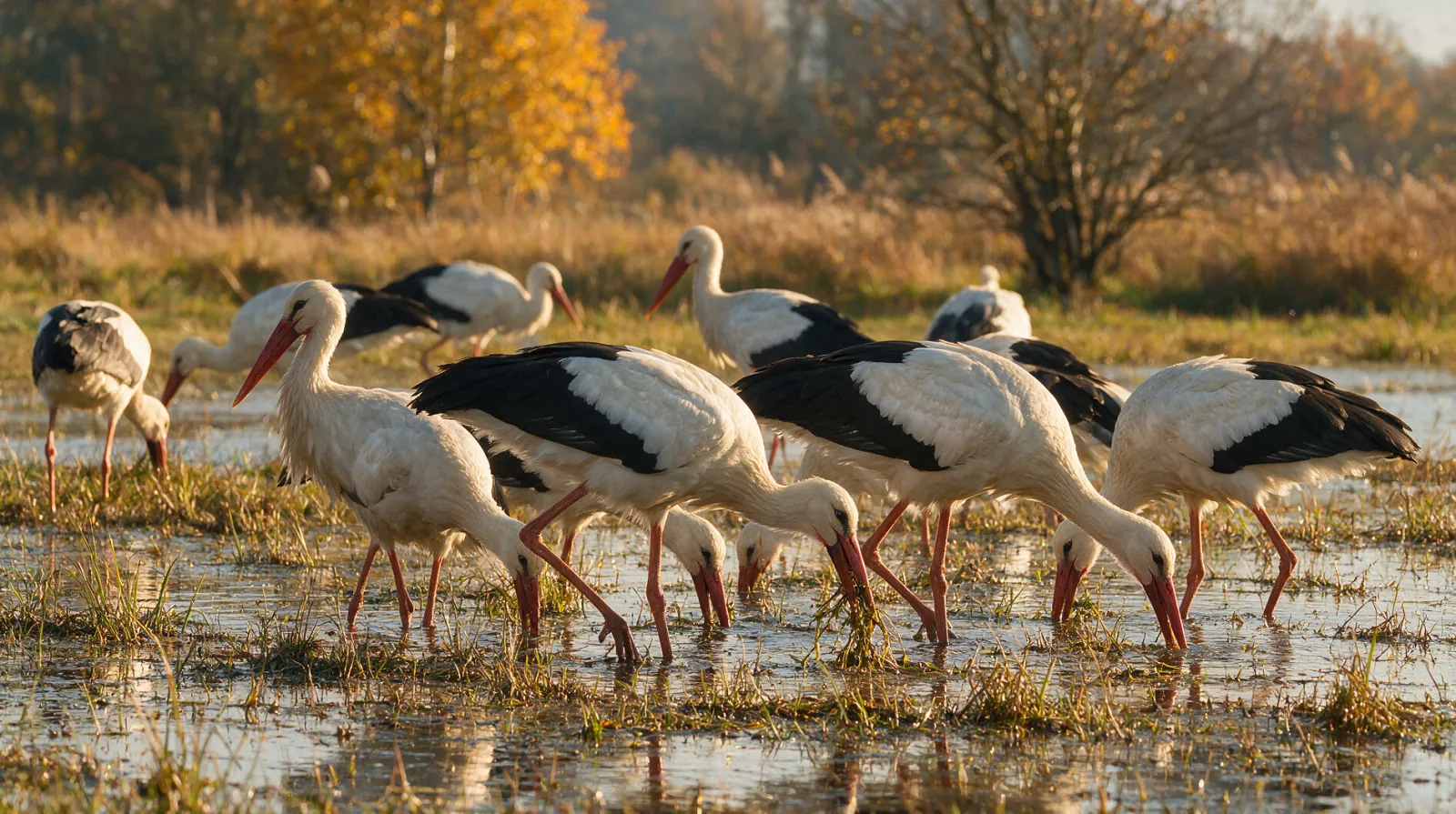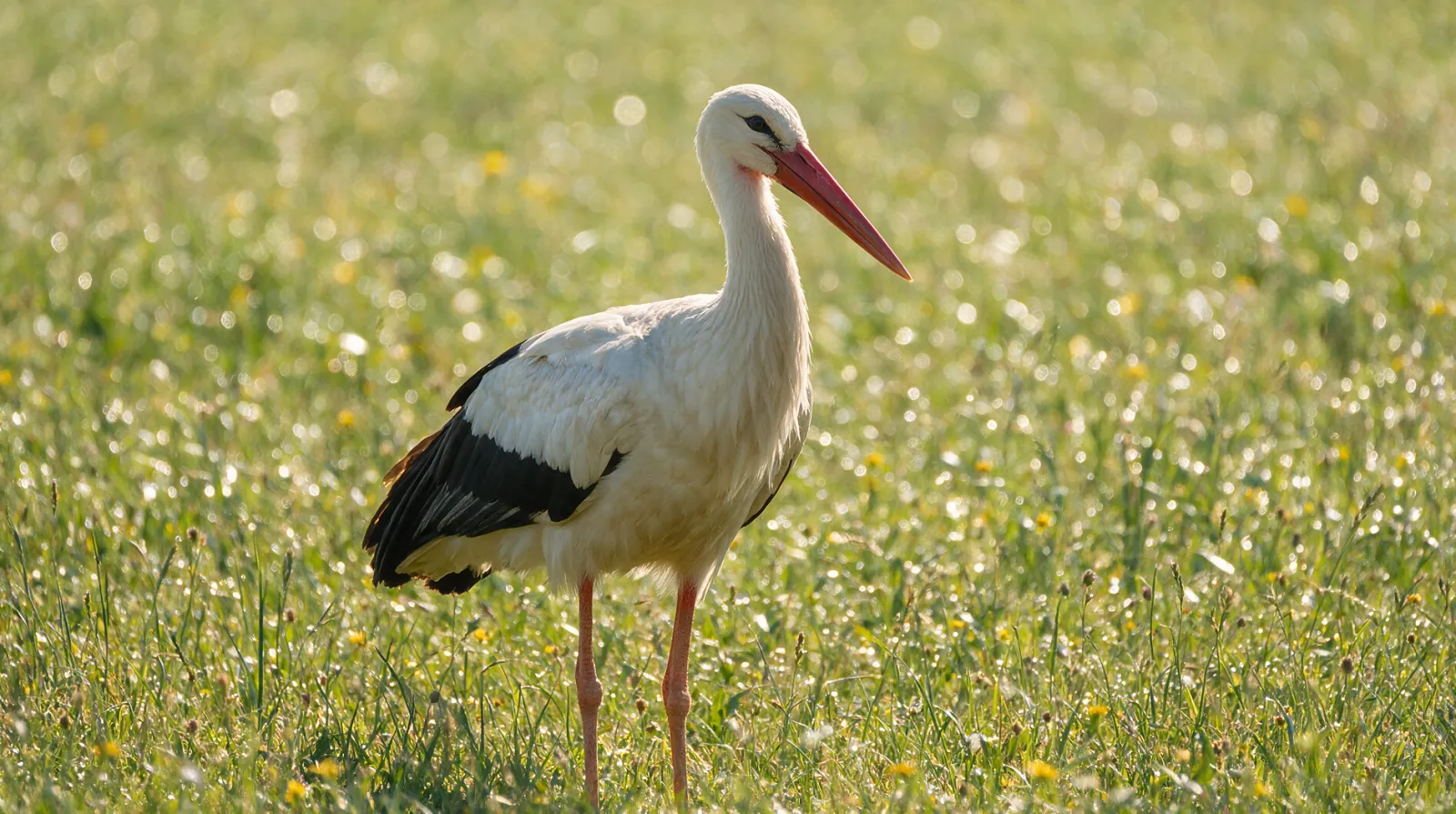
The heat of high summer settles over the fields in a shimmer, and the white storks slow down to meet it. Through July and early August the grass pales, the wet places shrink, and the air stands still. A stork in an open field looks becalmed, and much of the time it is.
Standing still is a strategy
Movement costs energy, and energy is expensive in July. A stork that stands in one place with its head high can watch a whole field without spending much. Heat rises off the bare earth and bends the air, so a bird at the far end of the meadow wavers like something seen through water. It steps once, pauses, steps again, and the pause is longer than the step.
By mid-morning the cool of the night is gone. The stork drifts toward shade, water, or the lee of a hedge, and waits for the worst of the day to pass. Shade is scarce in open farmland, and a bird will use a wall, a haystack, or the shadow of a single tree. Where there is none it endures the middle hours with its head lowered and its wings held slightly away from the body.
The young learn the same patience. The chicks are nearly grown by now, and they stand in the fields with the adults in loose, unhurried lines. They have left the nest and they are learning to wait, which is most of what summer feeding is.
How a stork sheds heat
A stork has few places to hide from the sun, so it uses its body. The white feathers reflect much of the light, and the long bare legs work as radiators, passing heat into the air and into shallow water. On a hot afternoon a stork will stand in the shallows for an hour and let the cool come up through its legs.
It may also hold its bill open and pant, the way a dog does, and spread its wings slightly so air moves across the skin. None of this looks like effort, and none of it is.
The pool pulls back
Weeks of sun take the water out of the soil. The meadow loses its green from the top down, the clay splits into plates, and the ditches stop running. Frogs bury themselves deeper into the mud, and insects come out only in the cool of the morning and the evening.
For a bird that hunts in shallow water, the dry season is a change of address. The water that remains is crowded. A shrinking pool gathers its food into a smaller and smaller circle. Everything that lives in it has to come to the edge to drink, to breathe, or to move, and the stork has learned to stand exactly there.
The technique is patience. The bird picks a stretch of bank where the water is a few centimetres deep, plants its feet, and watches. It may shift a step every few minutes and then hold again. When something moves, the bill goes down fast, and the catch is swallowed before it is properly seen. Grasshoppers and beetles are easier to catch in the heat than frogs, and the diet shifts through July as the wet places shrink.
Water also matters for drinking, though storks get much of what they need from prey. The birds at the pool are feeding and cooling their legs, settling their temperature before the next hunt.
Water for the chicks
The chicks in the nest feel the dry days more sharply than the adults. They cannot fly down to the last pool, so everything they get comes carried in a parent's bill. A frog is mostly water, and a good catch does two jobs at once. In a dry August the nest is fed on the same water the meadow is losing. The birds cannot store it, so the work simply repeats, hour after hour, until the light goes.
By the end of August the meadow may hold only one wet place, a shaded ditch or a spring that never quite stops. That corner becomes the centre of a stork's day. The bird returns to it in the morning and the evening, and other storks from nearby nests find it too. A dozen white birds can end up along a hundred metres of ditch, each one working its own stretch, and the last water is shared without much trouble.
The colony reads the farmland
A summer of storks rests on the land around the village. The birds fan out over wet meadows and damp corners, hunting frogs, insects and anything small that moves in the shallows. A stork covers a lot of ground in a day, and a good summer means the ground can feed every beak in the colony.
That depends on how the land is kept. Wet meadows, ditches and unsprayed edges hold the food, and fields drained and sprayed hold very little. The colony is a reading of the farmland around it. The birds also follow the mowers and the cattle, taking what the grass is holding.
The sky above the village rarely empties. There is always a parent crossing with food, a young bird practising a turn, a pair circling up on a thermal until they are specks. People get used to the shadows passing over the lane. On still evenings the sound of the colony carries further than the birds themselves.
By July the nests are crowded and noisy. The chicks that hatched in May are lanky, hungry young birds, and a row of roofs turns into a street of households all raising children at once. The change happens fast: two birds on the roof in April, five by June, and by July the five are as large as their parents and louder.
The season thins
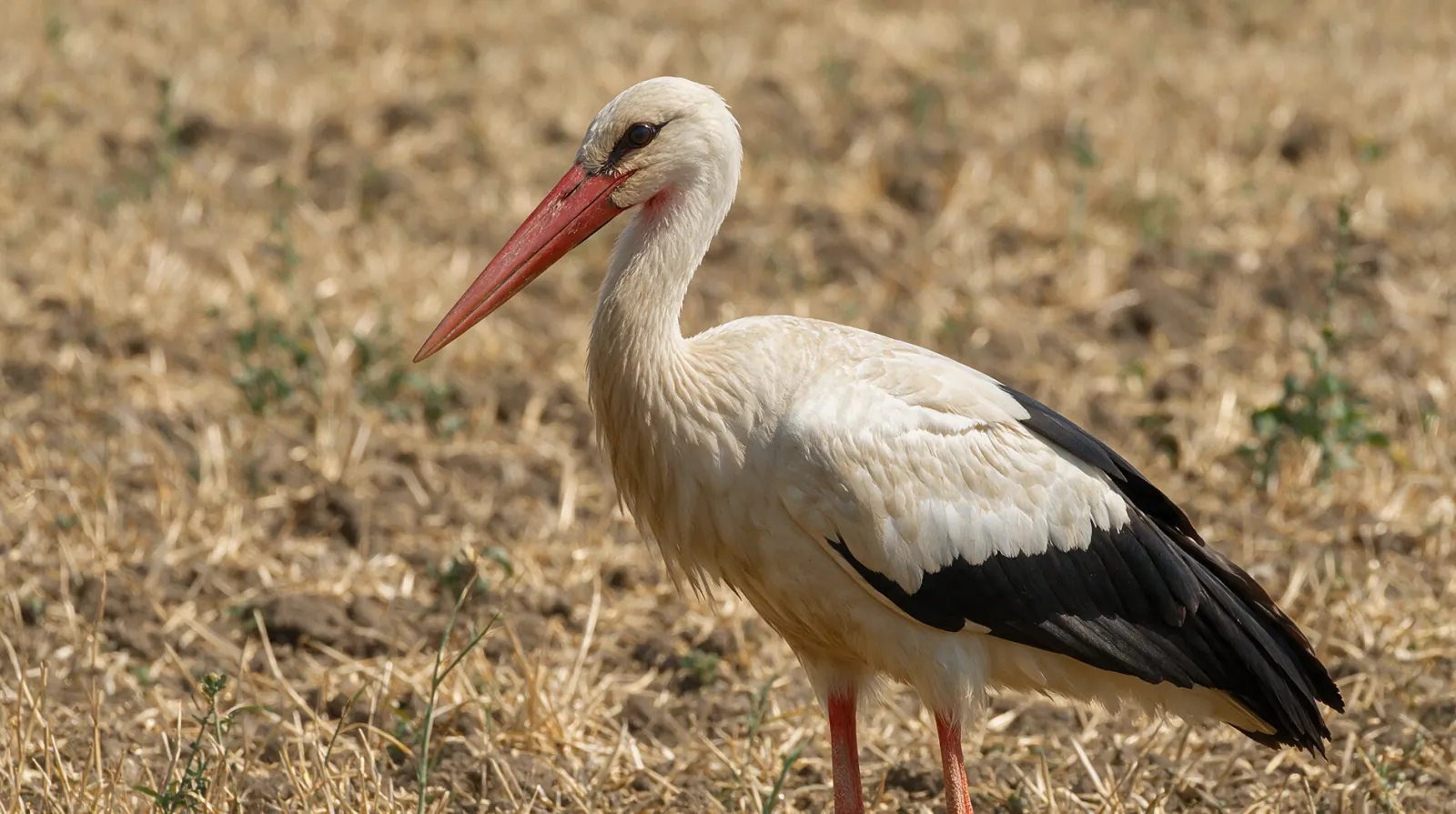
By late August the colony begins to change. The young birds fly further and come back less, and the noise on the roofs spreads out and softens. The adults keep their own pace, feeding on the drying fields and putting back some of the weight the summer took. Migration is still weeks away, but the direction is already in the birds. Evenings come earlier, and the field that was loud with begging in June is quieter at dusk.
The break in the weather
A storm builds over the fields for a day and then lets go. Rain hammers the cracked clay, the ditches fill, and by the next morning the meadow smells of wet earth. The pools spread out again, and the frogs come up.
The stork does not celebrate. It walks out into the softened ground and feeds, and the nest goes back to its ordinary rhythm. The urgent work of June is over, migration is still weeks away, and high summer is the pause between two hard seasons. Around the village the fields are emptier at midday than at any other time of year, and the birds have them mostly to themselves. The dry weeks will come again next year, and the bird will find the last water then, as it always does. A field that was white with cracked clay in August is soft underfoot by the first week of September.
Explore the gift