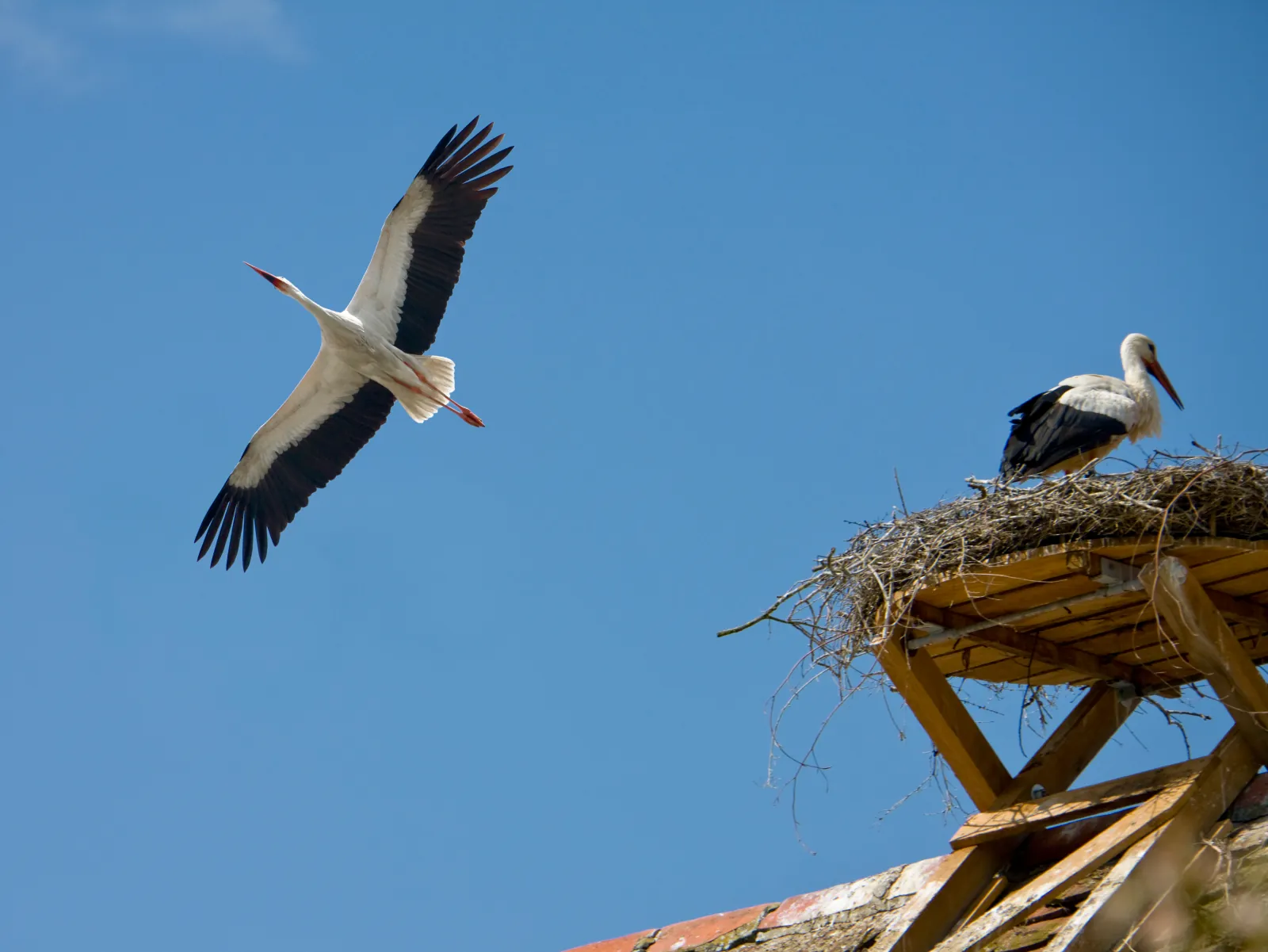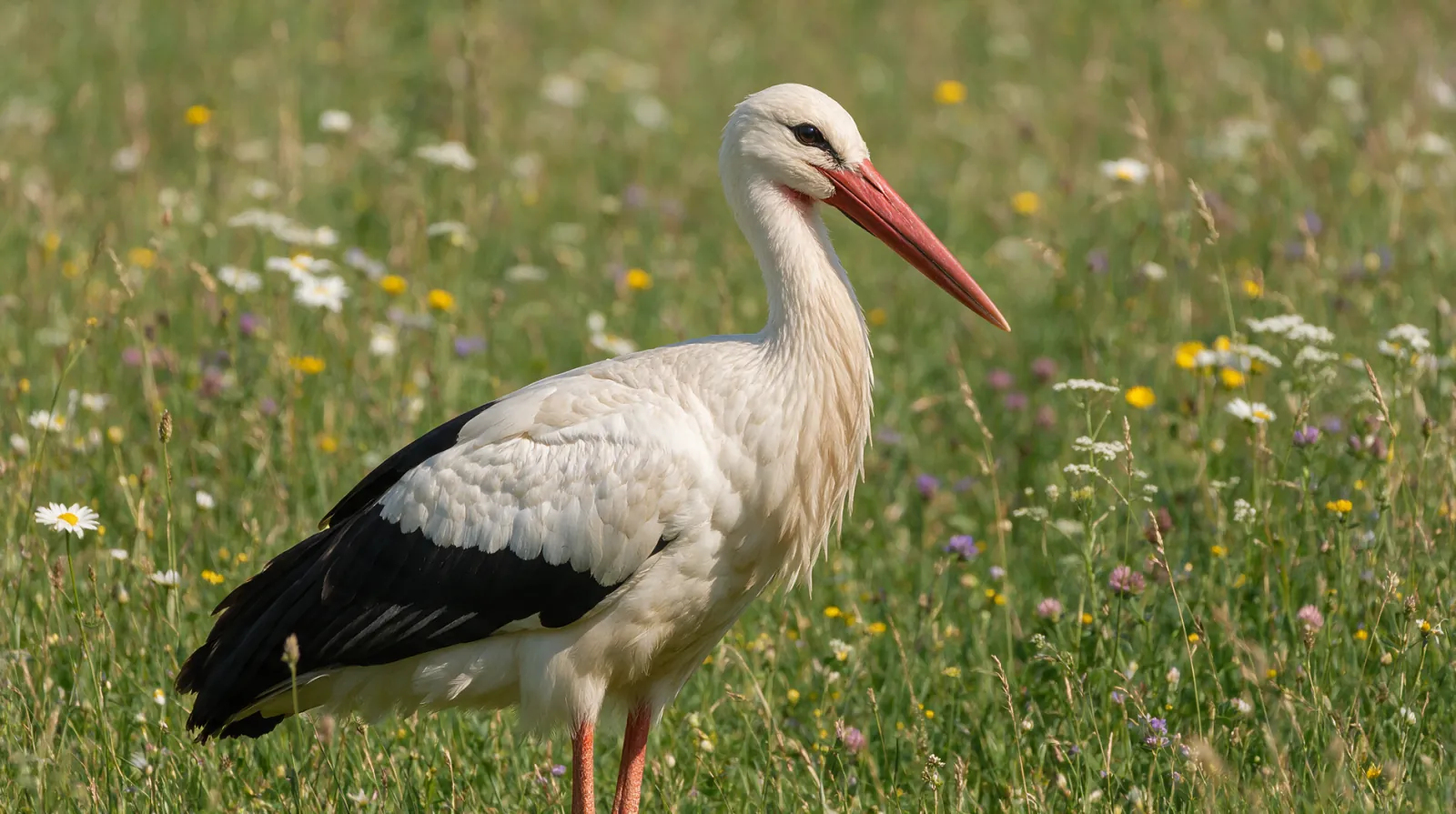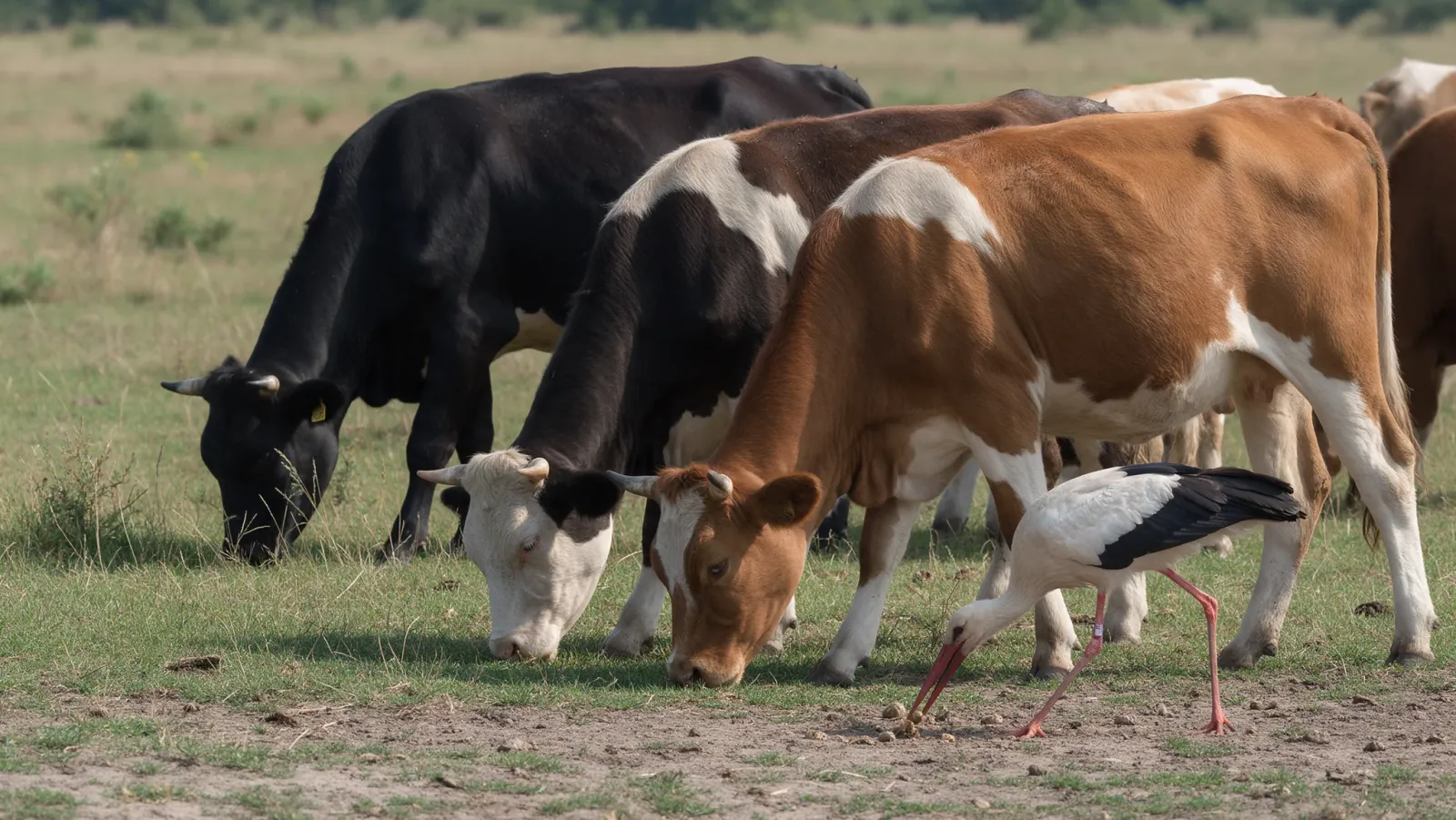
A herd of cattle in a wet meadow does work that a mower cannot. Hooves press the grass down, break the crust of the soil and leave hollows that fill with water. Grazing keeps the sward short enough for a stork to see into, and the animals leave behind dung, flies and disturbed ground. A white stork walking behind a herd is using centuries of shared history.
Hooves and hollows
A cow is heavy, and wet ground records every step. The prints fill with rain and become small pools that hold water after the rest of the field has dried. Those pools are where tadpoles and insect larvae survive a dry spell. A grazed meadow holds more small waters than an ungrazed one, and each of them is a nursery. On soft ground in a wet spring, a herd can turn a corner of a field into a chain of shallow pools in a week.
The short sward
A stork hunts by sight as much as by touch, and long grass hides prey. Grazing keeps the grass short, which makes frogs and insects easier to see and easier to catch. It also lets the bird land and take off without tangling in stems. The short sward is the stork's hunting floor, and it exists because something else is eating the grass. Where grazing stops, the meadow grows tall in a season and the storks move to the next village.
Dung and the insects around it
Flies and beetles arrive within hours of a fresh pat, and the insects in turn draw frogs and birds. A stork will pick through it for beetles and larvae, and it will take the flies that rise from it. The dung also feeds the soil, which feeds the grass, which feeds everything above. A herd is a slow spreader of food across a meadow, and the stork follows the spread. This is why the bird is often seen near cattle rather than at a distance from them.
The right amount of grazing
The balance matters. Too few animals and the meadow grows up. Too many and the ground is poached into mud, the nests are trampled and the insects lose their cover. Traditional wet meadows were usually grazed lightly in late summer or cut for hay and grazed afterward, which left the spring growth for nesting birds. Light grazing after the breeding season is the pattern that suits storks best. Heavy year-round stocking is a different thing, and it shows in the number of birds.
When the herd leaves, the change is slow and then sudden. The grass grows, the scrub comes in, the wet hollows fill with silt and the frogs lose their pools. Within a few years the meadow is a thicket, and the stork has nowhere to walk. The bird is a follower of grazing animals, and it disappears when they go. A village that keeps its storks usually keeps a herd too, or a mower, or both.
Buffalo wallows
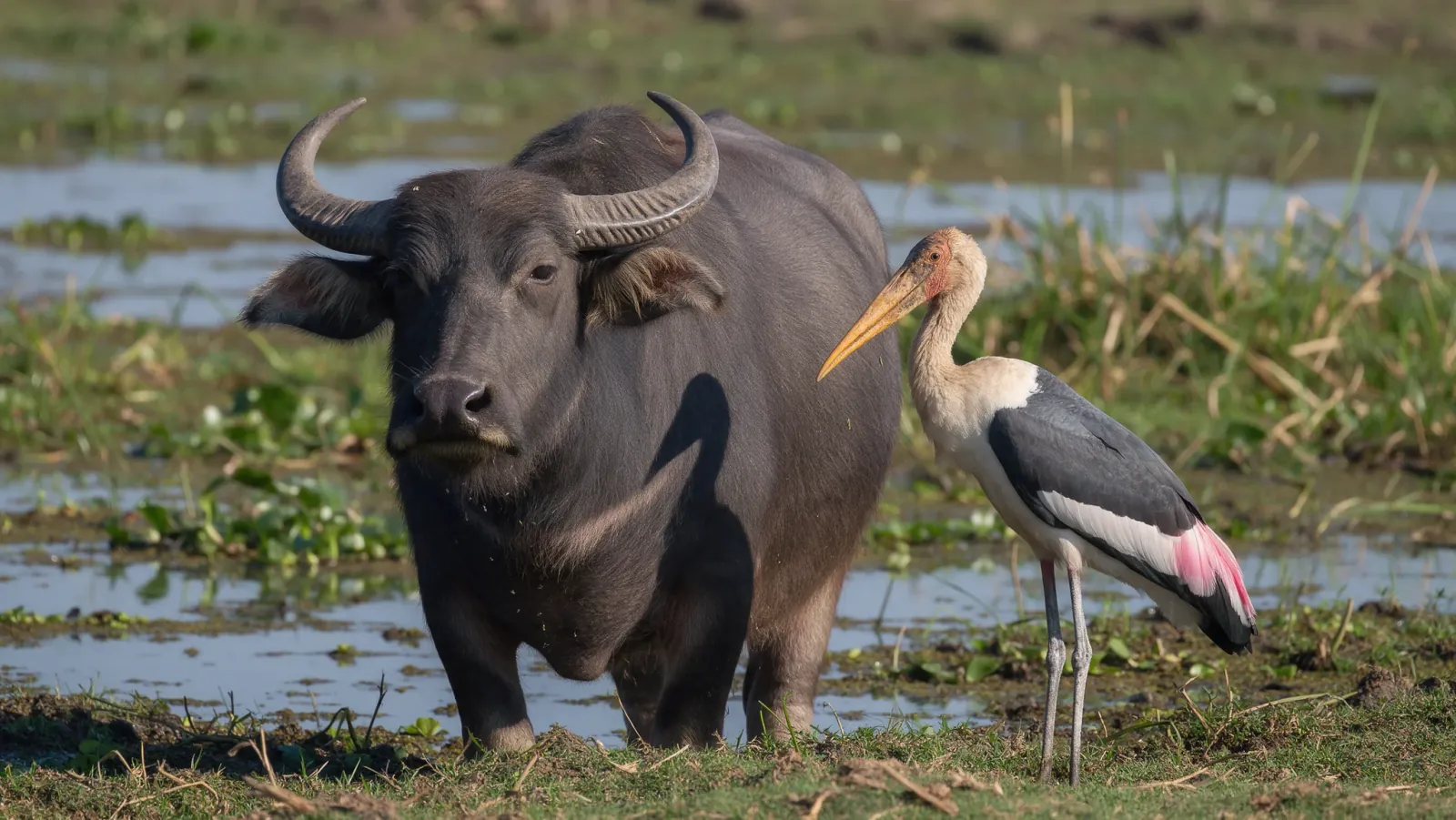
A water buffalo standing in a marsh changes the water around it. Its hooves break the surface, its body presses down the reeds and its wallowing hollows out a pool. A buffalo wallows to cool down and to escape flies. It rolls in soft mud, enlarges a hollow and keeps it wet through the summer. That hollow becomes a small pool used by frogs, insects and birds. A herd of wallowing animals creates a chain of open water in a marsh that would otherwise close over.
A buffalo is heavy, and wet ground takes the imprint. Each step makes a depression that fills with water and holds it after rain. The edges of the prints are broken and soft, which gives insects somewhere to shelter and wading birds somewhere to probe. The ground under a herd is never smooth, and that roughness is a habitat. A mown field is even and dry by comparison.
A mower cuts grass evenly and leaves the ground firm. A buffalo grazes unevenly, tramples, wallows and manures, and it does all of it while moving. The result is a patchwork of short grass, bare mud and open water that a machine cannot imitate. The stork needs that patchwork more than it needs any single feature, because each patch holds a different kind of prey.
A few European deltas and reserves keep water buffalo as part of marsh management. The animals are hardy, they cope with wet ground and they do work that machines cannot: they poach the surface, spread seeds and create pools. Using a large grazer to manage a wetland borrows an old ecological process, and it often produces better results than mowing. The trade-off is that buffalo need space, fencing and care, and not every marsh can carry them.
Restoration begins with a ditch
A drained marsh can be brought back, and the work usually begins with a shovel and a ditch. Most drained wetlands were dried on purpose. Ditches carried the water away, and the land was converted to grass or crops. Restoration reverses the plumbing: ditches are blocked, culverts are removed and the water is allowed to stand again. The first task is always hydrological, and it is usually cheap. Without that step, planting and nest boxes achieve very little.
The order of return
Water returns to bare mud, and the mud responds quickly. Algae cloud the shallow water, then pondweeds and rushes appear from seeds that have waited in the soil for decades. The seeds are a buried record of what grew there before the drainage, and many of them are still alive. A restored marsh often grows plants nobody planted, because the old seed bank was never destroyed.
Frogs, toads and newts move over land at night, and they find new water by smell and moisture. If there is a population within a kilometre or two, they will arrive, sometimes within a year. Dragonflies and water beetles fly in and lay eggs. Birds arrive in the order their food allows. Ducks and moorhens come first, then waders that feed on the muddy edges, then herons and egrets. Storks come later, when the water holds enough frogs and fish to feed a nest. A stork on a restored marsh means the whole food chain is working, from the water up.
Reed beds and wet woodland take years to establish, and the soil chemistry changes slowly after drainage. Peat that has dried and oxidized will not return to its old state in a human lifetime. Some parts of a wetland can be restored quickly and others cannot be restored at all. A restoration is judged by where the water sits in March, not by what has been planted. The birds will make their own judgement, and they are harder to persuade than a funder.
A restored wetland needs management once the water is back. Reeds need cutting on a rotation, meadows need grazing or mowing, and trees need controlling if the site is to stay open. Without that work the marsh scrubs over and the birds leave again. A marsh that is left alone after rewetting will scrub over within a few years, and the open water will close.
Explore the gift