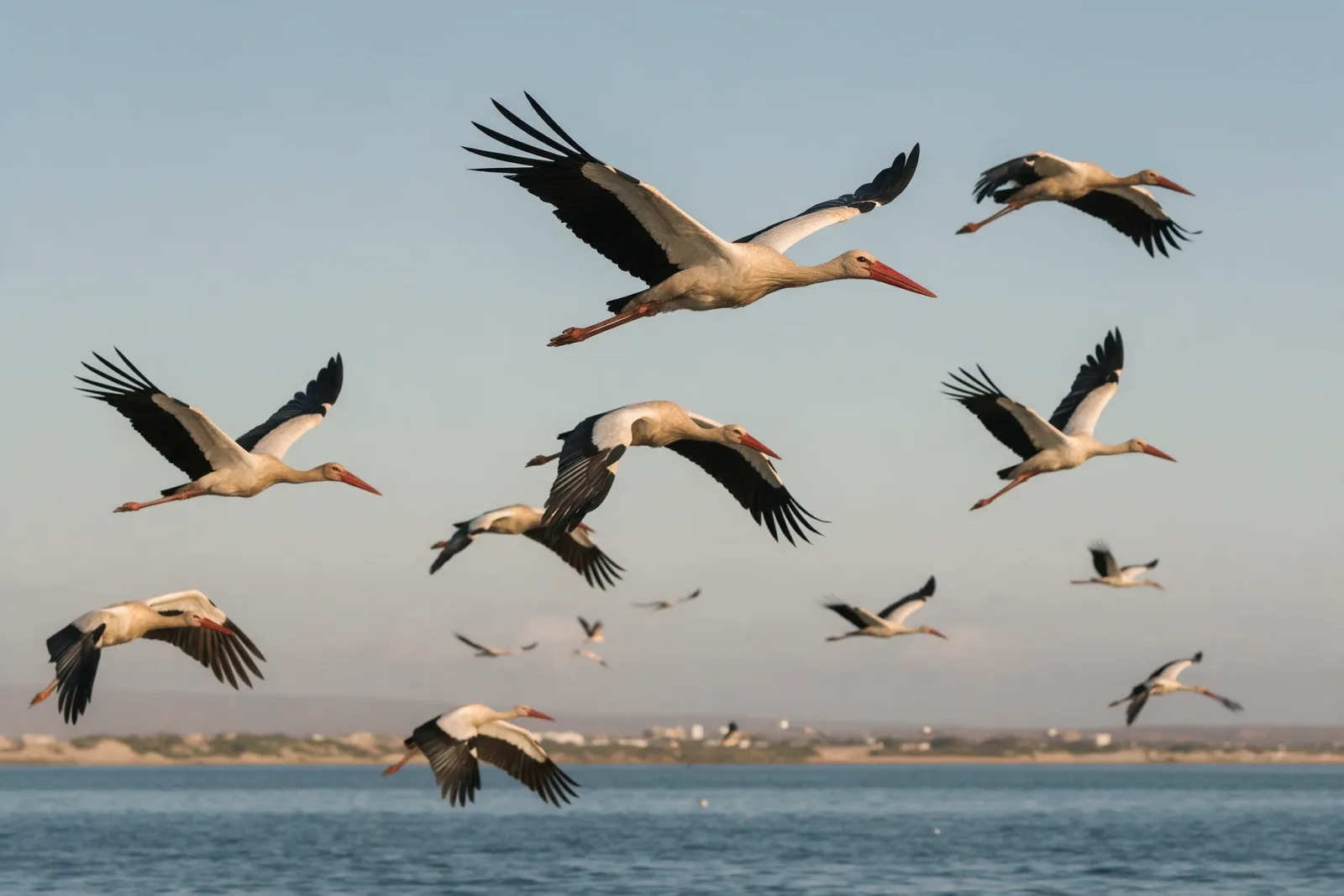
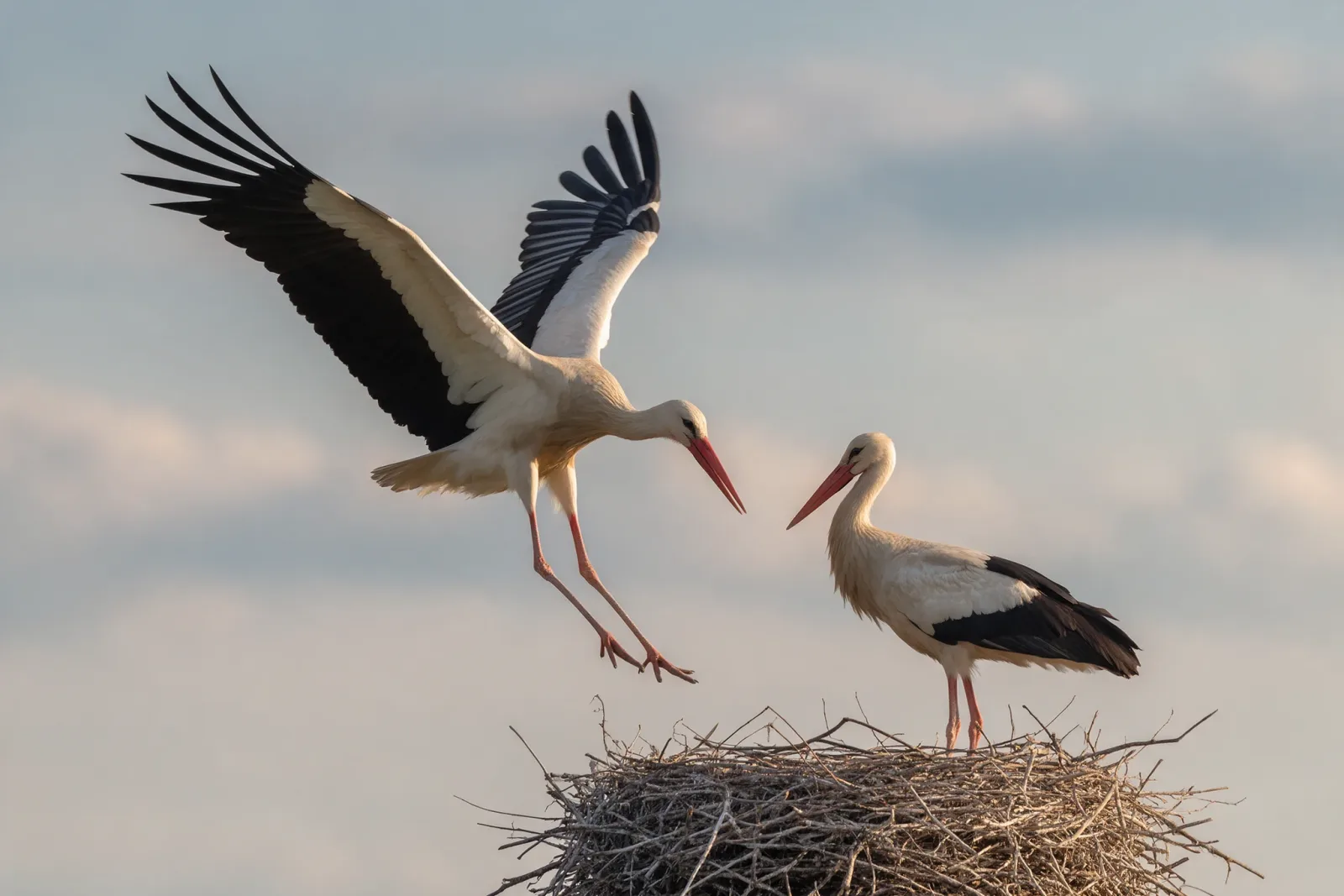
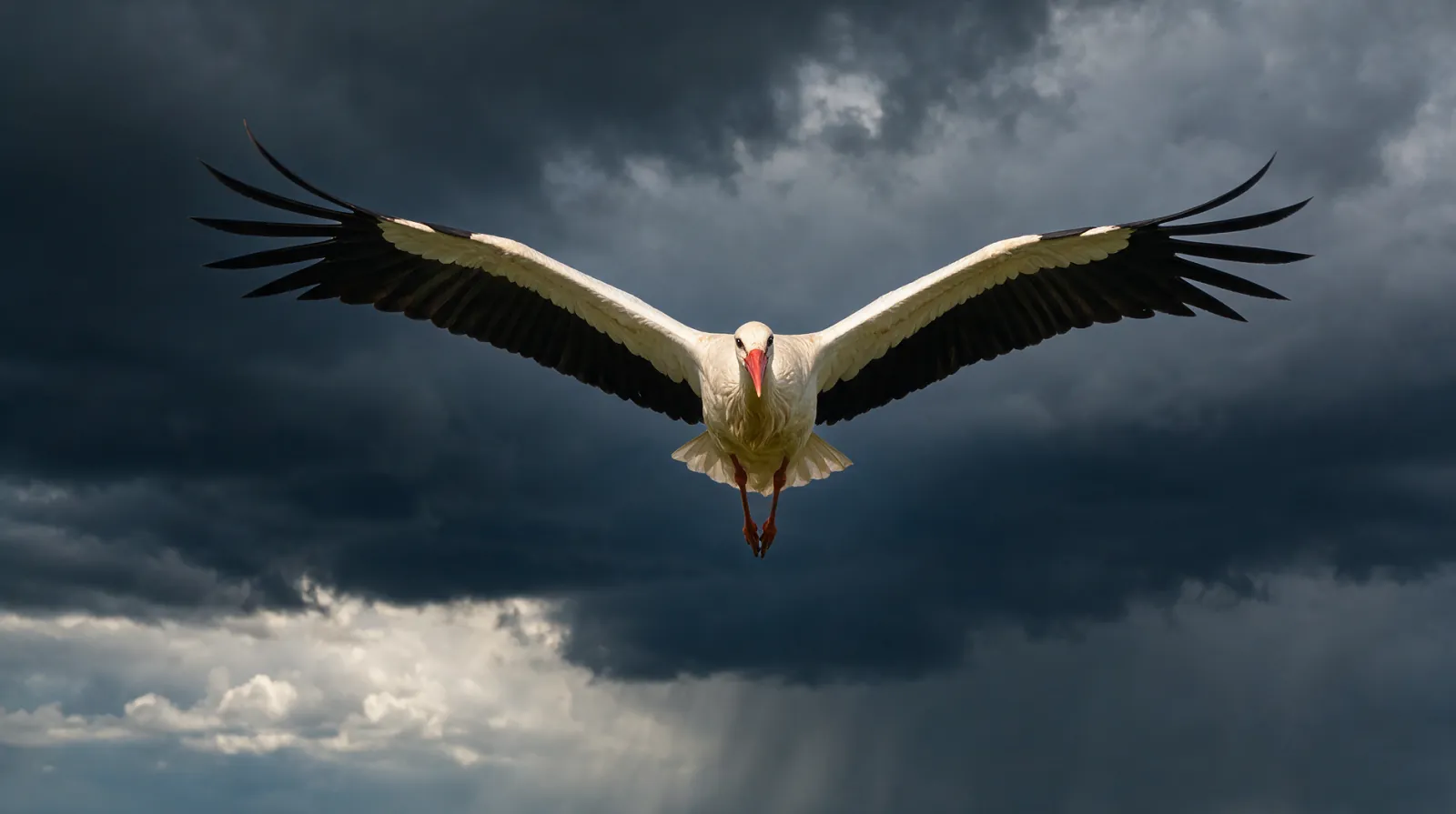
A white stork can cross a continent without much trouble and then hesitate for days at a strip of water a few kilometres wide. A soaring bird cannot soar over cold sea, so the migration is squeezed into the few places where the water is short enough to cross. The wait at the shore is part of the route.
Why the sea closes the map
Land warms in the sun and sends up columns of rising air. Water warms slowly and keeps its cool, so the air above it stays steady. A stork that flies out over open water loses the free lift it depends on and must beat its wings the whole way. With a body of several kilos and a two metre wingspan, that is a costly crossing. The sea offers no field, no tree and no shallow edge to stand in if the wind turns.
A stork can land on water in an emergency, but it cannot feed there or rest for long, and a soaked bird is heavy and cold. The birds avoid open water wherever the coastline gives them another choice. A coastline also gives them a line to travel along, with land on one side for lift and landing. Where the coast turns and the water narrows, they cross.
A stork will fly many extra miles to avoid a stretch of open water. The route looks indirect on a map and makes complete sense from the air. A stork's journey is drawn by the shape of the land, and the sea is simply the edge it will not cross.
Two doors and a long detour
The birds of western Europe gather near the Strait of Gibraltar, where Spain almost touches Morocco. The birds of the east funnel toward the Bosphorus, then travel down through Turkey and the Levant toward the short crossings at the eastern end of the Mediterranean. Between these doors lies a great deal of land, and the storks spread across it for most of the journey. Only at the water do separate flocks become one crowd.
The detours add distance. Western birds fly south through Spain rather than straight across the sea, and eastern birds swing through the Balkans and Turkey. The extra miles are paid for with free lift over warm land, which makes them cheaper than they look on a map. The shortest line and the safest line are rarely the same.
The two doors gather different birds. A stork from the Netherlands and a stork from Romania may never share a thermal, yet both will pass through a gap a few kilometres wide. Each crowd is drawn from a different half of Europe, and the two crowds meet again only in Africa.
The gathering on the shore
Before the crossing the birds feed in the fields near the coast and roost in the trees behind it. Their numbers grow day by day as new flocks arrive from the north. The waiting is unhurried. Storks stand in the stubble, hunt frogs in the ditches, and watch the sky. Local people notice them, and so do the birds' own kind: a flock circling over the shore pulls in others from miles away.
The gathering has its own use. A bird that arrives thin has time to feed, and a bird that arrives late finds company for the crossing. The crowd grows while the wind blows, and a day of rain is a day of rest. What looks like delay is the migration saving its strength for the one stretch where strength matters most.
A field that holds a hundred storks in the afternoon can be empty by the next morning if the wind turns. The people who watched them wonder where they went. The birds did not announce the crossing. They simply left on the first morning that offered height and a following wind.
The crossing itself
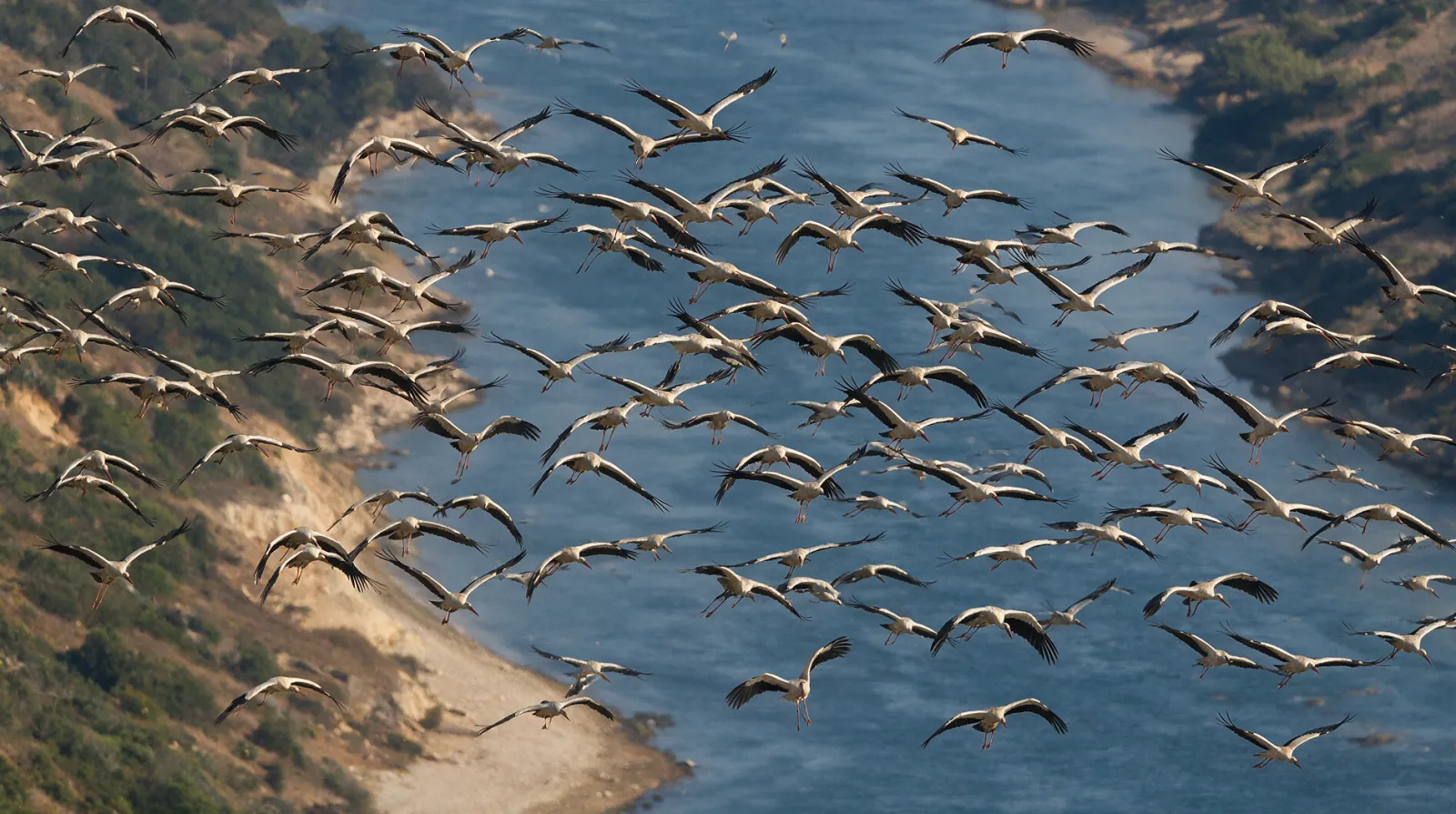
On a good morning the birds leave the land in a long stream. There is no lift over the water, so this is flapping flight, steady and level, pointed at the far shore. The narrowest crossings are short enough to manage in one push. A young stork on its first crossing has never seen the sea, and it follows the older birds in a long loose line, trusting the direction they take.
The flight is low and level, and the birds save their strength for the far shore. There is no circling over water, because there is nothing to circle in. A bird that tried to climb would find only steady air, and the effort would cost it the reserves it needs for land.
The crossing is short in distance and long in risk. A bird that starts too late, or meets a storm halfway, has no field to put down in. On the far side the flock spreads out again, and the crowd that gathered for days comes apart within an hour. Some birds drink and preen. Some simply stand. Then they rise on the first warm air over Africa and keep going south.
For the people watching below, the day is a marker in the year. The summer birds are gone, the sky is empty, and somewhere over the narrow sea a long line of wings is moving south.
When the weather closes the door
Not every day offers a crossing. A strong headwind over the strait, low cloud or rain can keep the birds on the shore for hours or days. The flock grows restless and then patient again. Storks feel the pressure change and hold. Then a quiet morning comes, the wind drops, and the crossing begins.
The pause concentrates the crossing. The clear air behind a passing front can send a larger crowd over the water than an ordinary day would. Every bird held on the shore leaves at once. The waiting is part of the funnel too: it is what turns scattered arrivals into a single crowd.
The stragglers pay for the lesson. A young stork caught out by a storm may turn back and wait, or push on and be blown wide of the crossing. The ones that survive learn to read the sky, and the following year they gather early.
The cost of a bottleneck
Concentrating the whole migration into a few places makes the journey possible, and it also makes the birds vulnerable. A storm on the wrong day can hold thousands at the shore. A change to the land at one of these crossings affects far more storks than the same change somewhere in the middle of a continent. The funnel is efficient and fragile at once, and the birds have no alternative but to use it.
People have watched these passages for centuries, and the same narrow places carry the same crowds. A strait that is a landmark for ships is a doorway for birds, and the two uses sit side by side without either noticing the other.
A change at one of these crossings reaches further than the same change in open country. The birds have gathered from a whole half of a continent, and a lost field on the shore is a lost field for all of them. The funnel is a place where a small decision has a wide effect.
You can see the same logic on any coastline. Storks keep to land even when the detour is long, because the sea is the one edge they will not cross. By the time the last birds lift off, the fields behind them are empty, and the water is crossed again.
Explore the gift