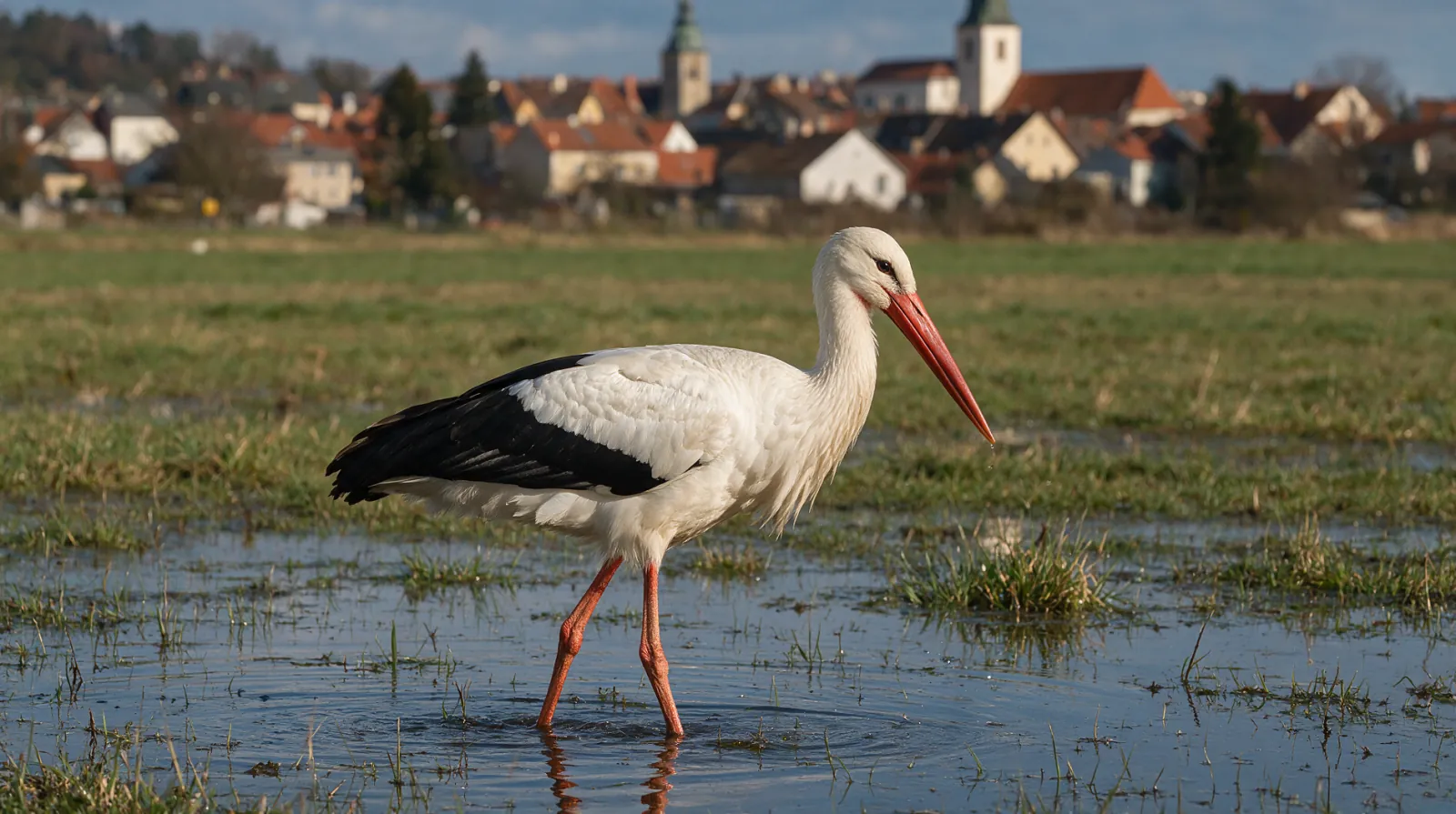
Shallow water is the part of a marsh that changes fastest. A spring flood connects ditches to the grass, small fish move out to feed, and by July some of those pools are gone. A white stork learns the sequence and visits each pool as it begins to fail.
Fish in the flooded grass
Small species and the young of larger ones use shallow water because the food is there and the predators are fewer. Minnows, sticklebacks, rudd and young carp all turn up in flooded grass. They feed on insects, larvae and each other, and they grow fast in the warm water. A shallow pool in June can be thick with small fish that were not there in April. The stork does not need to understand the cycle. It needs to walk the edge.
The shrinking pool
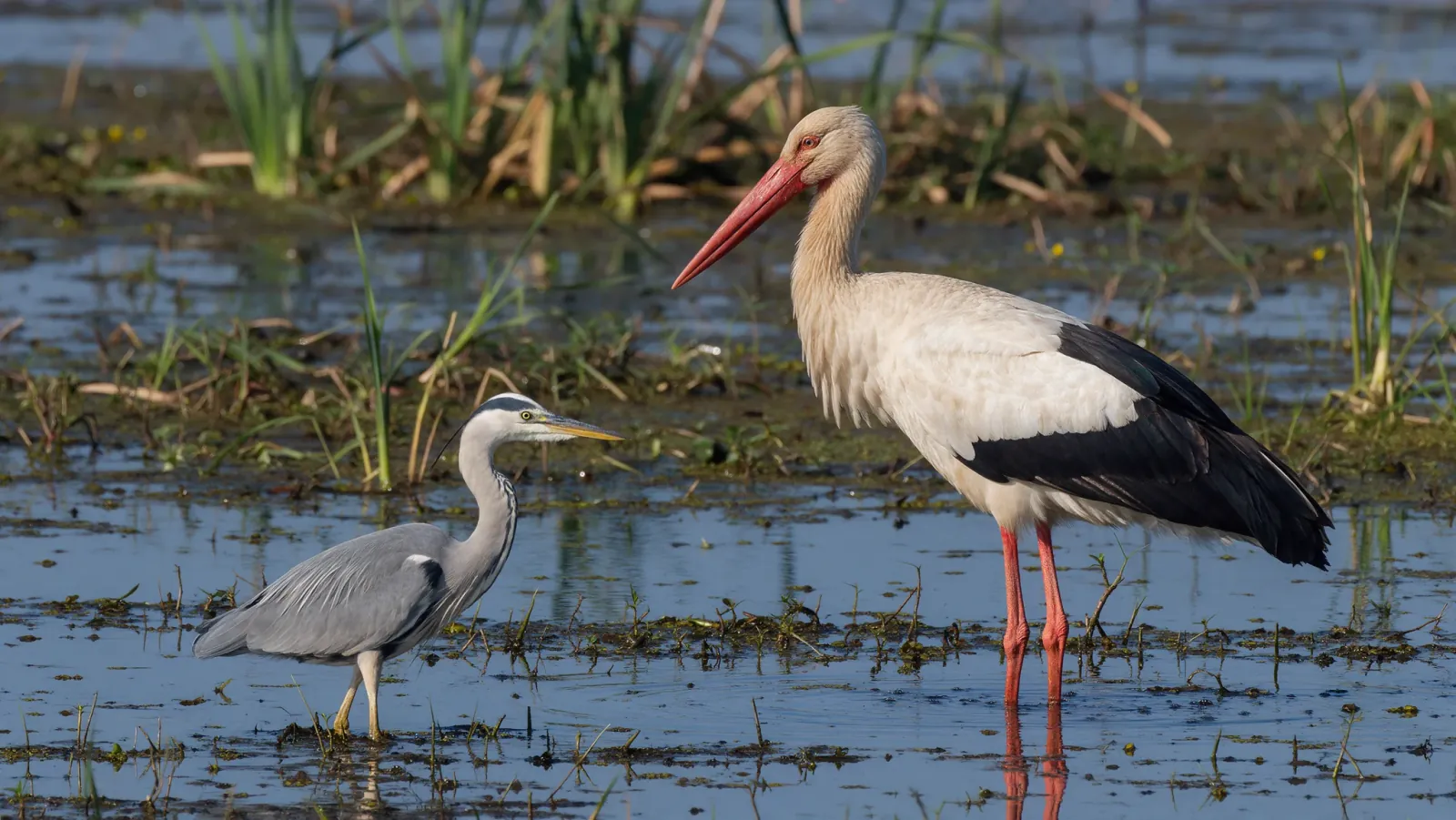
As the pool dries, the fish are pushed into less water and become easier to catch. A stork standing at the margin can strike at fish that have nowhere to go, and a heron will do the same from the other side. The last few days of a pool are a feast for every bird in the area. The bird returns to a pool it remembers, day after day, until the water is gone.
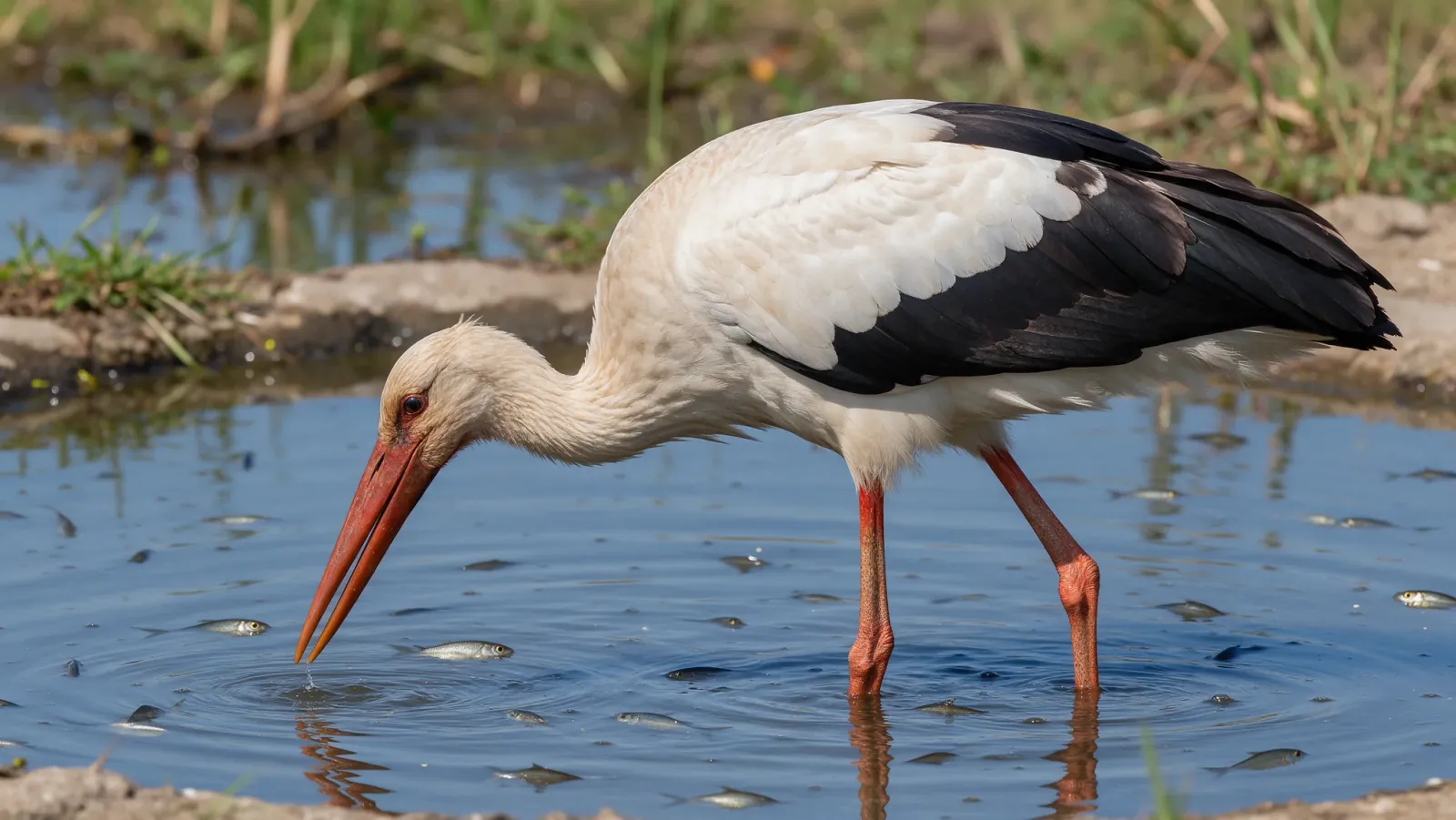
A stork reads a pool by watching the surface. A rise, a flash of silver, a line of ripples with no wind behind it: all of these mean fish. The bird also watches the margins, where fish crowd when the water is low. It walks slowly, stops, tilts its head, and strikes. The strike is aimed at a point the eye has already fixed, which is why a stork can take a fish from cloudy water as long as the pool is shallow.
The drying of a pool is a short, violent increase in food. Fish, tadpoles and insects are all concentrated. Birds that find it feed heavily for a few days, then move to the next one. A stork that knows the sequence can raise chicks through a drought, as long as some pools hold water long enough.
Eels in the mud
A stork hunting the shallows sometimes finds an eel at the edge of a marsh. An eel spends its days buried or half buried in soft mud, with only a ripple to show where it lies. It comes out at night to feed on worms and small fish. In daylight it holds still, which makes it hard to see. The bill probes the mud, and the bird catches eels as much by touch as by sight. When it finds one, the fight is short and violent, because an eel is strong, slippery and determined to get back into the silt.
A stork avoids deep water. It walks the edges, where the depth is measured in centimetres and the bottom is soft, and it steps slowly with its head down. These margins also hold frogs, small fish and insect larvae, so one pass along a bank can produce several kinds of food. Eels favour the same places because the mud is deep enough to hide in and the water is quiet.
A ditch is easy to overlook. It is a few metres wide, often straight, often shaded, and it looks like nothing much. In a wet meadow it is the deepest water for a hundred metres in any direction, and it holds fish, eels and amphibians through the dry months. When a marsh loses its ditches it loses the part of the larder that survives July. Clean banks and open water keep that store alive.
Eels are born far out in the ocean and travel up rivers as tiny, transparent young. They spend years in fresh water before returning to sea to spawn. That life depends on free passage. A weir, a pump or a dried channel can block the journey, and a river cut off from its marshes loses its eels one obstacle at a time.
Fat for the flight
Migration is expensive. A stork crossing the Sahara burns a great deal of energy, and the reserves it carries are built in the weeks before departure. Oily fish add weight quickly, and an eel is one of the richest meals in the marsh. A bird that feeds well on the water's edge leaves in better condition than one that lives on grasshoppers. This is why autumn feeding matters, and why the draining of a ditch full of eels is a real loss to a stork.
An eel does not come out of the water quietly. It coils, twists and slips, and a stork has to work it into a position where it can be swallowed. The bird often walks to the bank first, where it can control the fish against solid ground. Small eels go down head first and quickly. Large ones take longer, and a stork may lose one to a sudden twist.
Pools with a calendar
A seasonal pool fills in autumn or winter, holds water through spring, and dries in summer. For part of the year it is a shallow pond. For the rest it is a depression of cracked mud and dry plants. The animals that live in it have evolved around that rhythm, and the dry phase is as important as the wet one. The uncertainty is the point, and the species that use it are the ones that can cope with it.
Fish cannot survive a pool that dries, and their absence is a gift to everything else. Tadpoles, insect larvae and small crustaceans flourish in fishless water. A frog that breeds in a pool without fish has a far better chance of its tadpoles surviving. The dry phase is a defence against fish, and it costs the pool nothing it cannot recover from.
Eggs that wait
Many seasonal pool animals survive the dry phase as resting eggs. Daphnia, fairy shrimps, rotifers and some insects produce eggs that can survive desiccation for years and hatch when water returns. The eggs sit in the mud, protected from heat and frost, and the pool comes back to life within days of filling. The mud is a seed bank of animals, and it means a dried pool is never truly empty.
In summer the mud cracks, the plants set seed, and the pool looks dead. Buried eggs, seeds and dormant larvae are waiting, and the cracked surface lets air into the soil. Some plants need the drawdown to germinate, and some insects need the dry mud to complete their cycle. A pool that is kept full all year loses the species that need it to empty. Topping up a seasonal pool can do more harm than good.
The ditch in winter
When the pools are gone, the ditches remain. Deeper water holds fish through the winter, and the stork's hunting shifts to the banks of streams and ditches. A ditch that is dredged clean loses the fish and the cover they need. One left with soft banks and some vegetation keeps a population that can repopulate the meadows next spring. The pool is the feast and the ditch is the store cupboard. A marsh needs both, and the stork uses both in turn.
Explore the gift