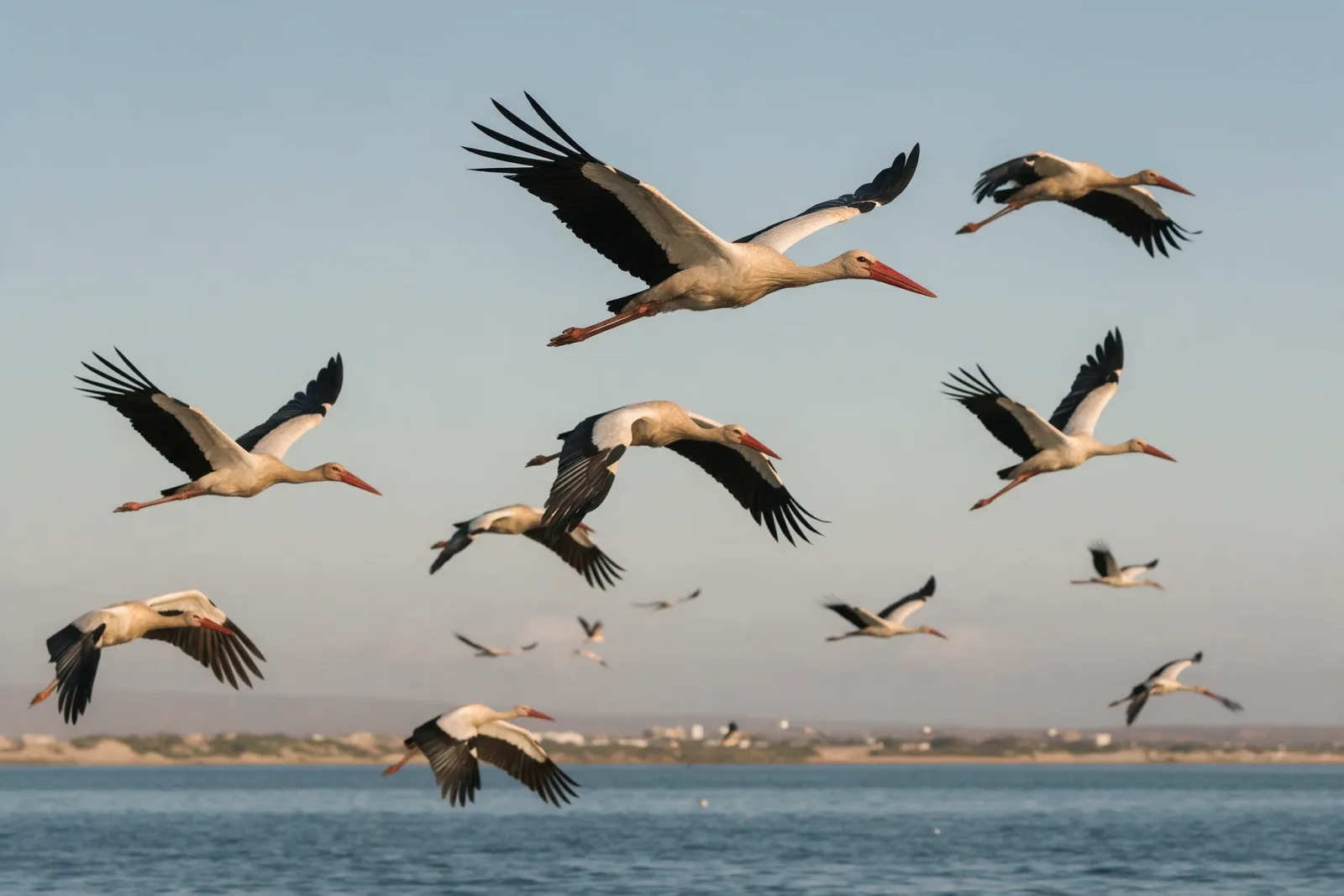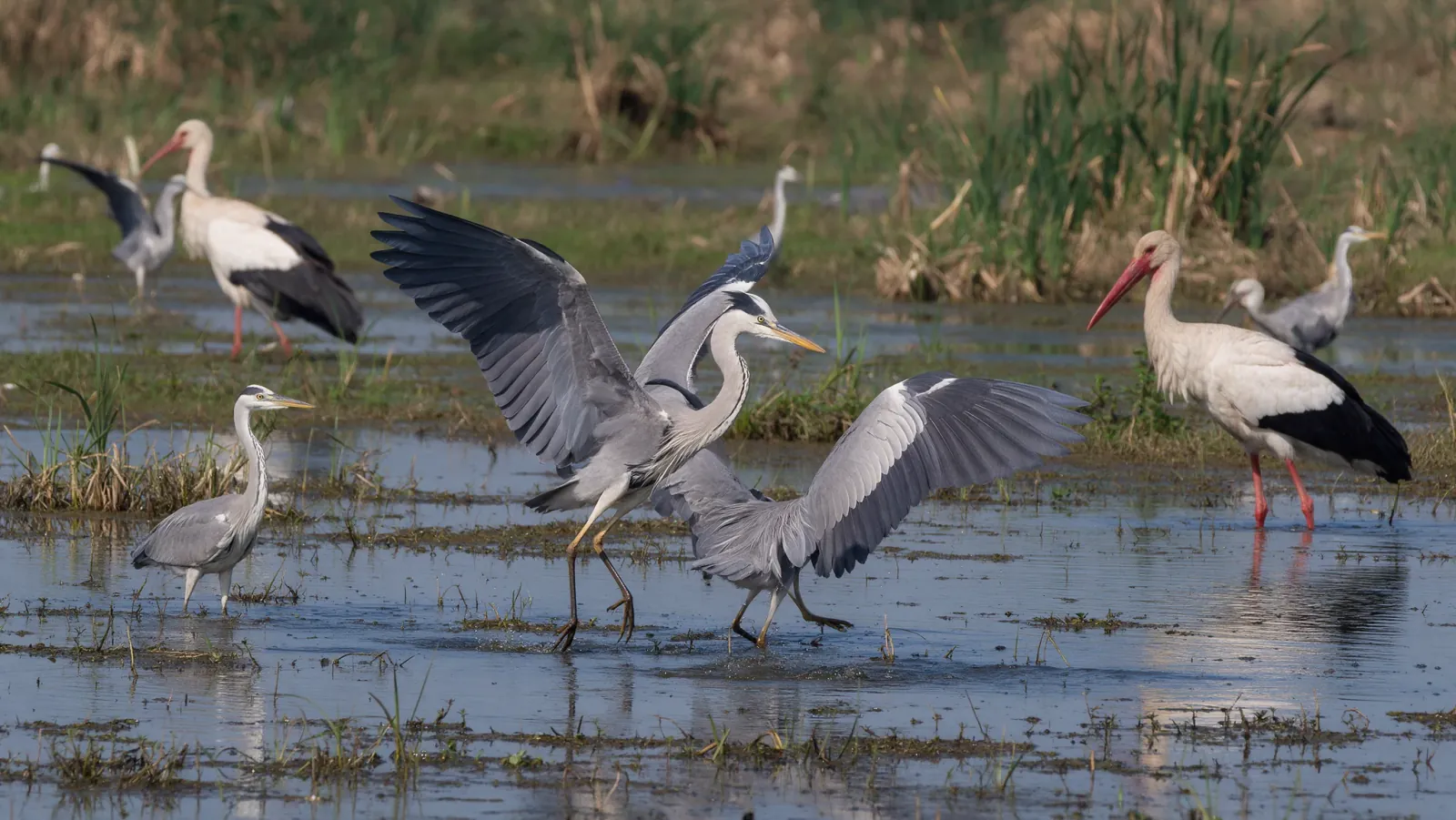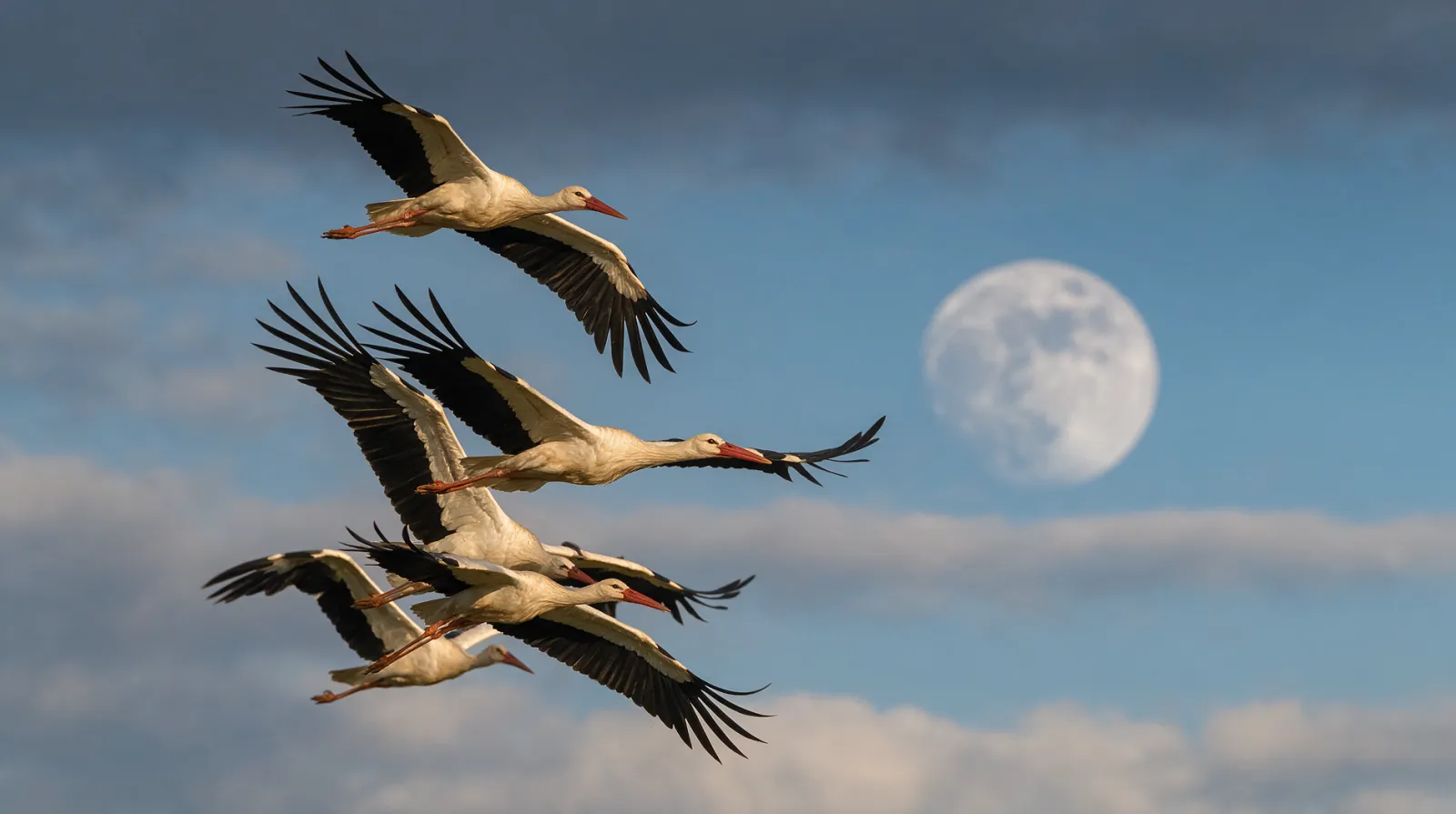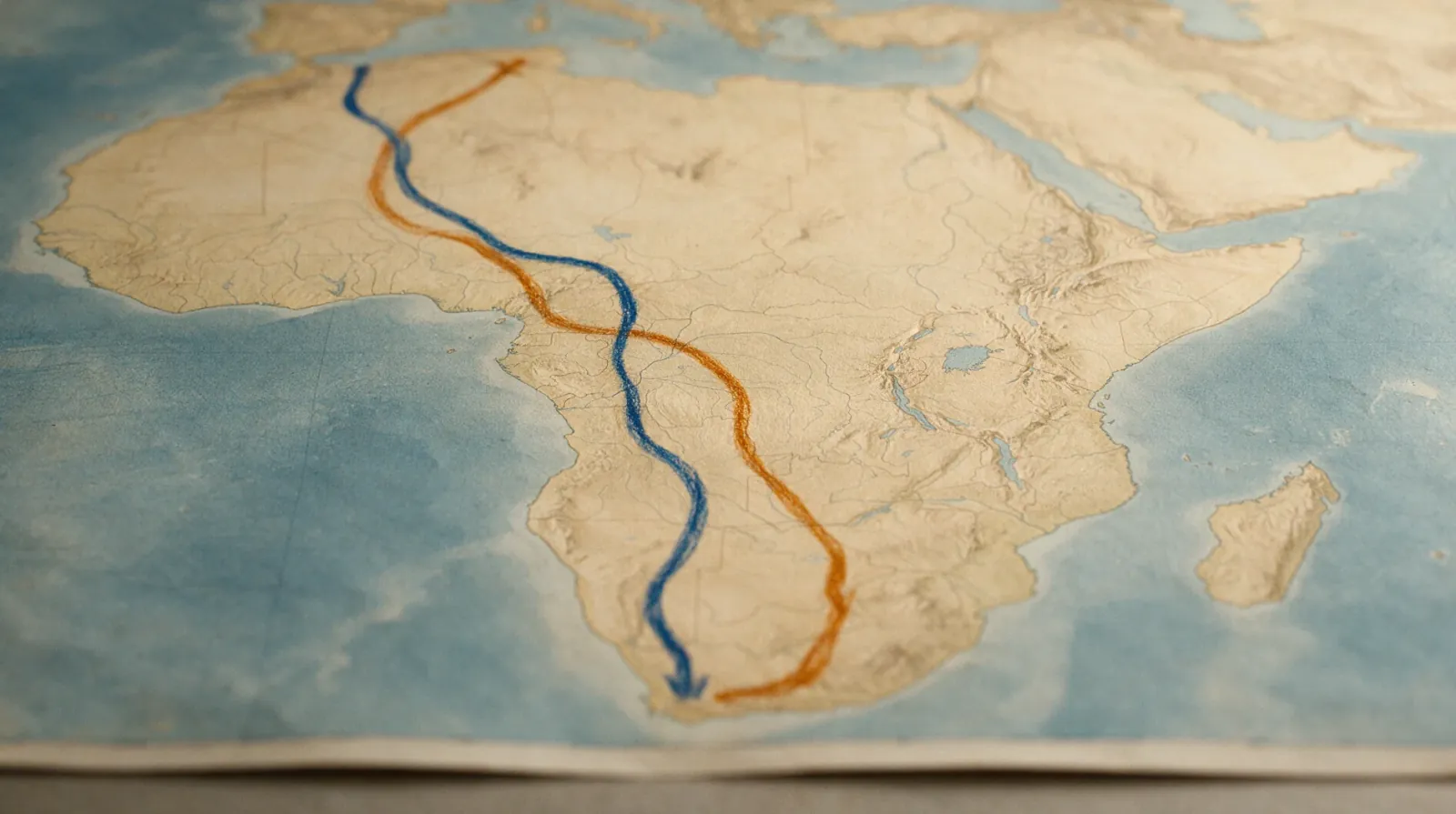
Two white storks can spend the winter in the same wet grassland without ever meeting. One hatched in the Netherlands and crossed at Gibraltar. The other hatched in Poland and came down through the Bosphorus, Turkey and the Levant. The routes divide Europe between them, and the coastline decides which road each bird takes.
The western road
Birds from the Low Countries, France and Iberia drift south through Spain and cross at Gibraltar, where Spain almost touches Morocco. Beyond the strait lie the Atlas mountains and then the Sahara. The western route is a long run over dry country, with the desert as its hardest stretch.
Many birds from western Europe never leave the continent at all, wintering in Spain or Portugal. For them the journey ends in a rice field, and the sea is never crossed. A bird that stays on the Iberian peninsula misses the desert and the tropics both, and its winter is a quieter version of its summer.
The strait itself is narrow enough to see across on a clear day, and the crossing is made in a single push. On the far side the birds face the Atlas range and then weeks of dry ground. Water becomes the thing they look for, and the green edge of a river or an irrigated field pulls a flock down out of the sky.
The eastern road
Birds from Germany, Poland and the Balkans head southeast. They pass the Bosphorus, cross Turkey, and follow the Levant down toward Egypt and the Red Sea. From there they cross into Africa and continue south, often along the Rift Valley. The eastern route is longer and more crowded, and it funnels a large share of Europe's storks through a handful of narrow places. On a good autumn day the Bosphorus carries a stream of birds that becomes a spectacle for anyone standing on the shore.
The eastern road crosses more countries, and each border is a change in weather, food and law. The birds do not notice the borders. They notice the coast, the water and the lift, and those follow the land rather than the map. A Polish stork may pass over the Balkans, the Bosphorus, Turkey, the Levant and Egypt before it reaches the Sahel.
Why the split happens
The divide is geography. The Mediterranean is too wide to cross in most places, and the Alps and the Balkans push the birds toward the edges. Western Europe has Gibraltar. Eastern Europe has the Bosphorus and the Levant. Central Europe sits between the two roads, and a bird from Austria may take either, depending on where it hatched and what the weather does.
A stork that starts in the middle of Europe is not committed to a single door. Weather can push a flock off its usual line, and a bird may end up on the other road. Young storks on their first journey are the most likely to drift. Ringing and tracking show that the boundaries between the routes are soft, with birds appearing where they are not expected and sometimes settling there.
A bird from Austria can end up on the western road or the eastern one, and neither choice is wrong. The route is settled in the air, by the weather of the first weeks, as much as by the place the bird hatched.
A bird that has crossed once is not bound to the same road forever. A tracked stork can take the western route one autumn and a different line the next, and the population as a whole shifts with the weather and the food. The map of the flyway is a habit, and habits bend.
The miles in between
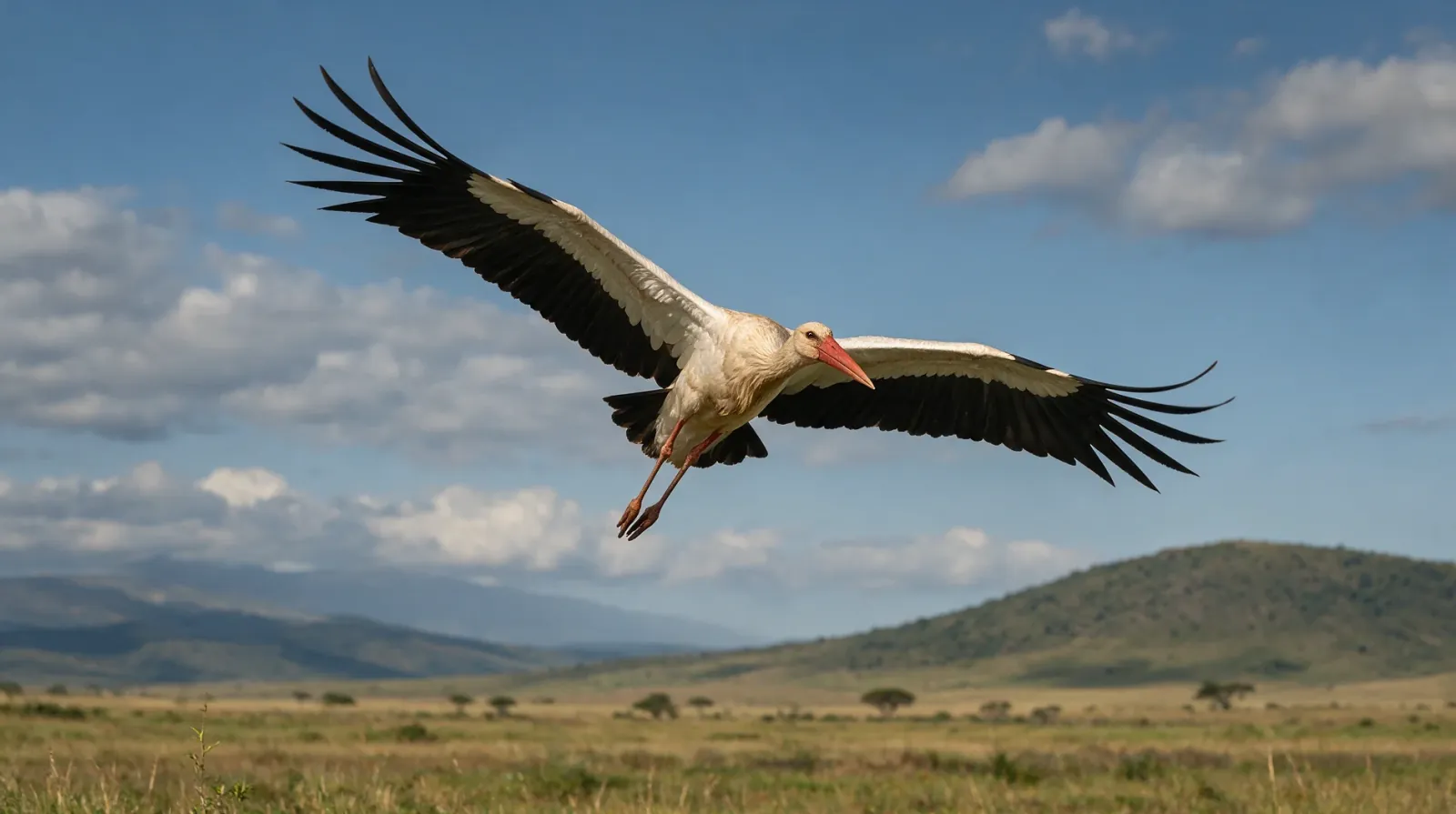
A stork from Portugal that winters in West Africa can cover several thousand kilometres in each direction. A bird from Poland or the Baltic travels a similar distance on a different road. The distance in the air is always greater than the distance on the map, and the gap can be large.
The bird circles in every thermal, climbing in spirals that add height but no forward progress. It detours around water, mountains and bad weather. A tailwind can shorten a day, and a headwind can turn the same day into a struggle. Figures for migration are ranges because no two journeys are alike.
For a long time the only evidence was a ring on a leg, found later in another country. A ring tells you where a bird was and where it ended up, and nothing about the way between. Small satellite tags changed that. A tagged stork can be followed hour by hour, and the track shows the loops, the rest days and the sudden pushes.
The return in spring is often quicker. The birds are heading for a nest, and a nest has a season. Pairs that have bred before may arrive early to reclaim a roof or a pole, and the birds that are late find the best places taken. Spring is a commute. Autumn is a wandering.
The journey takes weeks, and much of it is spent standing still. A bird that leaves Poland in August can be in Africa by September, having flown a track that looks nothing like a direct line. The wandering is how a soaring bird solves the problem of distance.
Crossing the Alps
A wall of rock, snow and hard wind stands on the European route, and not every stork meets it. Western birds go down through Iberia and never see the great peaks. Eastern birds pass north of the main range on their way to the Bosphorus. The storks that do cross are usually birds from central Europe, and they cross where the mountains allow it.
Mountains are crossed at their lowest points. A pass is a gap in the ridge, and storks use the same gaps that roads use. The birds come in low, follow the valley up, and cross at the pass where the wall is shortest. A pass is a funnel for wind as well as birds, and the air there can be rough even on a calm day. The same wind that lifts a stork can throw it against a cliff. Storks cross in the morning, when the valley air is steady and the sun is beginning to work on the slopes.
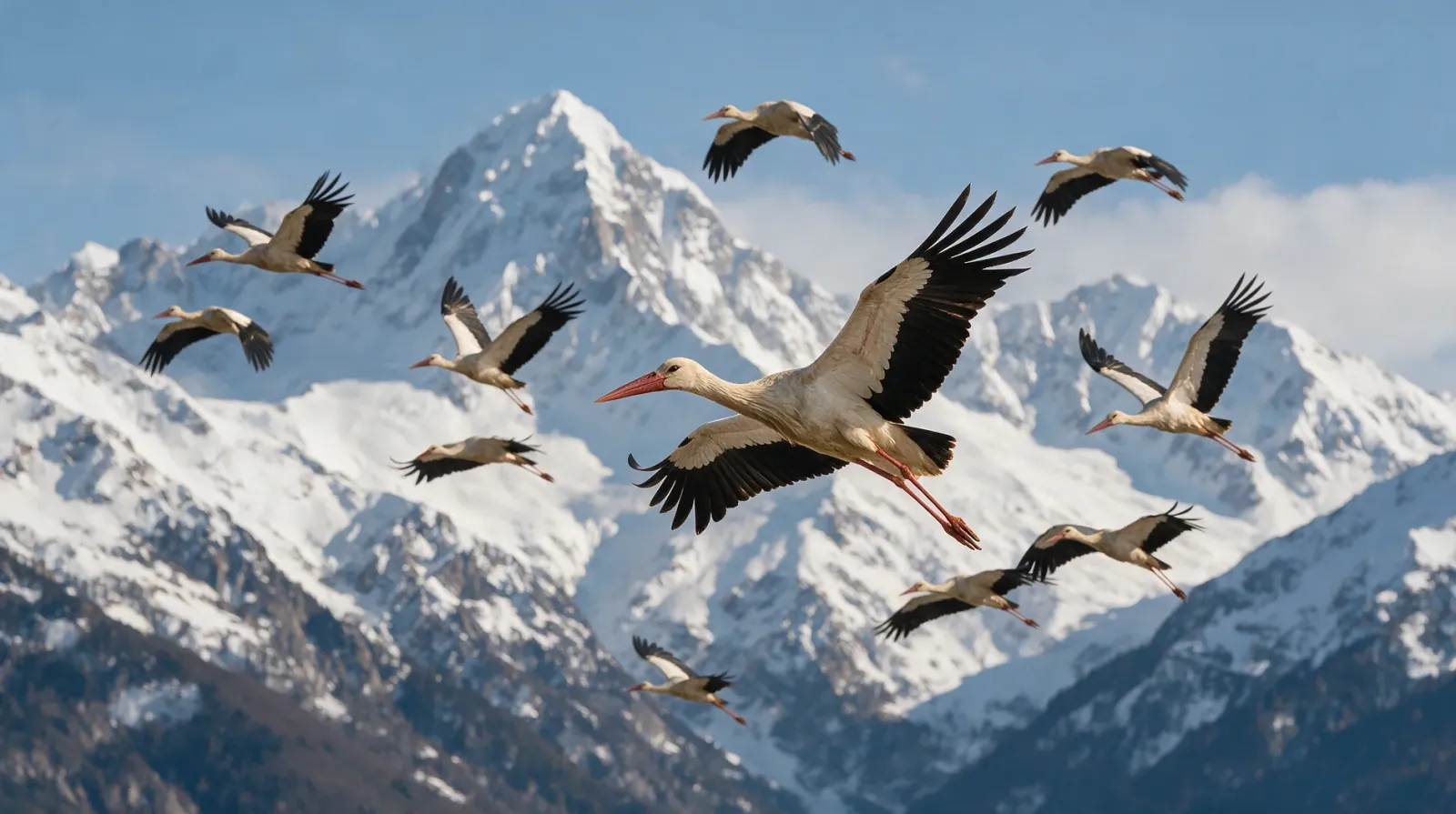
When the wind turns, the birds wait. A strong crosswind or a sudden gust can end a crossing, and the passes can be closed for days by cloud, snow or wind. Flocks gather in the fields below, feeding and watching the ridge. A flock held at the foot of the Alps is a sign that the weather above is not fit for flying. A detour adds days and keeps the birds alive.
Where the roads meet
The two routes converge in Africa. Birds from both roads spread across the Sahel and further south, and their wintering grounds overlap. A stork from Spain and a stork from Poland can feed in the same wet grassland without ever having seen each other's country. By the time they are standing in the same marsh, the road they took has stopped mattering.
The route a stork takes is decided by where it starts. Two birds that left opposite ends of Europe can end the year within a few hundred kilometres of each other, having flown completely different roads. One followed a coastline west and crossed a narrow strait. The other crossed a sea, a desert and a valley, and both arrived at the same water.
Explore the gift