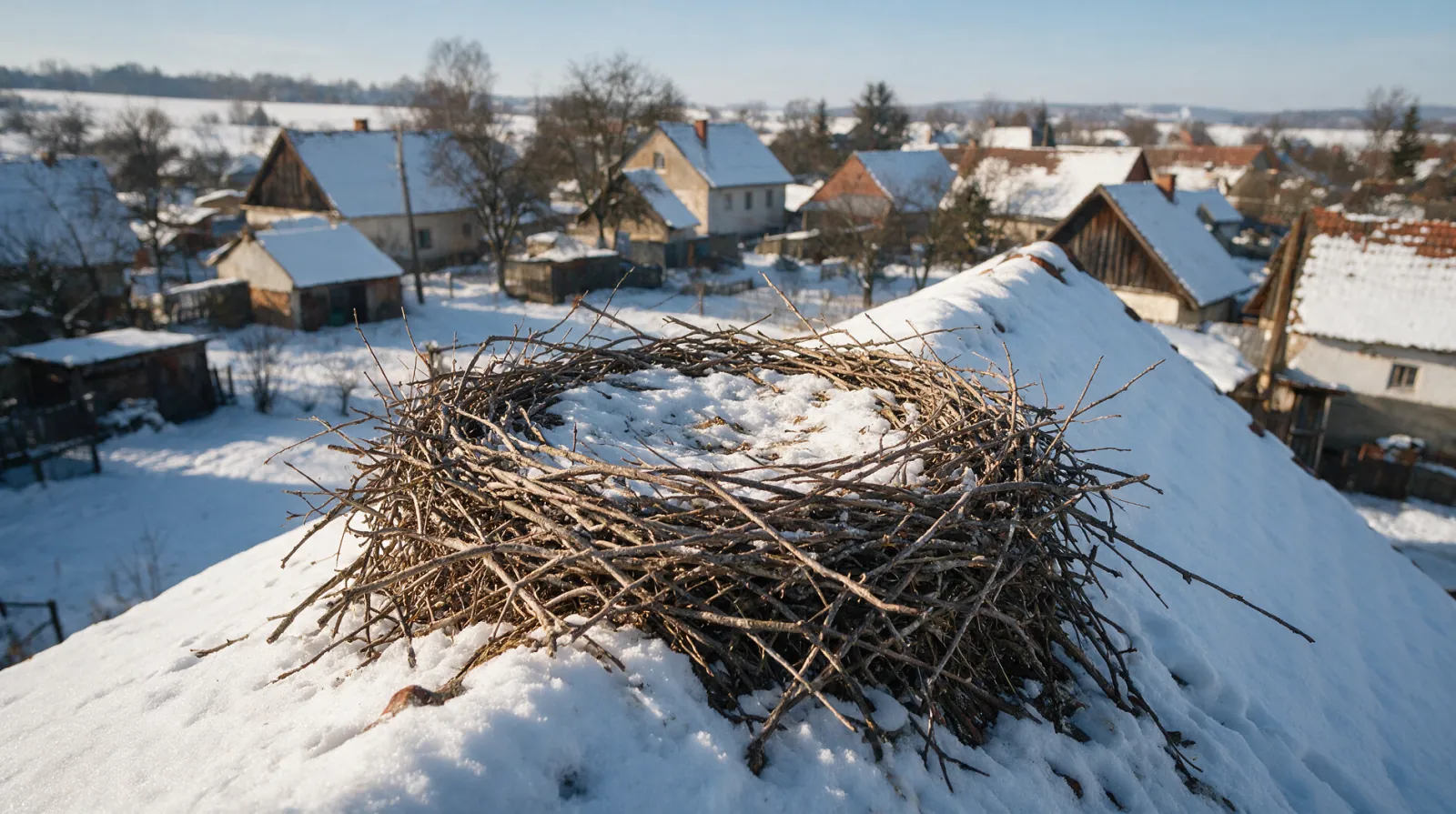
The deep winter quiet settles on the village after the first heavy snow, and it has an empty nest at its centre. The storks are gone, the roofs are white, and the whole place has been muted. The nest that clattered with chicks all summer sits silent on its gable, filling with snow.
The frost closes the pantry
By the time the fields turn white, the white storks are far down the long south. Most leave in late September and October. Some stay into the first cold weeks, and the last ones are often this year's young, flying a route they have never seen. They manage it without a guide. Young storks often leave after the adults and find their own way, and the flocks that pass in November are smaller and looser than the ones that went before.
The first hard frost shuts the pantry. Frogs and insects go down into the mud, and the shallow water at the field edges turns brittle. A stork that stayed would find less to eat each day. The birds leave while the eating is still good, and the cold closes a door behind them.
The empty fields are not empty of birds. Geese come down from the north to feed on the stubble, and winter thrushes strip the hedgerows. Crows and buzzards work the wet corners where the frost has not taken hold. None of them need the summer the way a stork does.
While the fields here stiffen, the storks are settling into winter quarters. They follow the warm air south, over the straits, across dry country, to wetlands and fields where the sun still works. There they wade in warm water and feed on what the north cannot offer for months.
Snow changes the sound
A fall on roofs, lanes and hedges takes the edge off every noise. Footsteps muffle, wheels hush, and the day's small sounds drop away one at a time. Cold air carries what is left further than it should, so a dog barking two streets away arrives clearly and then is gone.
At night the quiet gets deeper. Snow absorbs sound, and a village under it seems to have moved further from everything else. In a village that lives with storks, the snow also covers the one thing the year turned around. The nest stays visible anyway: the darkest thing on the roofline, a ring of sticks holding a small drift.
With the storks away, mornings start later and evenings close in early. People move more slowly and keep nearer the fire, and the lanes that rang with clatter in June now carry the sound of boots on packed snow.
Nobody says the storks are missing. The absence is part of the season now, and the winter has been arranged around it. There is tenderness in that quiet. The village is resting, the land is resting, and the nest is resting, all three on the same schedule.
A platform of sticks
A stork nest was never built to be warm. It is a platform of sticks, wide and heavy, made to hold eggs, chicks and the weight of two adults through the nesting season. Through the cold months it does nothing, and the frost does it no harm.
A stick that held a chick in July holds a drift in January, and neither asks more of it. An old nest can grow as tall as a person and become a serious weight on the chimney, and every spring adds to it. The lower layers are dark and compressed, the upper ones paler and looser, and the whole thing is held together by friction and weight rather than any binding. The shape that held a family in June now holds weather.
Other birds move in. House sparrows and starlings use old stork nests for shelter through the winter, and a platform that held a family in June becomes a crowded dormitory by November. Rain soaks the sticks and the wind works at the outer edge, and a well-built nest takes both without losing its shape.
The first snow
It arrives quietly, usually overnight, and by morning the empty platform has a new outline. First snow rarely announces itself. A few flakes drift down and seem too soft to matter, then the fall thickens and the roofs and lanes go pale. The flakes land one at a time and hold, and the ring turns from dark to grey to white.
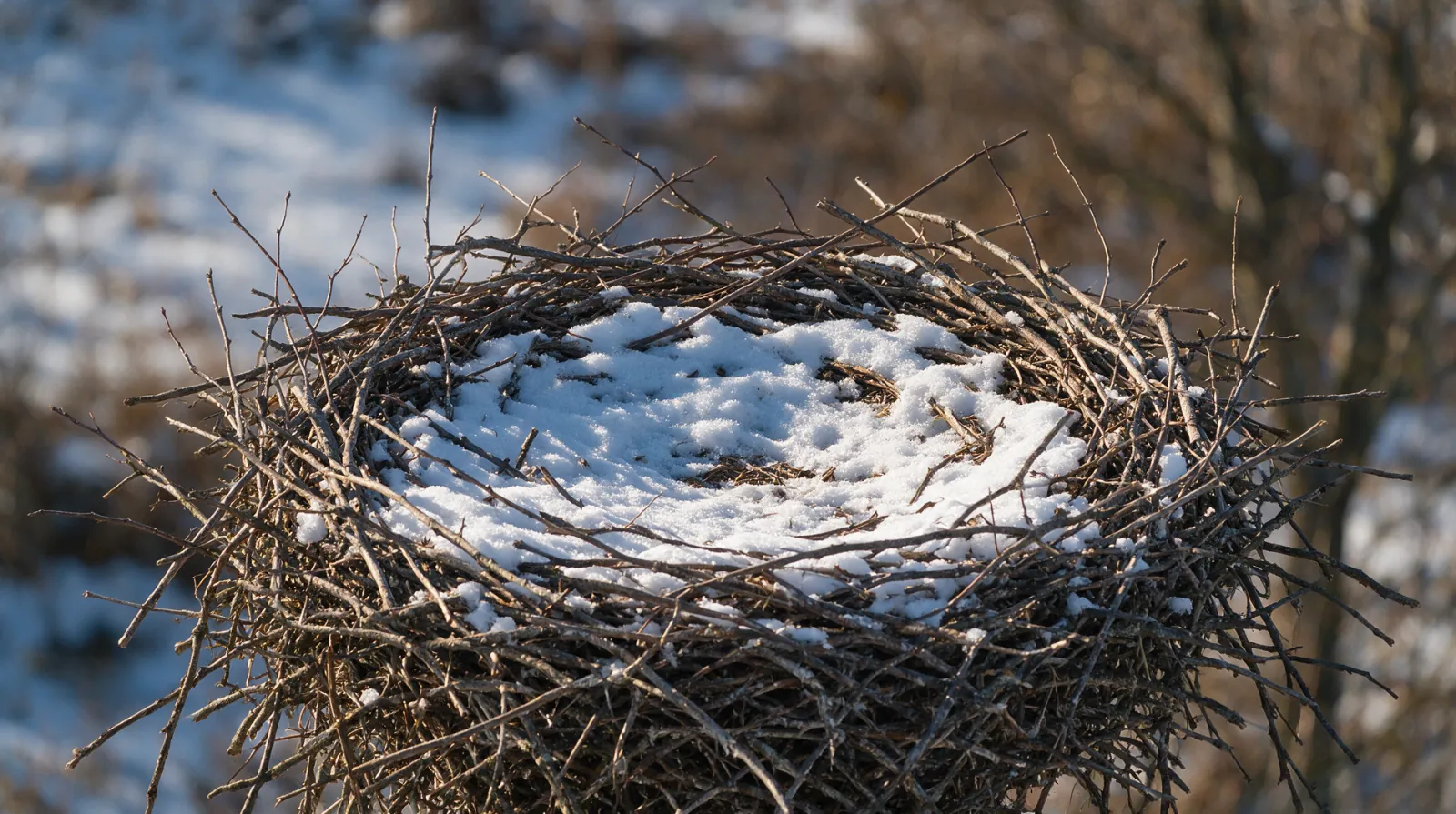
On the nest the effect is finer than anywhere else. The dark ring of sticks turns white on top and stays dark underneath, so the shape reads clearly for once: a shallow bowl balanced on the chimney. The snow etches what summer hid. You can see how the sticks were laid, which ones were added last spring, where the cup dips in the middle.
From an upstairs window the difference is unmistakable. From the street below it is easy to miss, and half the village will walk past without looking up.
Wind scatters it. Sun melts it. By noon the nest is dark again, and by evening there may be no sign that anything happened. The first snow is a drawing erased the same day.
A child will ask where the storks have gone, and the answer will be a long way away. The snow on the nest is easier to explain. It is winter arriving on a place that belongs to summer. The snow sits where the chicks sat, and anyone watching feels the difference without needing it explained.
The marsh under ice
Water sits under the ice out on the marsh, the reeds stand stiff, and the mud below the frost holds frogs and insects in a sleep that costs almost nothing. The marsh freezes from the edges inward, and the last open water sits in the middle of each pool, shrinking through December.
The food the storks will need is being kept rather than made. That is what an empty winter field is for. The quiet months store the next loud ones.
A field white with frost and empty of storks looks like an ending. It is a pause. The same ground will soften in the thaw, and the same nest that gathers snow will hold a pair again. Frost does not touch a platform of sticks, and it will stand on the chimney through every cold morning until spring.
The wait has a shape
By January the nest has stood empty for months, and the village feels it. The days are still short. Nothing in the village needs doing, and the whole place is arranged around a return that has not happened.
The silence holds all of it: the fields under snow, the sky without wings, the platform on the roof. Some time in February the light will start to change and the quiet will begin to lift. The nest will take rain, then frost, then snow, and it will still be there when a white shape comes back over the fields.
Nothing needs to be done to it. Storks repair their own nests, and the bird that returns in spring will find the platform where it left it. Snow falls again, heavier, and each fall stays longer than the last. By February the nest is a white mound with dark edges, and the days are still short, and the counting goes on.
Explore the gift