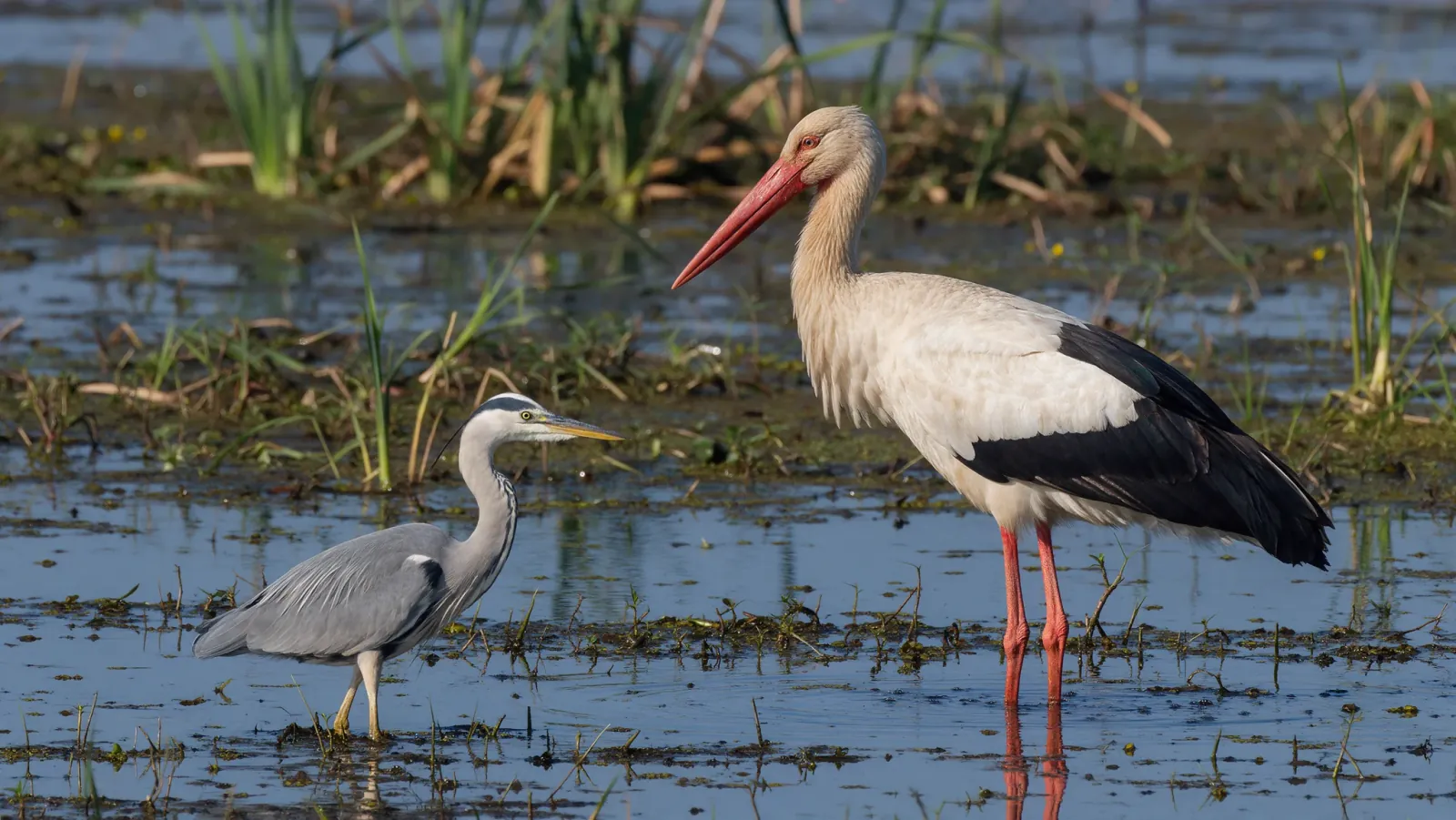
A white stork and a great egret can stand in the same wet meadow and look, at a glance, like the same tall white bird. The differences sit in the neck, the bill, the legs, and the way each one waits. Once you know those four things, the two birds separate at almost any distance.
The neck settles it in flight
A stork flies with its neck stretched forward and its long legs trailing behind. An egret, like every heron, pulls its neck back into a tight S and tucks its head against its shoulders. In the air the neck is the quickest test: straight out means stork, folded back means egret. The legs tell the same story from below, because a stork's red legs extend well past the tail while an egret's dark legs trail shorter. A standing egret can also retract its neck until the head sits close to the body, then shoot it out at a fish. A stork's neck stays long and open, even when the bird is resting.
The bill is a different tool
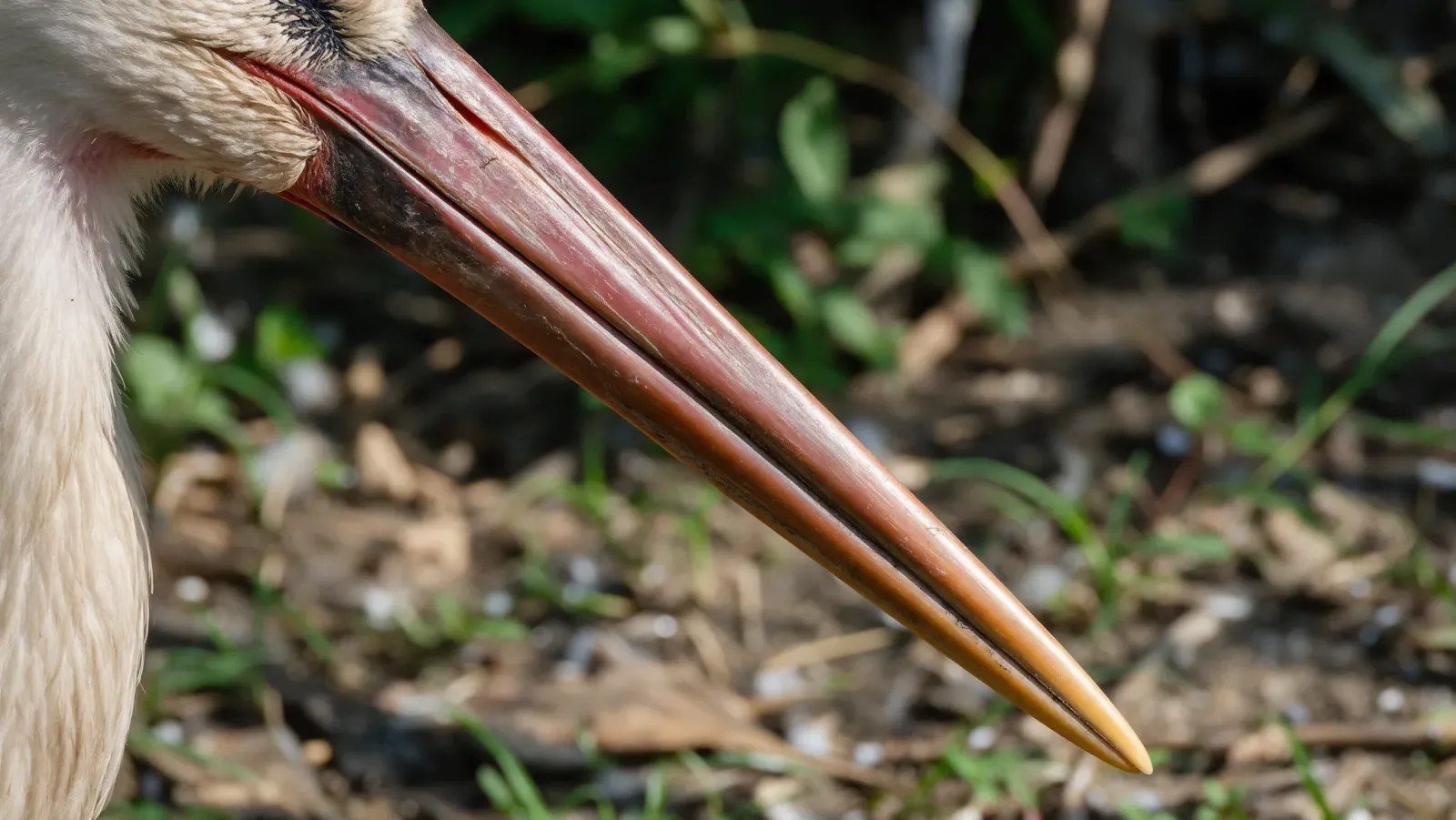
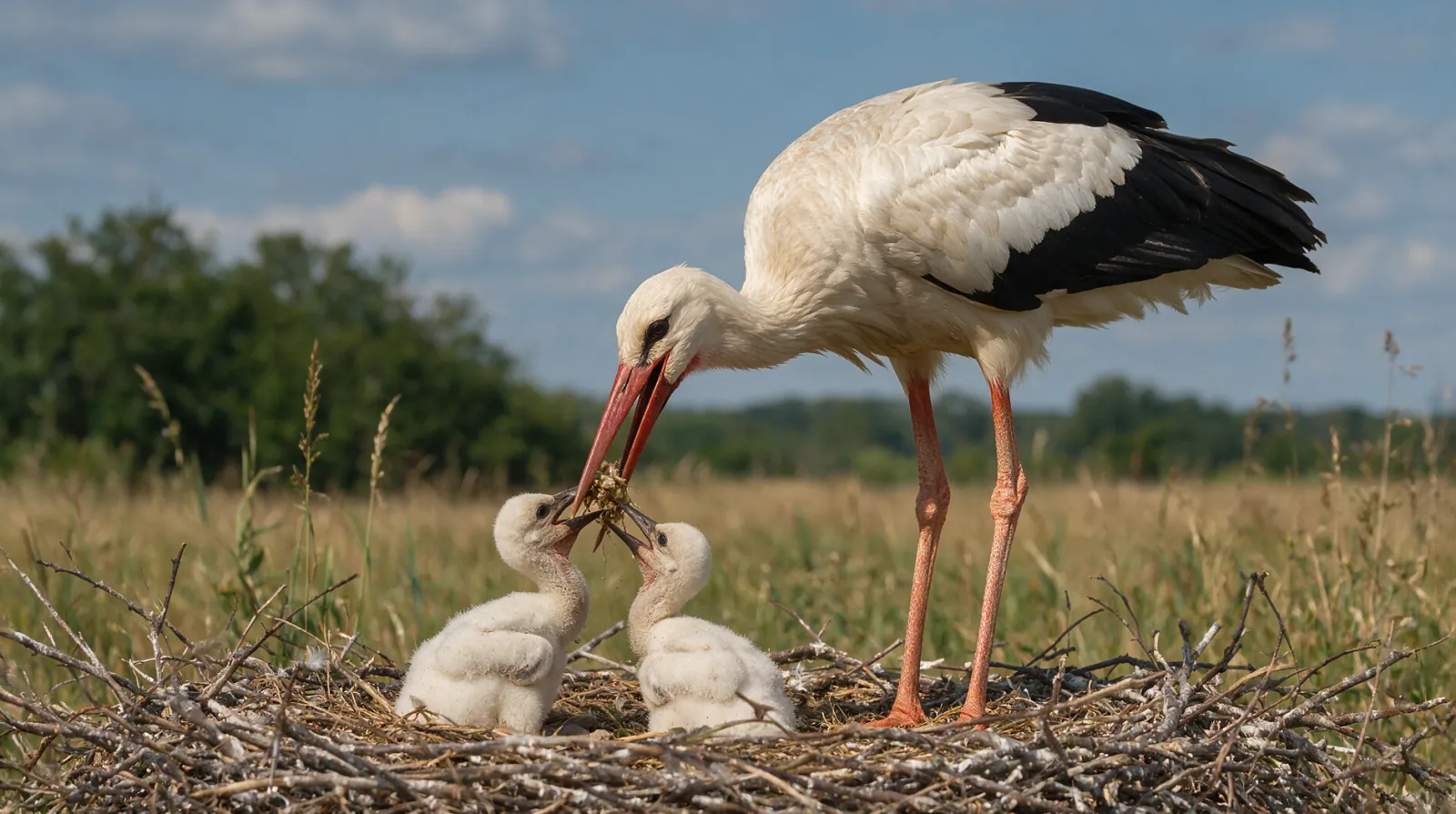
Both bills are long, and they are built for different work. A white stork carries a straight, heavy dagger of a bill, red in adults, and uses it to grab frogs, insects, voles, and the occasional snake. A great egret has a thinner yellow bill and uses it like a spear. The stork's bill is for seizing; the egret's is for stabbing. Colour helps at close range: red legs and a red bill belong to the stork, while the egret stands on black legs with a yellow bill. In breeding plumage the egret also grows long white plumes down its back, which the stork never has.
Legs and the way they stand
A white stork stands about a metre tall, and a great egret is nearly as tall on a much lighter frame. The stork looks heavy through the body, with broad wings and a thick neck. The egret looks drawn with a fine pen: slim, upright, all angles. Both birds rest on one leg with the other drawn up, so posture alone will not settle it. Look instead at the overall weight of the bird. A stork has the build of a bird that walks a long way. An egret has the build of a bird that stands and waits.
Patience looks different
The feeding styles are the clearest difference at close range. A stork walks slowly across wet grass, lifting each foot, scanning, then striking down at something it has seen. It covers ground. An egret often stands motionless at the edge of a pool for minutes, then unfolds its neck in a single quick thrust. The stork hunts by walking; the egret hunts by waiting. Both are patient, and the patience has a different shape. An egret may take one fish from a pool in an hour. A stork working a wet field may take many small prey in the same time, then move on to the next field.
Where you will meet each
White storks favour wet meadows, farmland, and the muddy edges of rivers, often far from deep water. Egrets prefer reedbeds, ditches, ponds, and coastal shallows, and they are more likely to be alone or in loose groups. In spring a stork may be on a roof or a pole; an egret will be down among the reeds. If you are unsure, watch for a minute. The bird that strides off across the field is the stork. If a white stork has taken up a nest on your street, you can adopt a stork for a newborn and follow the bird through the season. For the two comparisons that started this series, see storks versus cranes and the difference between storks and herons.
Explore the gift