A stork summer is measured in trips. Out to the meadow, down to the grass, back to the roof with a full bill, and again. Freya raised two chicks in a high nest above a farmhouse, and the work of it filled the whole season.
The first cold night
She sat through the cold end of April, and when the last frost had gone the two eggs beneath her began to chip. A newly hatched stork is a wet, helpless thing with a bill too big for its head and a hunger that starts at once. The first chick came out in the morning, the second before dark.
The first night was cold. Freya covered both chicks with her breast and did not sleep. Her mate stood on the rim and watched the sky. For the first days one parent was always on the nest. A chick that cannot yet keep itself warm will die of a cold night, so the nest is never left alone.
The endless errand
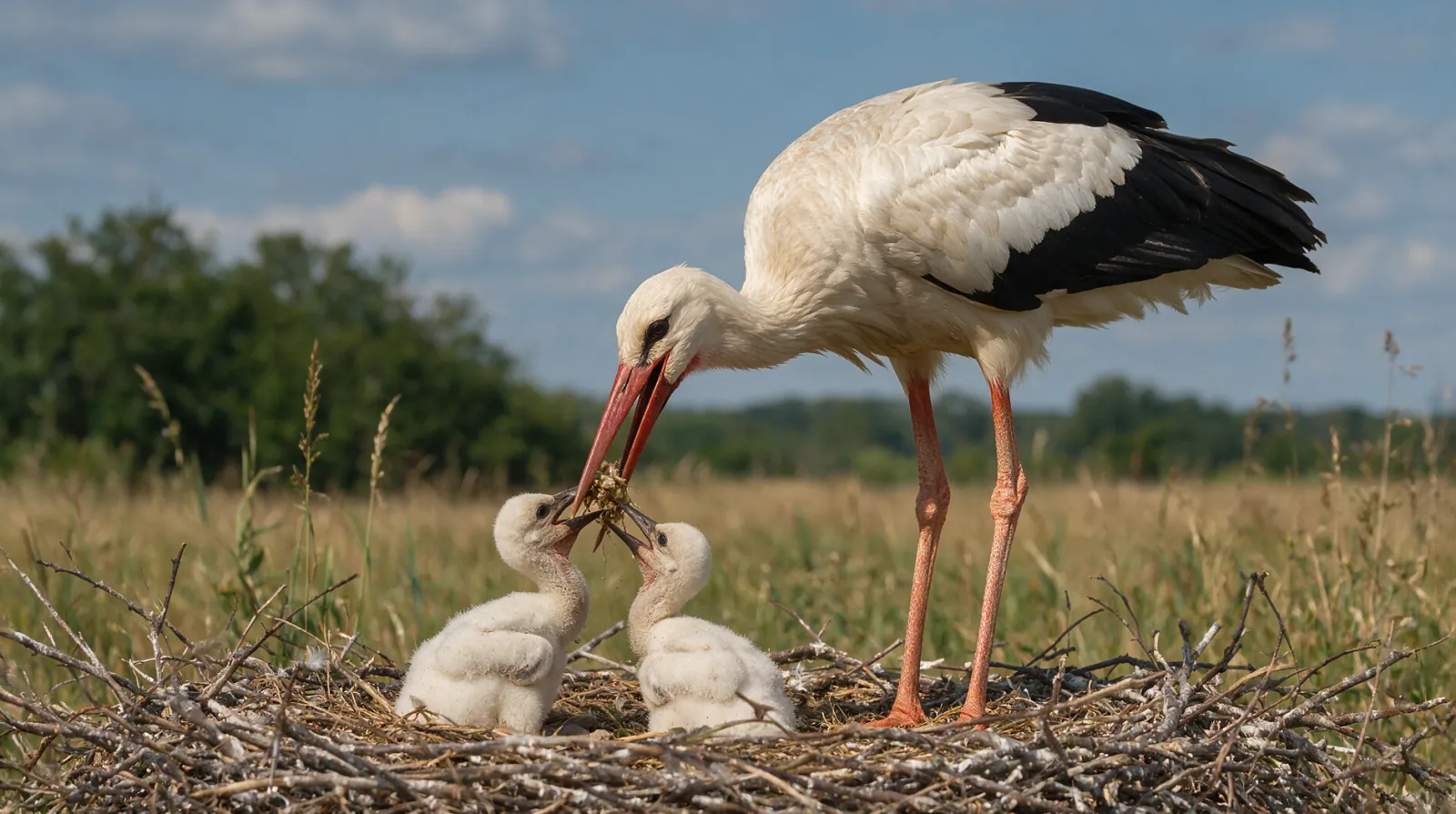
Two chicks eat from dawn to dusk. White storks feed their young by bringing food up from the crop, and a growing chick can take an astonishing amount. Freya and her mate flew out to the meadows before light and came back with frogs, insects, and the occasional small fish or vole. The chicks grabbed at the bill and pulled the food down, and then begged again. By July the nest sounded like a small factory that never closed.
By the second week the pair had a rhythm. One hunted while the other stood over the chicks, and they swapped places with a clatter and a bow each time. Freya fed more than her mate in the early weeks, and he took more of the hunting as the chicks grew. Neither of them rested for long.
Pere knew the same routine with three chicks. He left before light, flew low to the wet meadow, landed and walked. Frogs, insects, voles, the occasional chick of another bird, all of it went into the crop. A stork feeds its young by bringing food back up from the crop, and a chick can take a surprising amount in one visit. Pere would empty himself into the three open bills, clatter once, and go back out. On a good day he made the trip a dozen times.
The meadow was generous that year, and Pere still lost weight. The work of a breeding stork is constant, and the body spends itself on the chicks. His feathers went dull. The muscles in his chest ached at night. He fed himself in the gaps between trips, quickly, standing in the grass with one eye on the nest.
Shade and water
When the sun was at its worst, Freya spread her wings over the chicks and made a patch of shade. She held the pose for an hour at a time while the farmyard shimmered below. Water was carried in her bill and dribbled onto the chicks, and the nest was turned and cleaned. The work of a stork summer is food, and also shade, water and a clean floor under two growing birds. Freya turned the nest lining every day and carried the soiled grass away in her bill.
The smaller chick
One of Freya's chicks was smaller from the start, and it begged less than its sibling. She fed it when it asked. In a lean year the smaller chick would have stood no chance, and this was not a lean year. The nest held enough for two, and both of them grew. The smaller one was always the last to be fed and the first to try its wings.
The chicks changed faster than seemed possible. Down gave way to white feathers. They stood, wobbled, and began to exercise their wings at the rim. By August they were nearly as tall as Freya, and the nest that had held two small mouths held two young storks that could not stop moving.
Practising at the rim
Ayla practised for a week before she left her nest. She would crouch, leap and flap hard, and the wind would lift her a little before she settled back onto the sticks. Her wing muscles were still soft, and the first attempts ended in a scramble. The nest was high enough that the ground below looked like a different country, and she did not look at it. A young stork learns to fly by flying, in short, clumsy jumps that grow longer each day. Each leap took her a little higher, and she began to feel the air hold her for the length of a breath.
Her parents watched from the next roof and did nothing. They brought no food to the nest now, and they did not coax her. Once, her mother flew past close enough that Ayla felt the wind of her wings, and that was the only lesson offered. Ayla flapped and leapt and fell back onto the sticks, and the two older birds stood by and waited.
On a still morning, with warm air and soft ground below, she did not stop at the rim. She ran to the edge, threw herself out, and beat her wings with everything she had. For a moment the nest fell away and the rooftops turned beneath her. The drop was longer than she had expected, and the air colder. Then the air took her, and she was flying. She did not go far. One wide circle over the village, the street she had only ever seen from above, and then back to the nest. The landing was harder than the flying. She came in too fast, wobbled, and caught herself with a late flap that nearly tipped her over the edge.
The empty nest
One morning Freya's chicks went. The first rose, tipped forward and was airborne, and the second followed before the day was out. Freya stood on the nest and watched them circle the farmhouse, clumsy and loud. She had carried food to this nest for two months, and the sky had taken them off her hands in a single morning. She clattered once, and they came back to the roof, and the summer's work was almost done.
The begging stopped in stages. First the chicks stood at the rim and flapped. Then they made short flights to the roof next door and came back begging. Then one morning they left and did not come back.
Pere stood on his empty nest for a long time. The meadow was still there, and the frogs were still there, and the errand that had filled his summer was over. He preened, slowly, for the first time in weeks. He made one more trip the next morning, out of habit. He flew to the meadow, caught a frog, and brought it back to an empty nest. He stood there with the frog in his bill for a moment, then swallowed it himself. After that he stopped going out in the mornings.
A stork nest is loud in June and quiet in August. The young grow, fledge and leave, and the pair follows them south. The work ends, and the nest stays on the roof.
Explore the gift