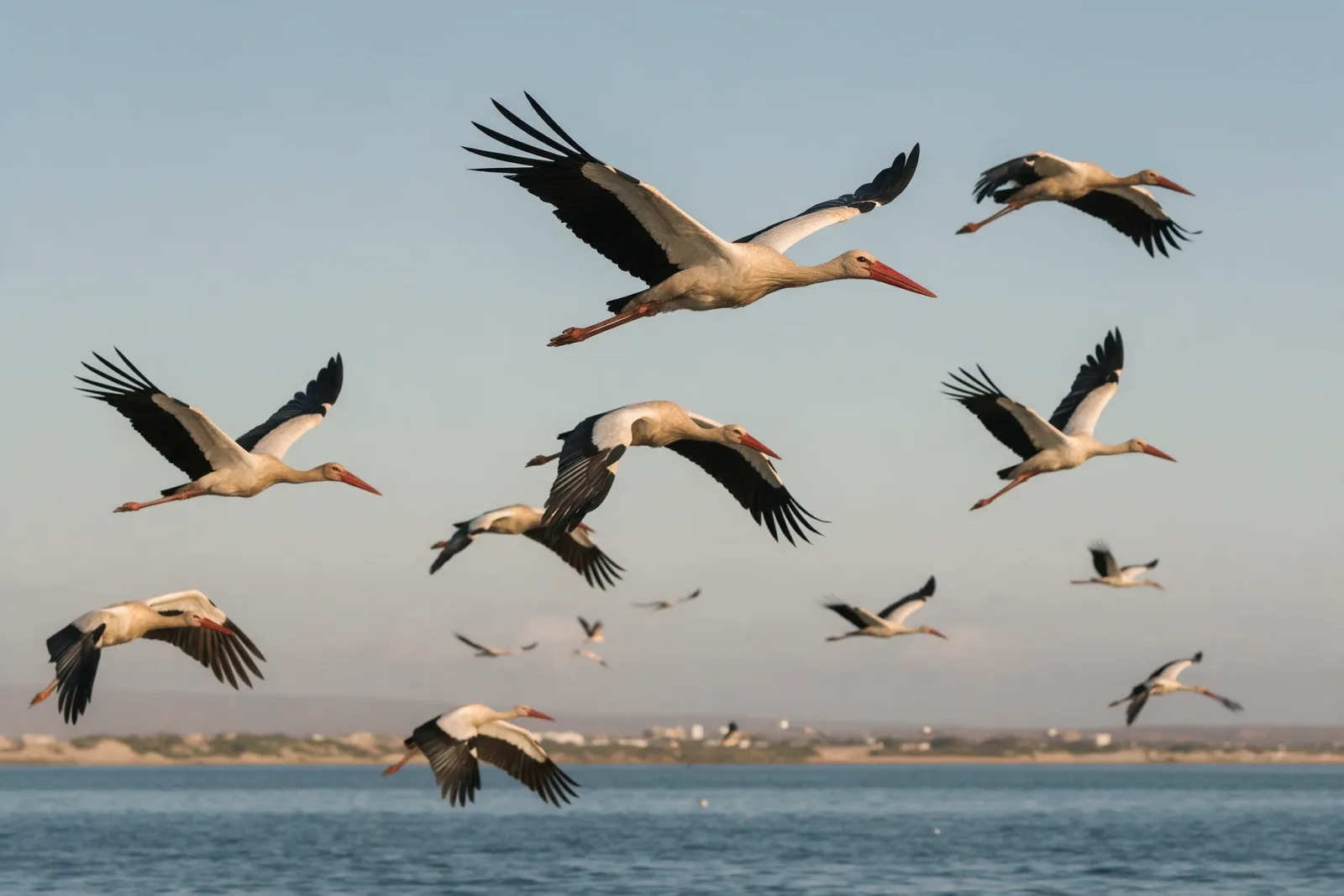
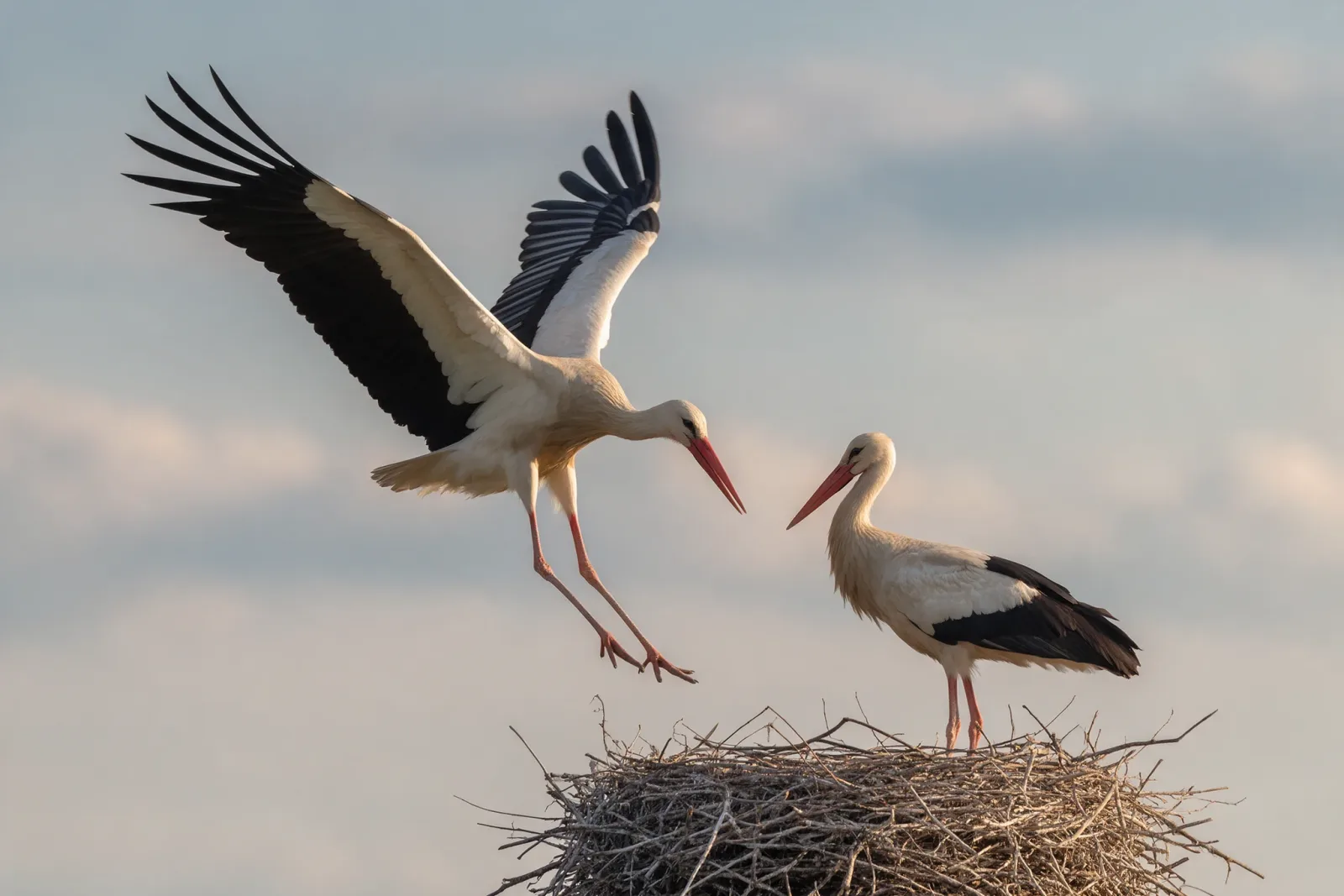
A white stork can cross a continent without much trouble and then hesitate for days at a strip of water a few kilometres wide. Cold water gives no lift, and a soaring bird that flies out over it must beat its wings the whole way. The crossing is the one part of the journey a stork cannot hurry.
Why the sea closes the route
Land warms in the sun and sends up columns of rising air. Water warms slowly and keeps its cool, so the air above it stays steady. A stork that leaves the shore loses the free lift it depends on. With a body of several kilos and a wingspan of about two metres, that is a costly flight. The sea offers no field, no tree and no shallow edge to stand in if the wind turns.
A stork can land on water in an emergency, but it cannot feed there or rest for long, and a soaked bird is heavy and cold. So the birds follow the coast wherever the land gives them another choice. A coastline also gives them a line to travel along, with land on one side for lift and landing. Where the coast turns and the water narrows, they cross.
Ronan reached his crossing on the fourth morning, after three days of waiting on a crowded shore. He had flown a long way to get there, and he had crossed this water before. The waiting never got easier.
The long way to the shore
He did not come straight to the coast. The flock followed the land for days, because a stork would rather add miles than fly over water, and the route bent with every bay and headland. They passed villages, rivers and fields of cut grain, and at every stop more storks joined until the sky above the shore was thick with wings. The flock slept on sandbars and in shallow bays, and each morning they were up before the light.
The crossing is a narrow place, and every bird on the route funnels toward it, the way water runs into a narrows. Ronan remembered the shape of the far shore. Memory helped, and it did not make the water any smaller.
The waiting
The shore was crowded. Storks stood in the shallows and on the wet sand, hundreds of them, all watching the sky. A crossing needs a steady wind off the land, one that pushes a bird across instead of fighting it. On some days the wind is wrong, and everyone waits.
Ronan waited, fed on the shore, and slept with his head tucked. The oldest birds stood with their heads turned into the breeze, and he read the weather by them. A few birds gave up and drifted back inland, and others arrived to take their places. The wait can last a day or a week, and the birds do not seem anxious. A stork standing in a field with its back to the wind is doing the sensible thing.
The morning the wind turns
On the fourth morning the air changed. A low breeze came off the land, steady and warm, and the flock felt it at once. Storks began to lift, a few and then hundreds, until the air above the shore was full of white wings. The sound was like a hundred small doors closing at once.
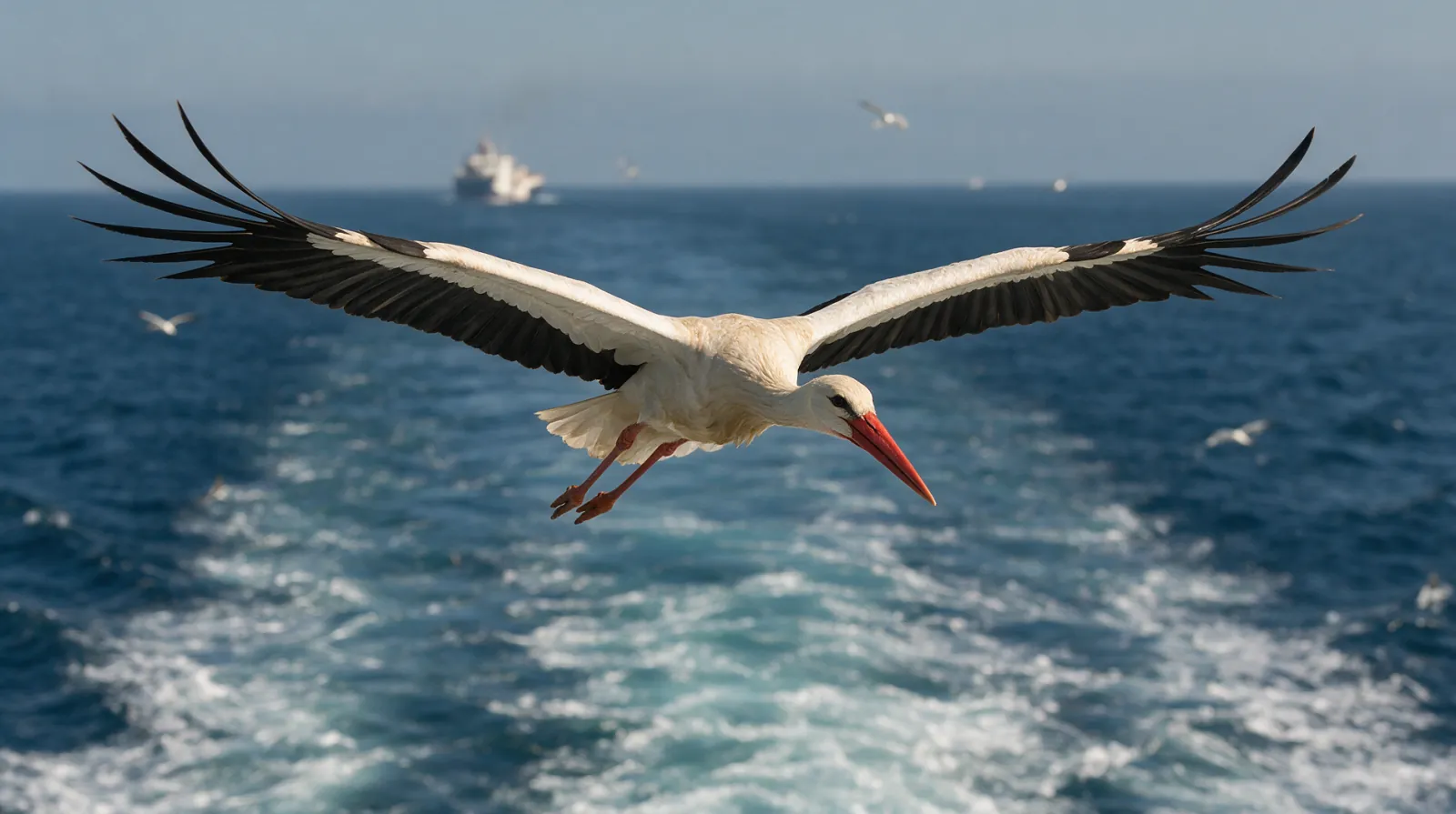
A crossing is offered for an hour, and a bird that misses it waits for the next offer. Ronan rose with the flock and took his place in the middle of the line, where the flying is easiest and the wind is broken by the birds ahead. The water slid beneath him for a long time. He held his wings wide and let the wind carry him, beating only when he began to sink. Below, the sea moved in slow dark rolls, and a ship crawled along the grey without interest. He watched the far shore, a pale line that grew until he could make out fields and the green of land beyond.
When his feet touched the ground, storks were landing all around him. Some drank. Some fed at once in the wet grass, and the grass was rank and salty. The crossing that had looked so large from the far side was behind them, and the rest of the journey lay ahead on solid ground.
The crossing Gwyn missed
Gwyn reached the shore with the rest of the flock, a young bird on his first migration, and settled on the headland to wait. The morning came after three days. The air warmed early, and the first birds lifted before the sun was clear of the hills. The flock went up in a great slow spiral and drifted out over the water.
Gwyn was on the mud at the far end of the shore, feeding. He had eaten well and slept badly, and he had let himself be late. By the time he lifted his head the sky was emptying. He ran and beat his wings and rose, and the last of the flock was already a line of specks over the sea. He turned back. From the shore he watched the line stretch across the water and thin, and the far side swallowed the birds one by one.
The days after were long. Rain came in from the sea, and the wind blew the wrong way, and Gwyn stood in the wet grass with a few other stragglers. It was a week before another good day came, and by then he was hungry and quiet. He crossed with a small group, and the far shore came up slowly. The beach was empty except for gulls, and the silence after the flock was strange. He arrived late and thin, and the good pools were taken. The next autumn, when the flock rose at the strait, Gwyn was in the middle of it before the first birds were off the ground.
The wires above the fields
Power lines cross the same flat land, rivers and wet fields that storks follow. The birds are large and need room to change course. A line that appears late, at speed, with the light behind it, is hard to avoid. Most collisions happen in the first grey light of morning or in bad weather, when the wires disappear against the sky.
Dax crossed a wire on a clear morning with the sun behind him. He was on his first migration, and the wire was one of many strung between steel towers above the fields. He saw it in time and turned, and the whole flock turned with him. The stork ahead of him lifted and swerved, and Dax followed without thinking. The wire passed beneath him with a whistle of air, and behind him the flock came through in a ragged wave.
People who build the lines have ways to make them visible. Spiral markers and plastic coils hang on the wires and move in the wind. Burying a line, or routing it away from a wetland, works better where it can be done. None of it makes the wire safe. It makes the wire less invisible.
A flock learns a route by repeating it. The old birds know where the wires hang, and they lift earlier and turn sooner than the young ones. Dax flew behind them and copied what they did. By the third crossing he was lifting before he could see the line, and the knowledge had moved from his eyes into his wings.
The shore empties when the wind turns, and the wire is behind the flock until the next crossing.
Explore the gift