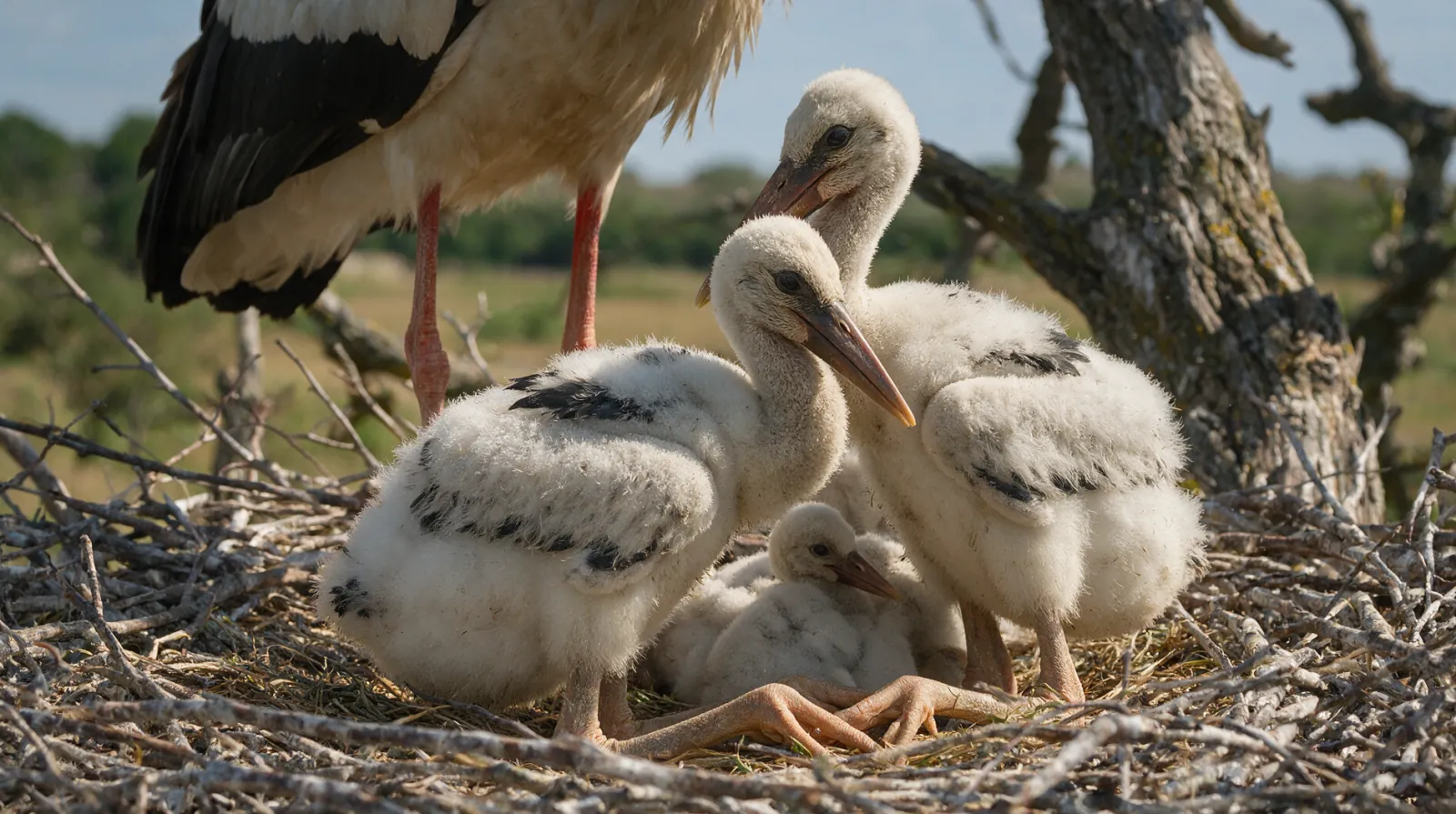
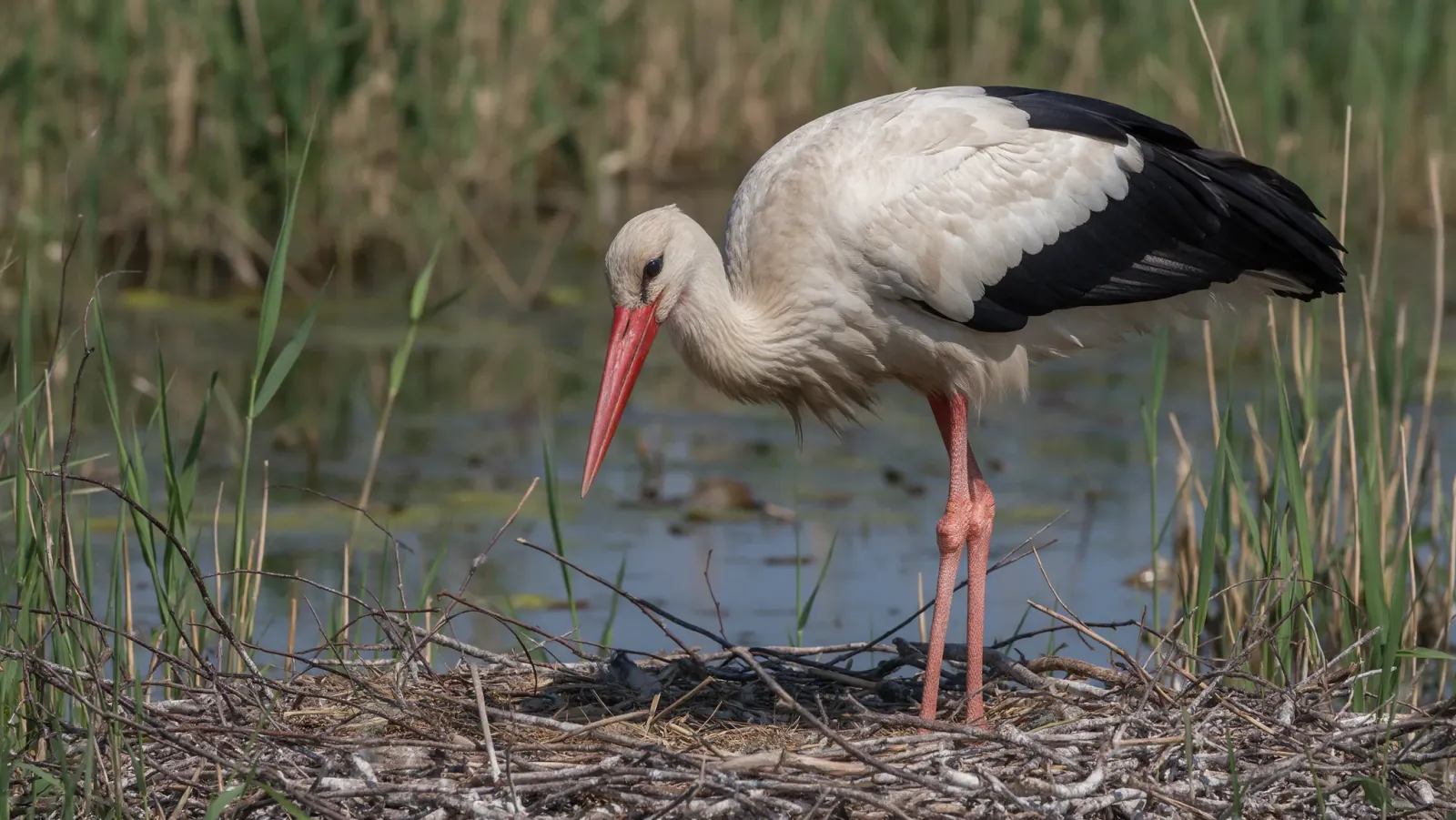
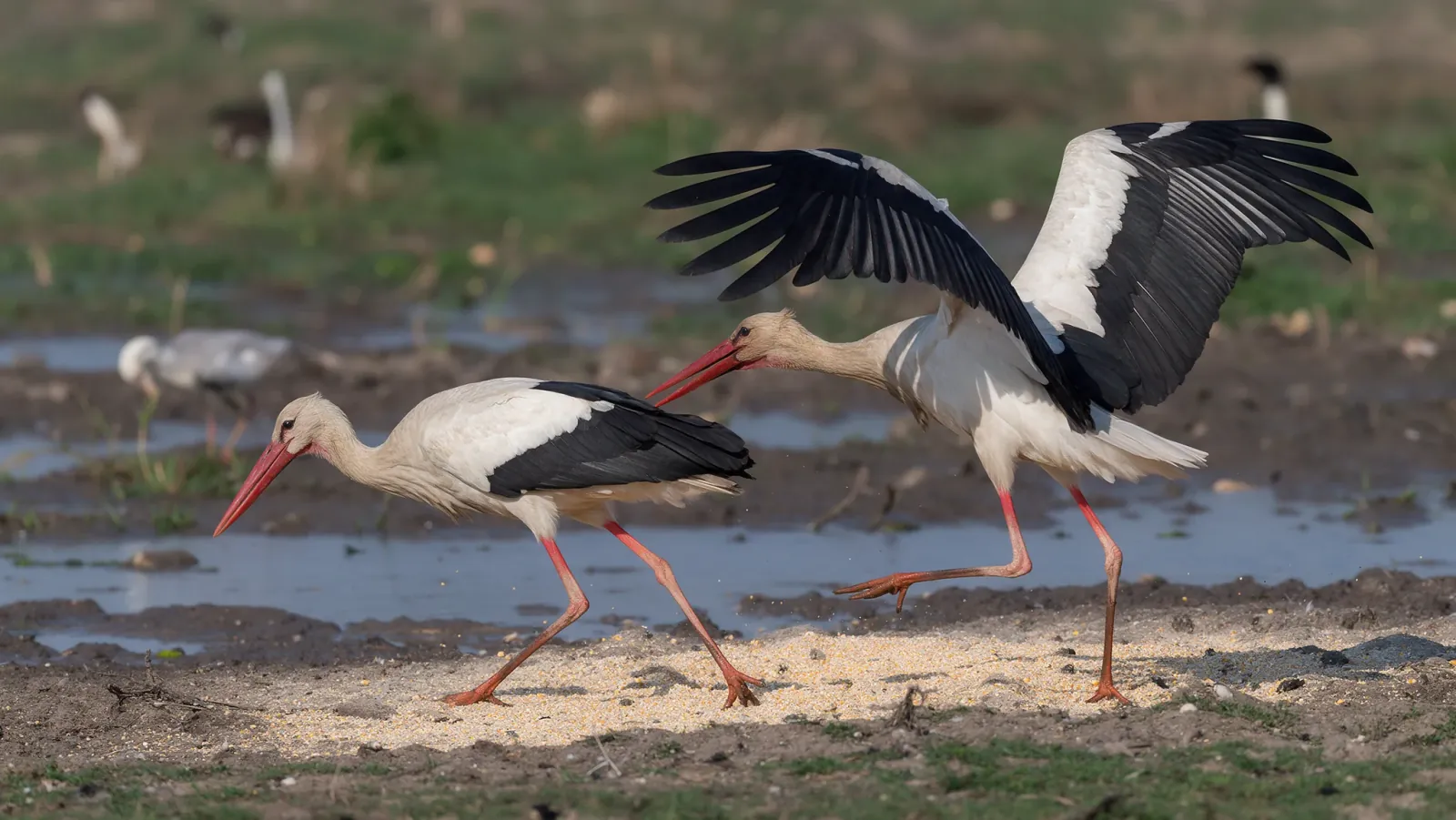
A stork defends its feeding spot by standing tall and, if that fails, by chasing the other bird off. The whole exchange is usually over in seconds. A good patch of shallow water or newly cut grass is worth holding, because the food in it feeds the bird and its chicks.
The patch worth holding
A stork feeds by sight and patience. It wades through shallow water or walks a cut field and snaps up whatever moves within reach. A patch thick with frogs, voles, or insects will feed a bird for an hour, and a field that has just been cut or a ditch that has just flooded draws storks from all around. The bird also remembers. A stork that has fed well in one corner of a meadow will come back to that corner on later days, and will defend it again. It holds the few metres of water or grass it is working, with no wider claim. When the feeding is good, that small space is held hard.
The stand that warns
The first defence is a display. When another stork walks near, the feeding bird straightens, raises its head, and points its bill at the newcomer. The stance says the patch is taken. Most of the time that is enough. The intruder reads the posture, turns, and walks off to feed somewhere else. A younger bird may need two warnings, and the defender will repeat the stance until the message lands. Storks settle these things without touching each other, and a long bill aimed at the chest is a strong argument. The defender loses nothing but a moment of hunting. A bird that is feeding chicks is less willing to give ground, and it will hold its stand longer than a bird feeding only for itself.
When the chase starts
If the intruder keeps coming, the defending bird moves. It runs a few steps with its neck stretched forward, or lifts off and flies low at the other stork, and the chase ends as soon as the intruder gives ground. A chase can cover twenty metres across a meadow before the birds separate. Then the defender walks back to the patch and starts hunting again, and the intruder finds a spot further off. Neither bird is hurt. If the intruder refuses to move, the defender may land on it with its feet, and the two birds tumble briefly before one gives up.
Real fights happen, mostly in spring when birds are tired from migration and the best ground is crowded. Two storks may lock bills, grip each other, and beat their wings, and the struggle can last longer than either bird would like. Serious injury is rare, and most disputes end at the first show of force. The bird that holds the better patch usually holds it, and the bird that gives way loses a meal rather than a season. Most of these clashes happen in the first weeks after the birds return, when good ground is crowded and everyone is hungry.
A feeding stork is feeding a family. During the weeks when chicks are small, one adult may be at the nest while the other hunts, and every frog that gets taken by a stranger is a frog that does not reach the nest. Later in the summer, when the meadows have dried and the chicks are nearly grown, the same birds feed in loose crowds with hardly a raised bill.
Why storks gather
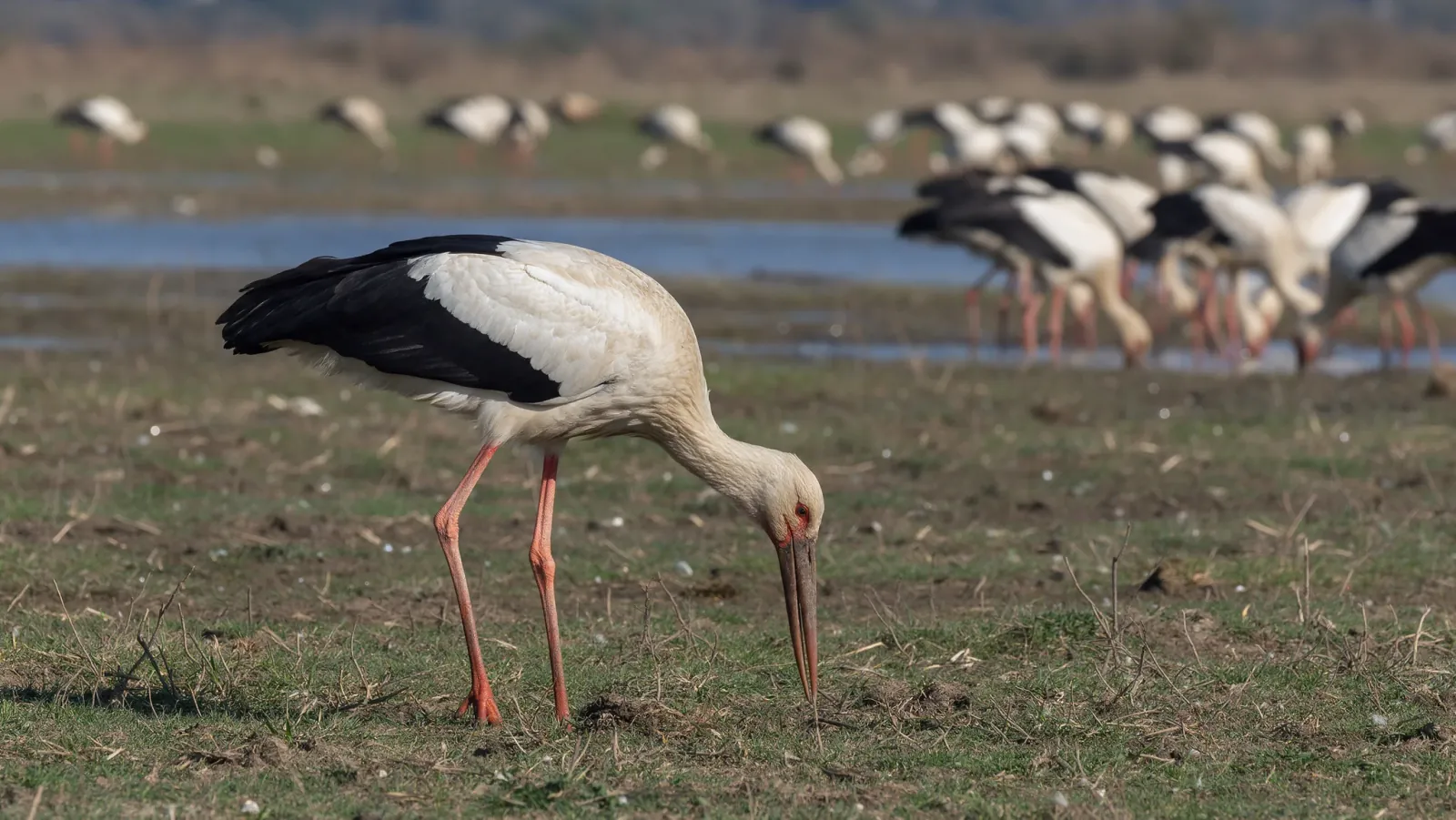
There is safety and information in numbers. Many eyes find food faster than two, and many birds watch for danger while each one eats. A flock over a cut field is a group of birds all reading the same ground, and each one gains from what the others notice. The flock is also company. White storks are calm among their own kind and will feed shoulder to shoulder without fuss. For a bird that spends weeks tied to a nest, the feeding flock is a return to company. Birds come and go from it all day, and none of them claims the group. A flock at a freshly mown field can build within an hour, as birds drifting overhead see the white shapes below and drop in.
Why one bird feeds apart
A lone stork is often a bird that has found something worth keeping. A small wet corner with a run of frogs will not feed a crowd, and the bird that finds it does better alone than in the middle of thirty competitors. Sometimes the bird is young and has not yet learned where the crowd goes. Sometimes it is old and slow and prefers the edge. Feeding apart is a choice about food, and it is usually made by the bird that is doing well. The lone bird often stands with its head down for longer stretches, because it does not have to watch the others for signs of alarm.
In the breeding season, one adult often stays at the nest while the other feeds. That bird stands on the platform, shaded by its own wings, and waits. When the mate returns, they swap. The changeover is quick and quiet: a landing, a greeting, a step aside, and the hungry bird is gone. A stork alone in a field may be the one on its way home, carrying a meal that has to reach the chicks while it is still fresh. It does not join the flock because it has somewhere to be. A bird carrying food flies straight and high, and it does not stop to feed on the way home.
The midday pause
Through the morning the bird hunts, walking slowly through wet grass and shallow water, and in the hottest part of the day it stops. It rests standing, often on one leg, on a rooftop or in the middle of a field, and it may stand there for an hour without moving more than its head. The middle of the day is hard work for a bird that hunts by sight. The light is flat, the ground dries, and prey that was easy to find at dawn has moved into cover. Walking hot fields burns energy that the bird could spend better in the cool of morning and evening. Resting at midday is a way of spending the day's energy where it earns the most. A bird that hunted through the heat would catch less and tire more, and the chicks on the nest would feel the difference by evening.
A resting stork often stands on a single leg, with the other drawn up into the belly feathers. The standing leg locks straight, the weight settles over it, and the bird can hold the position for a long time without effort. Tucking a leg also keeps it warm, since the bare skin sits against the body instead of hanging in the wind. On a hot roof it sometimes stands with both wings lifted slightly away from the body, which lets the air move through and takes the edge off the sun.
Even at rest a stork is never fully off guard. Its eyes stay open in slits, and its head turns at a sound or a movement below. When a chick calls from the nest, the standing bird answers straight away, so the rest breaks whenever the family needs something. A fence post or a bare branch will do as well as a roof, and birds that have fed well often gather in loose groups to rest, spaced a few metres apart.
The bird is patient about the wait. It does not fight the heat. It stands still while the sun crosses its highest point, and it moves again only when the light begins to soften. When the heat eases, it stirs, shakes out its feathers, and steps back into the day.
A flock in a field often has one bird at the margin, facing the other way, working a ditch the crowd has missed. It has found the corner worth having, and the flock may drift toward it within ten minutes, until the edge becomes the middle.
Explore the gift