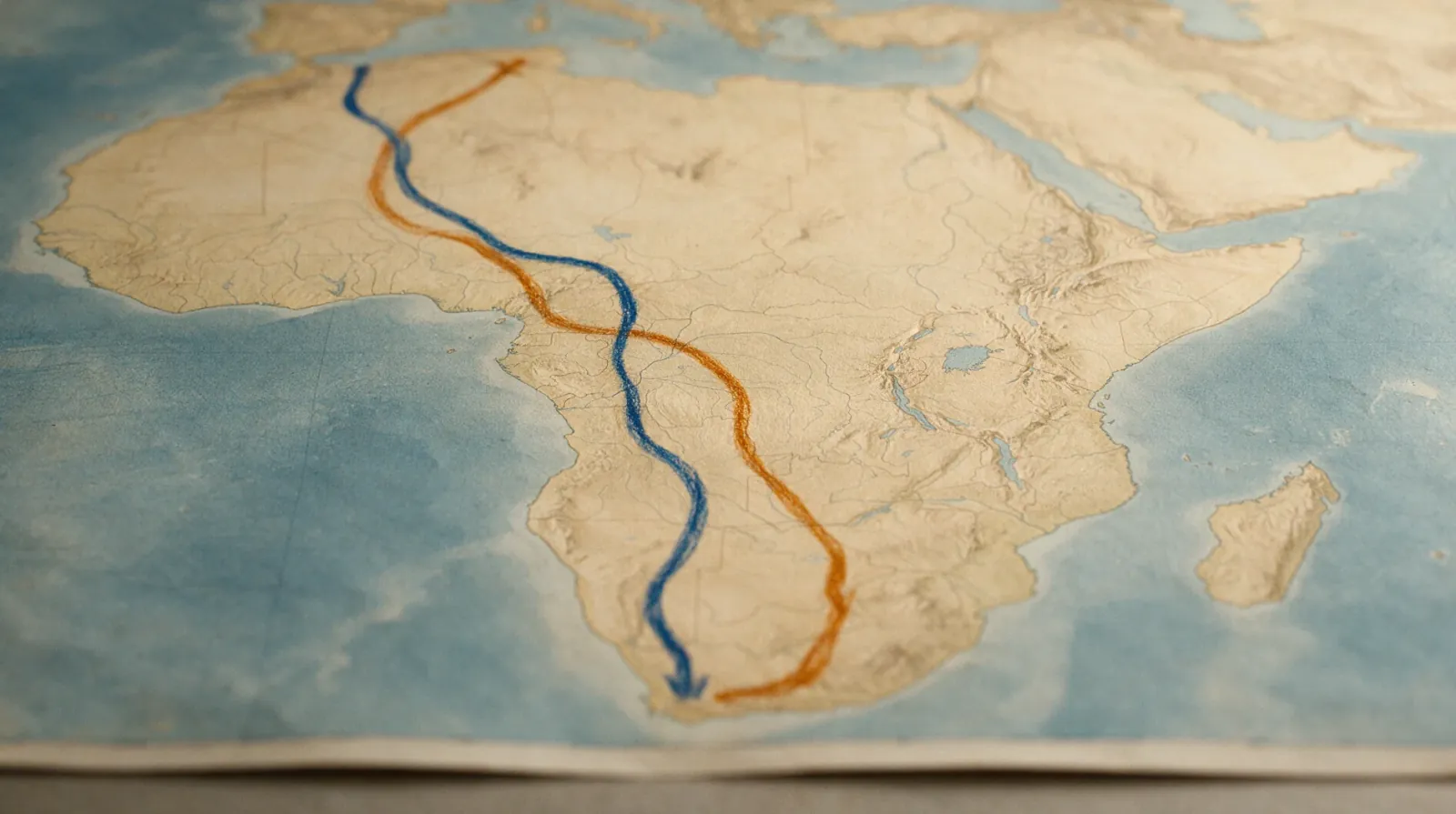
Jasper and Kaja were ringed on the same morning, in nests a few kilometres apart, and their routes split at the first real decision of their lives. One turned west toward Spain and the Strait of Gibraltar. The other turned east toward the Bosphorus. The study keeps both lines in the same file, which makes the difference easy to see.
One notebook, two nestlings
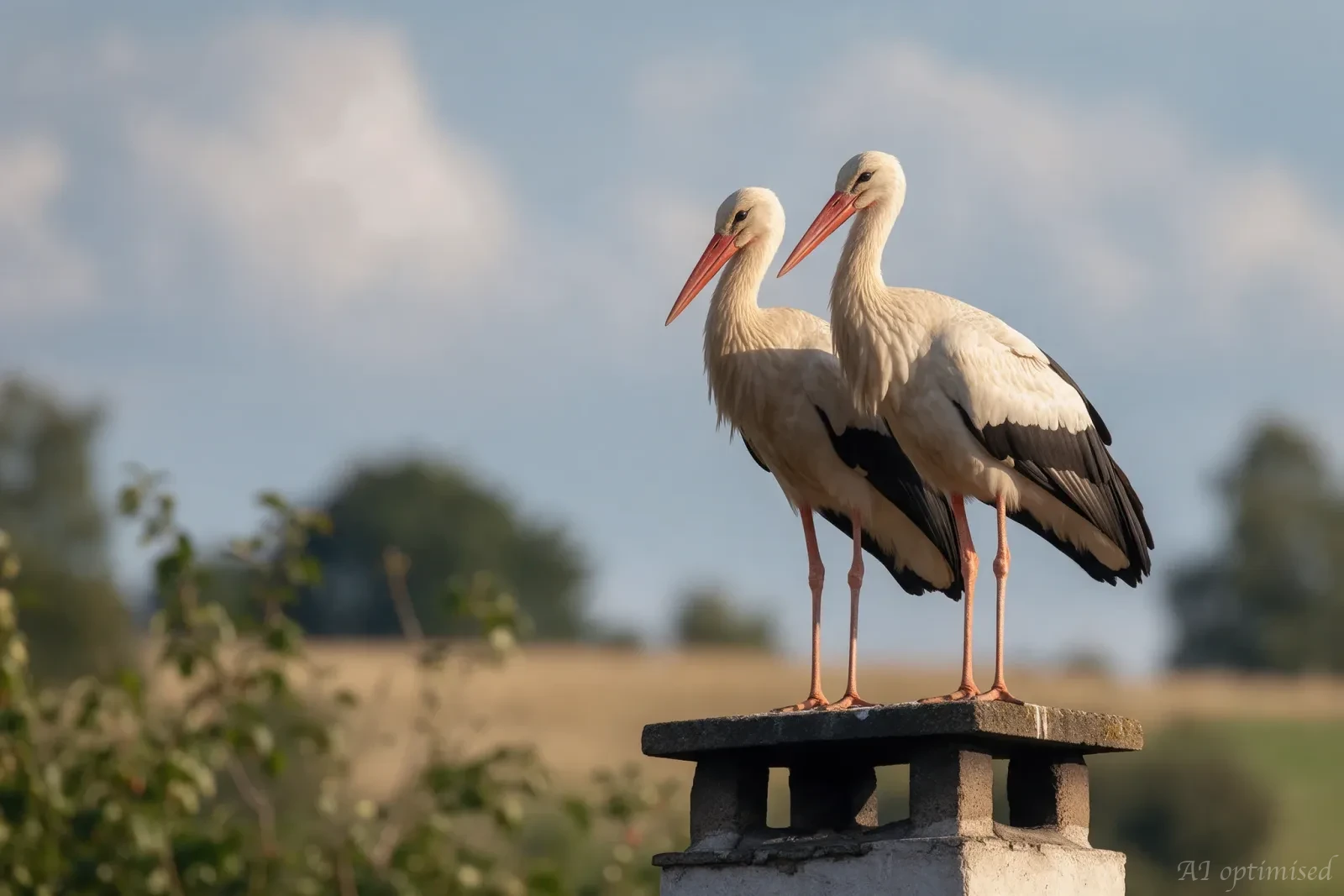
Both birds were chicks when the rings went on. Both were measured, weighed and returned to the nest. On paper they were nearly identical: same species, same age, same red legs and red bill, same black flight feathers on a white body. The names arrived later, and the names are the only reason a reader can keep them apart.
Without the names they would be two codes in a column, and a column is hard to care about. The names do the work a photograph would do for a person: they make the record into a subject. The codes remain the hard fact underneath, unchanged by the story built over them.
The western corridor
Jasper's first autumn carried him southwest through France. White storks on this route follow the warm air over the plains, cross the Pyrenees at their western end, and gather near the Strait of Gibraltar. The sea there is narrow enough that a stork can see the far shore on a clear day, which is the whole reason the crossing works.
His points moved in a steady rhythm. Feed in the morning, climb at midday, roost in the evening. There was nothing dramatic in the line, and that is what a good migration looks like: a long series of ordinary days. The route bends around high ground and open water, and the bends are where the weather makes its decisions.
The corridor is crowded in late summer. Birds from across Europe arrive at the same coast, feed in the fields behind it, and wait for a morning when the air is clear and the wind does not push them sideways. A good crossing can begin late and still finish before dark. A poor one is abandoned at the shore.
The eastern corridor
Kaja went the other way. The eastern route runs down through the Balkans, funnels at the Bosphorus, and continues through the Levant toward the Nile. The Bosphorus is one of the great stork bottlenecks of the world. Thousands of birds pass over it in a few weeks, riding thermals that form over the warm land on either side of the water.
For Kaja the crossing is a different problem. The corridor is crowded, the weather is different, and the landmarks are unfamiliar to a bird that has never flown them before. He manages it the way young storks do, by following the birds around him.
The eastern route is longer over land and crosses more dry ground. Water and food are spread differently, and a stalled flock can find itself far from a wet field. The birds that use it learn the stopping places the way the western birds learn the coast.
Why the routes divide
Two chicks from the same region can end up on different flyways because the choice is made by the flock they join, the wind on the day they leave, and the route they learned from their parents. A stork does not consult a map. It follows air that rises and birds that know where they are going.
A young stork on its first migration learns the route as it flies it. It responds to the same cues that sent its parents south, and the second autumn will be easier.
The two corridors reward different things. The western route is shorter over water and crowded with Spanish rice fields. The eastern route is longer and crosses more dry ground. Neither is safer in every year. A storm over one can make the other look easy.
The long way around high ground
Not every line follows the main corridor. A white stork travels by soaring, and high, cold ground gives it nothing to ride. A thermal is a column of warm air rising from ground the sun has heated. Fields, roads, dark roofs and dry soil produce them. High mountains do not. The air over a range is often cold, thin and moving in the wrong direction.
So a bird may follow the edge of a range instead of crossing it, and the map records a wide, smooth arc where a straight line would seem sensible. The Pyrenees produce this kind of bend on the western route, and the Alps produce something similar further east. The bird did not plan the curve. It followed the rising air, and the rising air follows the land.
The detour costs days and meals. Extra days mean more time in fields that may be wet or dry, hunted or quiet. The cost is still lower than the cost of crossing a range with no lift. A stork that tries the direct line may find itself below the ridge with nowhere to climb.
The first bird over the water
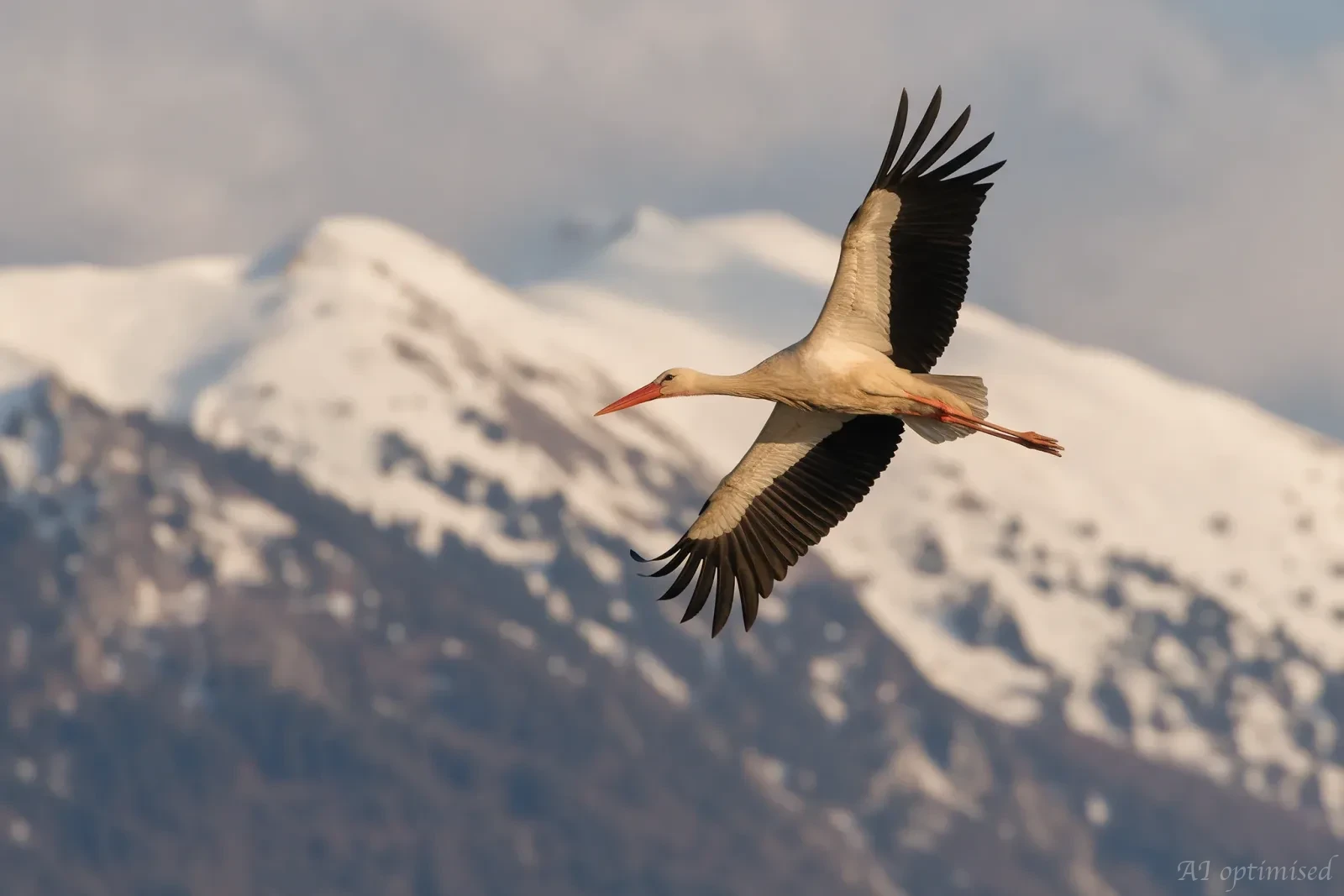
Every autumn the storks gather at the narrow sea and wait for the right air. One bird usually leaves before the numbers feel safe, and the others follow within days. The first bird is often an adult, and often one that has made the crossing in previous years. Experience shows in the timing.
Over open water a stork cannot soar, because there are no thermals rising from the sea. It flaps, or it glides on whatever height it carried from the shore. The crossing at the narrowest point is short enough to be possible, and long enough to be dangerous if the bird starts too low.
The most honest part of a crossing is the silence. A solar tag over the sea may not charge, and the receiver network may not hear it. For a few hours the bird disappears, and the blank space is the closest the map comes to showing risk. When the next point arrives on the far shore, the season has its first traveller.
Two lines, one season
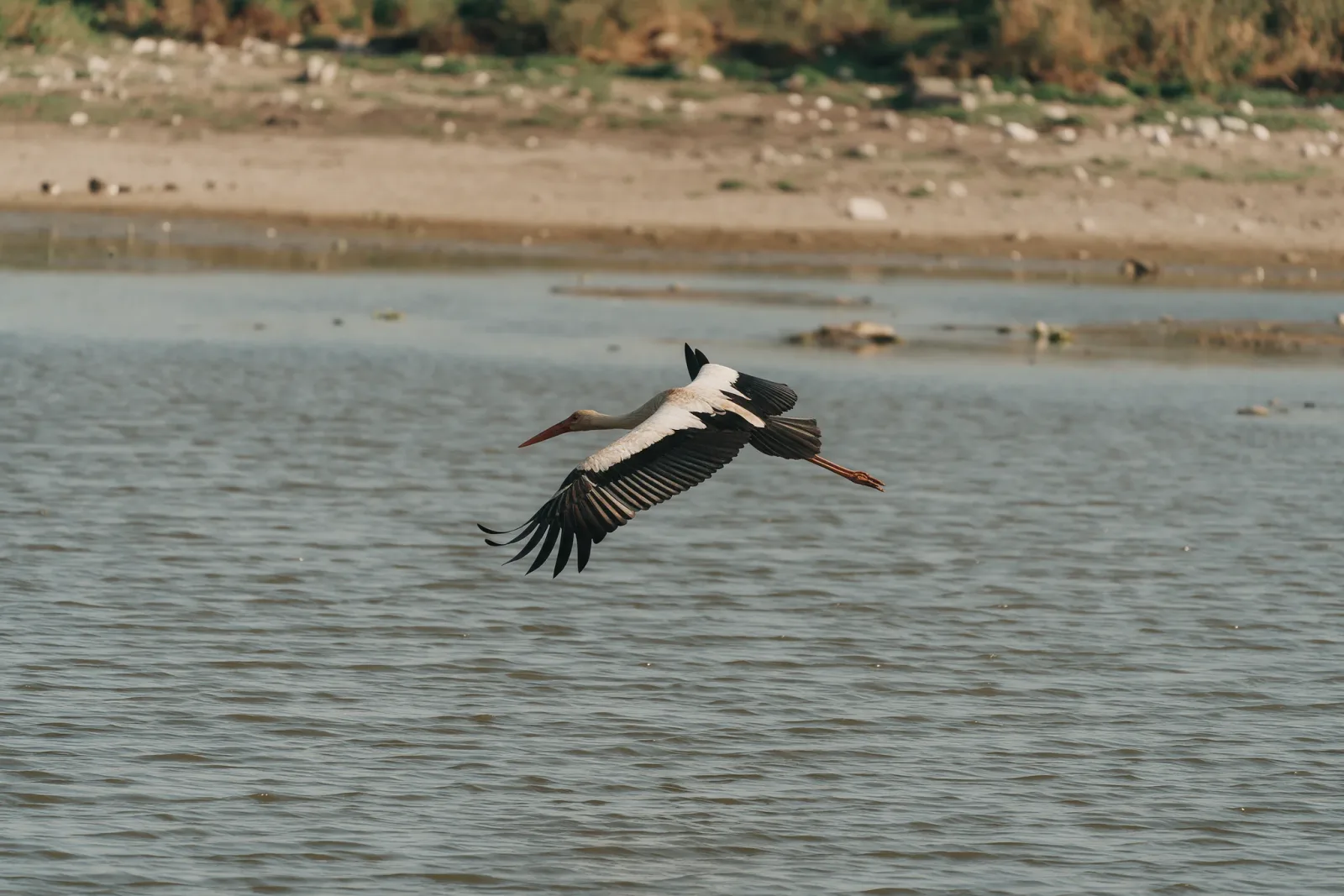
In the records their codes sit a few lines apart. On the map the lines separate and never touch again until both birds turn north in spring. Jasper will come back to a roof in the west, Kaja to a roof in the east, and the file will show two journeys that began in the same notebook.
A single line looks like the way storks migrate. Two lines show that there are several ways south, and the file keeps both of them. The longest tracked journey in the study belongs to a bird that did nothing unusual. It flew south, fed through the winter, and flew north again. A white stork on the western route may cover close to 10,000 kilometres between one spring and the next. Most of that distance is spent gliding, climbing in circles over warm ground, and descending to feed.
The last point of the year lands within a few hundred metres of the first, and the season closes on the same roof. The file keeps both lines, and the two together say more about the season than either line alone.
Explore the gift