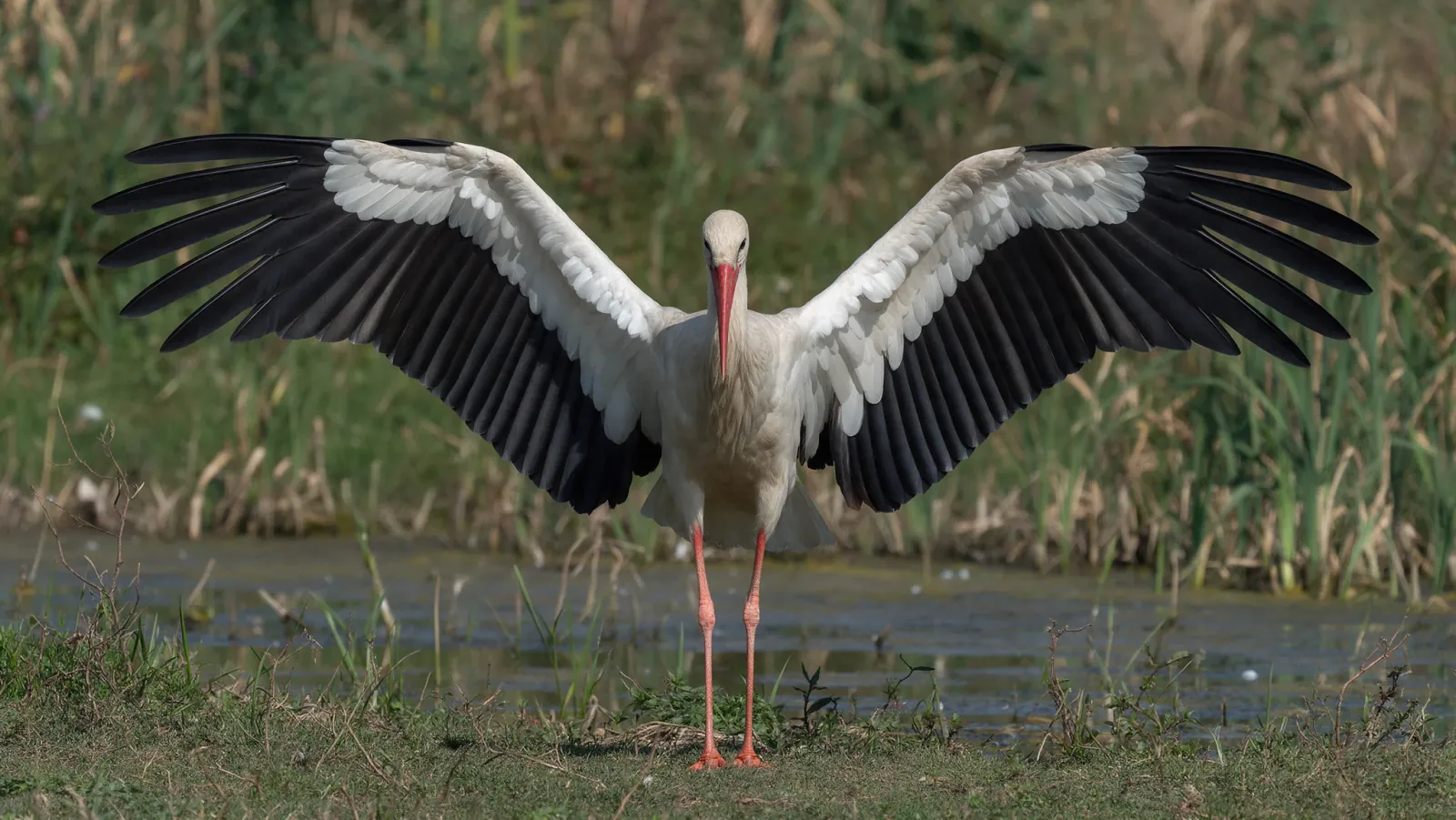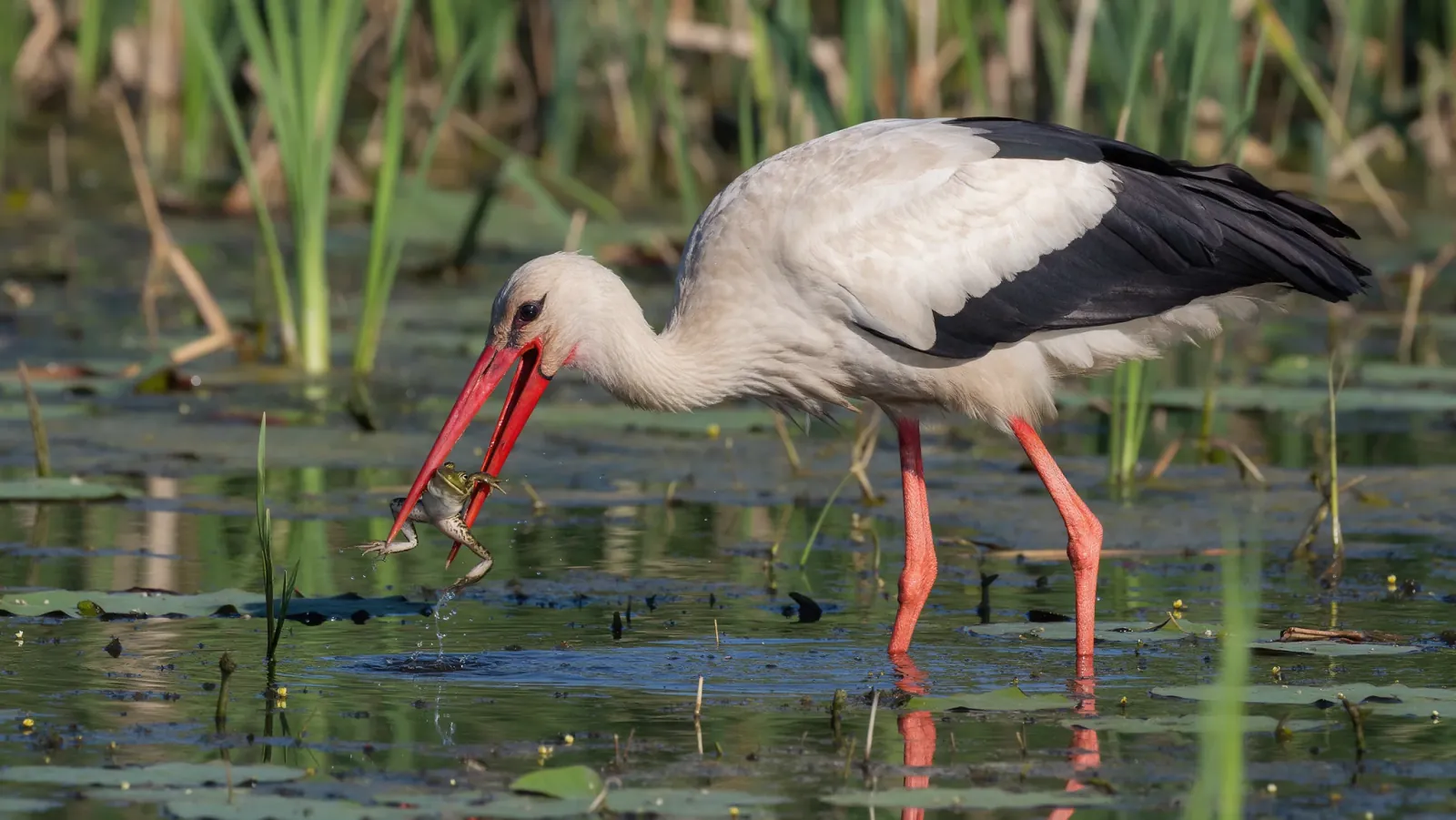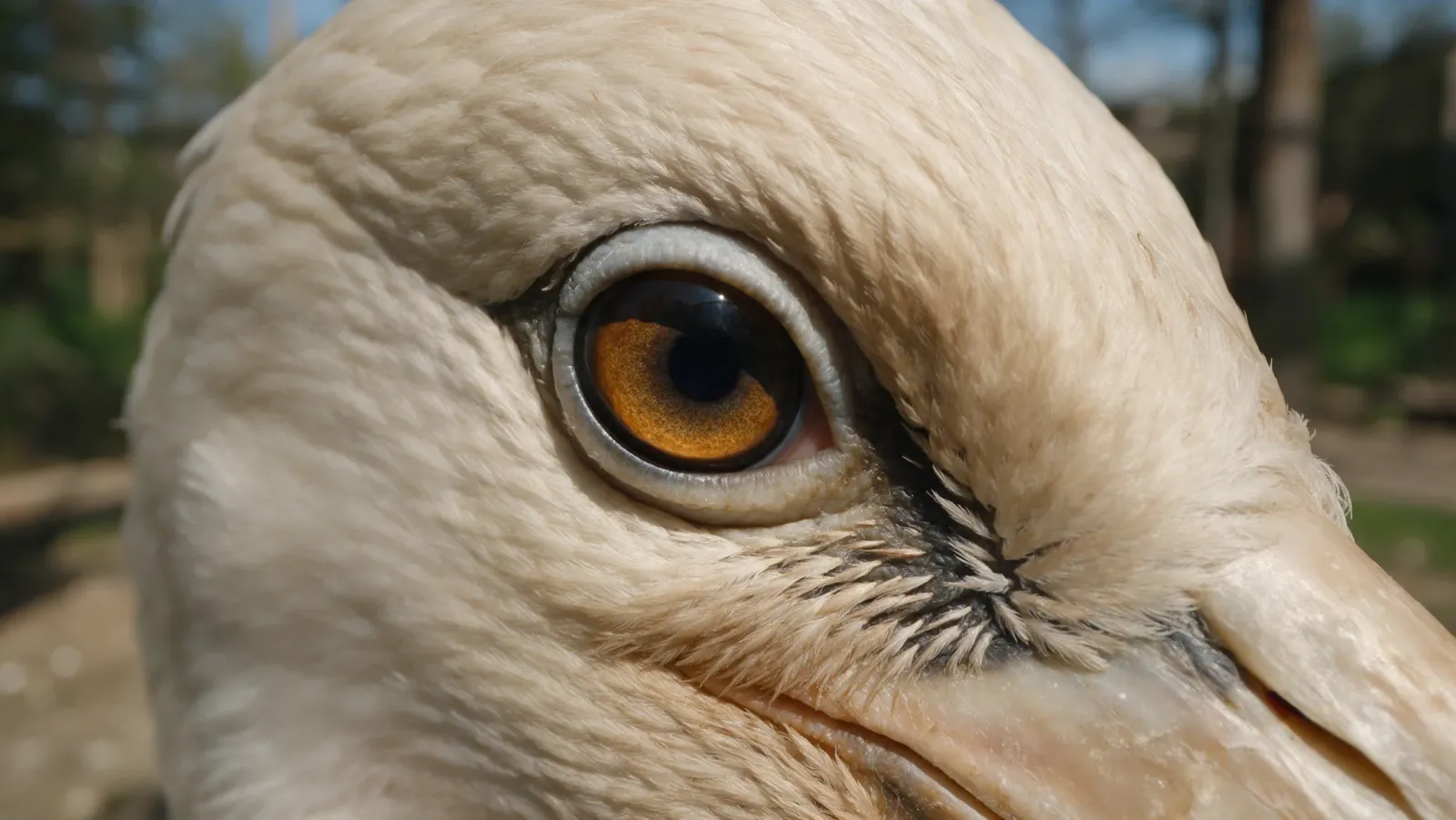
A white stork feeds by sight. It walks wet grass and shallow water with its head low, watching for the smallest twitch of a frog or the glint of a beetle. The bill arrives a split second later. The eyes that guide that strike are large, wide-set and quick to catch movement.
Large eyes, wide view
The eyes of a stork are big for the size of its head. A larger eye gathers more light and can hold a sharper image, the way a wider window shows more of the view. The eyes sit toward the sides of the head, which gives the bird a broad field of vision while it feeds.
That width is a guard as well as a hunting tool. A stork with its head down in the grass can still notice a shadow crossing behind it. The same eyes that find prey also watch the sky. A bird feeding in an open meadow has no cover, so the view to the side matters as much as the view down.
The eyes are also protected. A thin membrane can sweep across the surface to clean it without closing the lid. The bird keeps watching while the eye is wiped, and the hunt goes on without a blink. On a wet morning that membrane earns its place, clearing mud and water while the bird keeps its head in the grass.
A sharp centre and a narrow overlap
The clearest vision in a bird's eye is concentrated in a small spot on the retina where the light-sensitive cells are packed most densely. A stork uses that sharp centre to study one patch of ground at a time. It can shift focus quickly from a stem to a ripple to a movement in the mud.
What the bird sees is detail. A frog barely breaking the surface, a beetle shifting under a leaf, the faint disturbance of a fish in a puddle. The eye reads these small signs long before they would mean anything to a person standing nearby.
The wide-set position has a cost. The fields of the two eyes overlap only in a narrow band in front of the bill, so the stork has limited depth perception at close range. It gains a nearly all-round view in exchange. When the bird strikes, it relies on motion and on the alignment of the head rather than on a precise judgement of distance.
A stork also holds its head remarkably steady while walking. The body moves, the long neck absorbs the sway, and the eyes stay fixed on the ground ahead. The steadiness makes small movements easier to detect. A still head turns a twitch in the grass into a clear signal.
Four kinds of colour cell
A stork's colour vision reaches further than ours. Human eyes mix every colour from three kinds of light-sensitive cell. Birds carry four, and the extra set reaches into ultraviolet light, which human eyes cannot see at all. The meadow a stork stands in is a different place from the one we see.
Each kind of cell responds to a different part of the spectrum. With three, we can match any colour we know. With four, a bird can tell apart shades that look identical to us, and it can see markings that reflect ultraviolet. Flowers, feathers and the skin of small creatures can carry patterns in that range. To a stork, a plain green field is full of marks that human eyes never register.
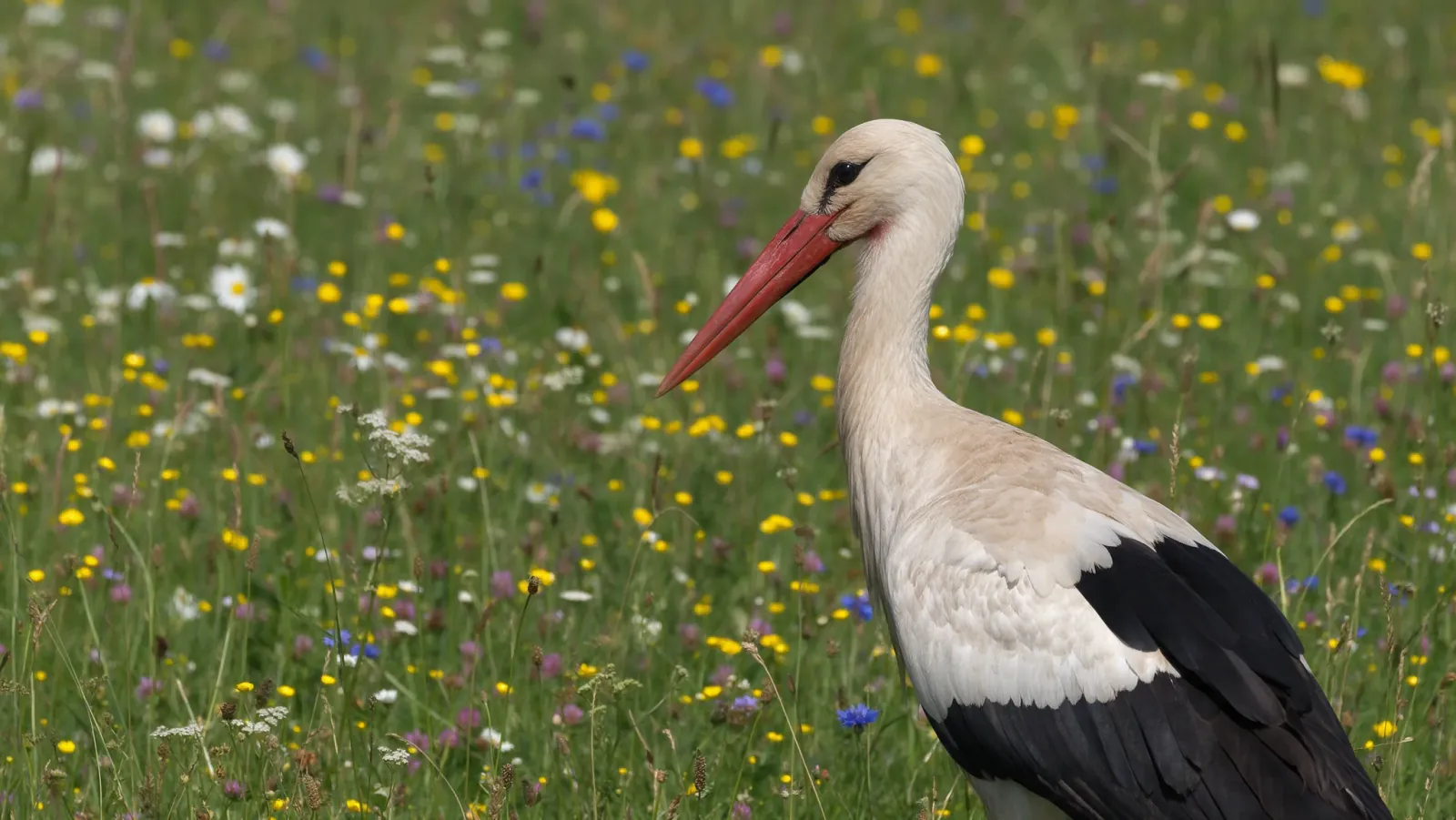
Colour has a practical use in the hunt. Many insects and small animals reflect ultraviolet light, and their markings can stand out to an eye that sees them. A stork scanning a meadow may pick out a frog or a beetle by a pattern on its skin before the creature would show against the grass to us. Colour helps the bird sort food from mud and stems, working alongside the sharp centre of the eye and the quick response to movement.
The same sense works in the other direction. The white plumage of a stork reflects ultraviolet light, and to another bird those feathers may carry a brightness and a pattern that human eyes miss. Storks recognise one another by sight, and the subtle signals in the plumage are part of that recognition. Feather colour also changes with wear. A fresh feather in spring is more intense than the same feather at the end of summer, and the ultraviolet signal fades with it.
Inside a bird's eye, tiny coloured droplets of oil sit in front of some of the light-sensitive cells. Each droplet screens out part of the spectrum, so a single cell can separate colours that would otherwise blur together. The result is a colour world that is better sorted than our own, and a view of the meadow that is both richer and quicker than ours.
The slow walk and the strike
A stork moves through a wet meadow with its head down and its eyes on the ground, one careful step at a time. Long legs lift high and settle without a sound, so the frogs and insects in the grass do not feel the ground shake. Each step is deliberate, and between steps the bird stands still and watches.
The still moments are when it sees the most. A grasshopper shifting on a blade. A frog blinking in the shallows. The bird is reading the ground, and the reading takes time. Its head turns to follow a small movement, and the rest of the body stays where it is.
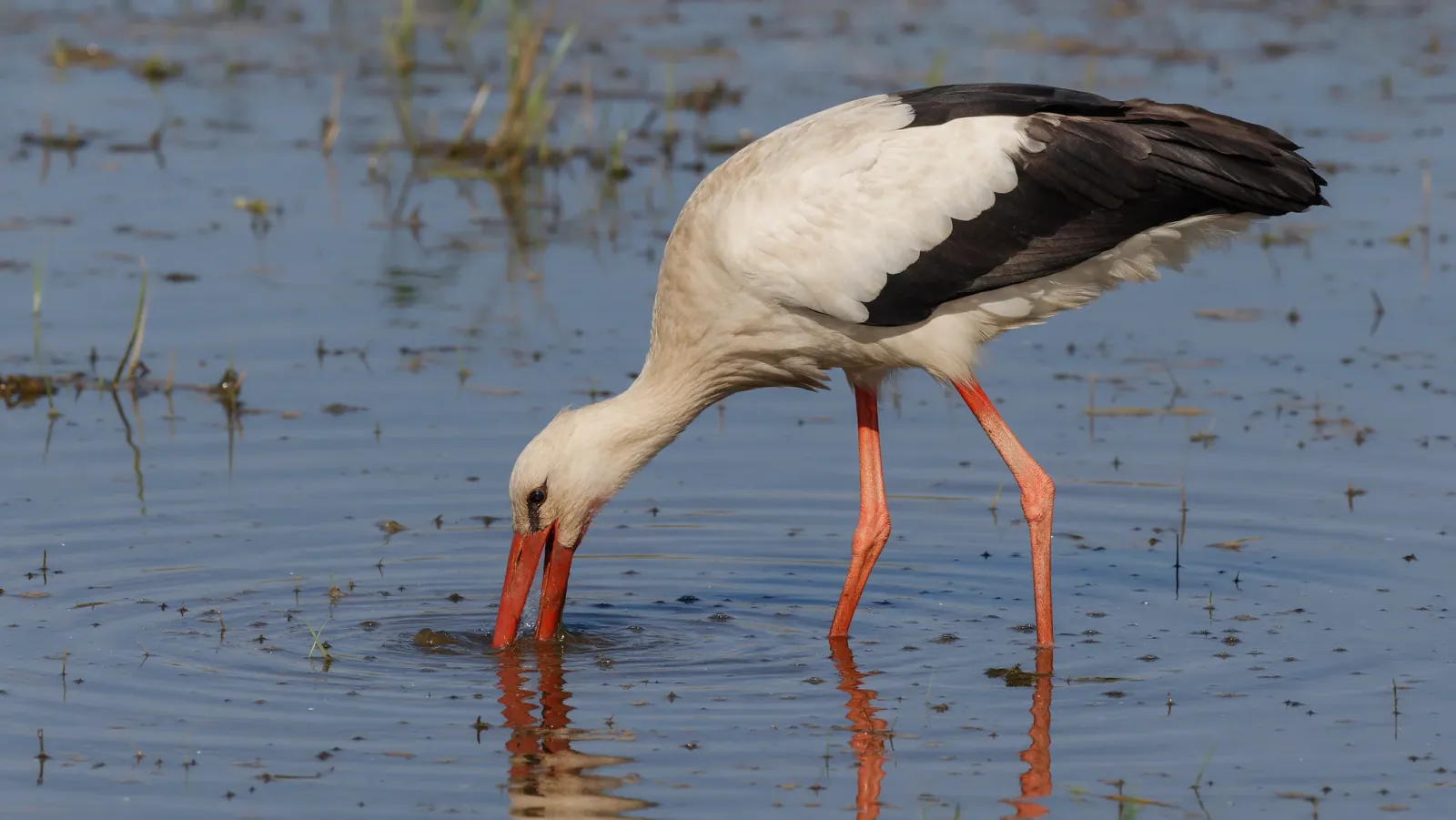
When the stork sees prey, the whole body moves at once. The neck draws back and the bill shoots forward into grass or water, snapping shut on contact. A frog, a beetle, a vole. The catch is over in a fraction of a second. If the first strike misses, the bird tries again a moment later.
A stork may catch dozens of small creatures in a morning. Each one is small, and each one adds to the long work of staying alive. The strike looks sudden because the waiting was long.
Working the water line
A stork often hunts along the water's edge, where the ground is soft and small animals gather. It wades a little, lifting each foot clear of the mud, and watches the surface. A frog sitting too near the edge is caught with a quick stab.
The water line is a long, rich seam of food, and the stork works it from end to end. Because its meals are tiny, it must keep hunting from morning to evening. Feeding is a full day's work, done at a walking pace.
Storks often follow farm work. A plough turning soil brings worms and insects to the surface, and the birds gather behind it. The habit is old, and it is one reason storks and people have lived close together for so long. The same places draw the bird back: shallow water after rain, a hayfield after it is cut, the muddy edge of a pond.
A stork learns which fields hold food after which weather, and it returns to them season after season. Early morning and late afternoon are often the best hours, when small animals move and the light is low. The bird works the same ground at the same hours, day after day.
What the eye cannot do
Sight carries most of the hunt, and the other senses do less. A stork's sense of smell is modest, and its hearing is not tuned to find prey under mud. It works by watching, and it trusts the eye.
That trust shapes the bird's day. It stands for long stretches with its head low, and the patience is active. The eyes are moving, the head turns to follow the smallest change, and the long wait is a kind of attention. When the meadow moves, the bird answers in a fraction of a second, and the long bill reaches the exact spot the eye picked out.
The colours of a meadow shift through the day. Low morning light brings out different shades from the flat glare of noon. The bird's colour vision is a live view, changing with the light.
Explore the gift