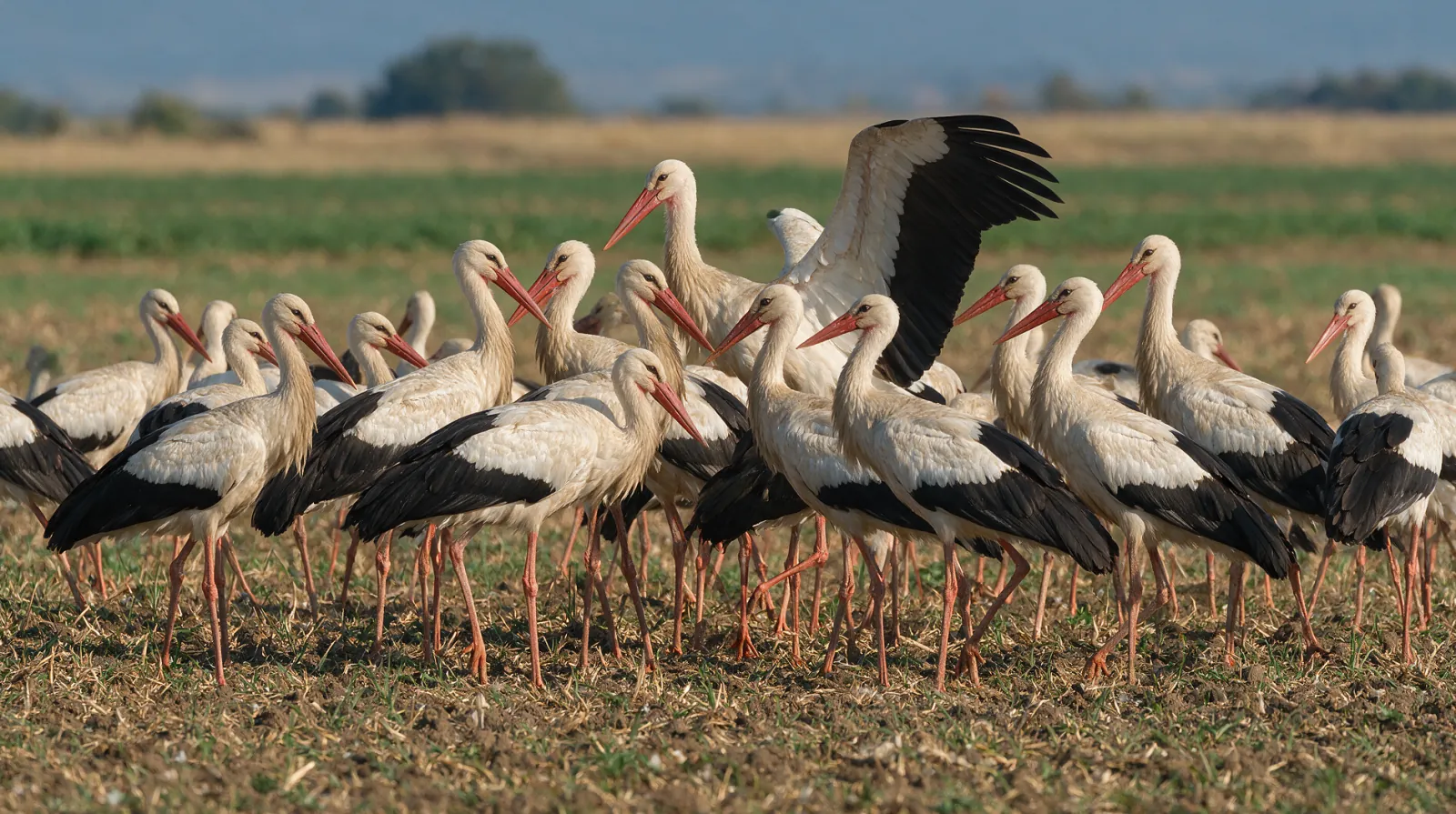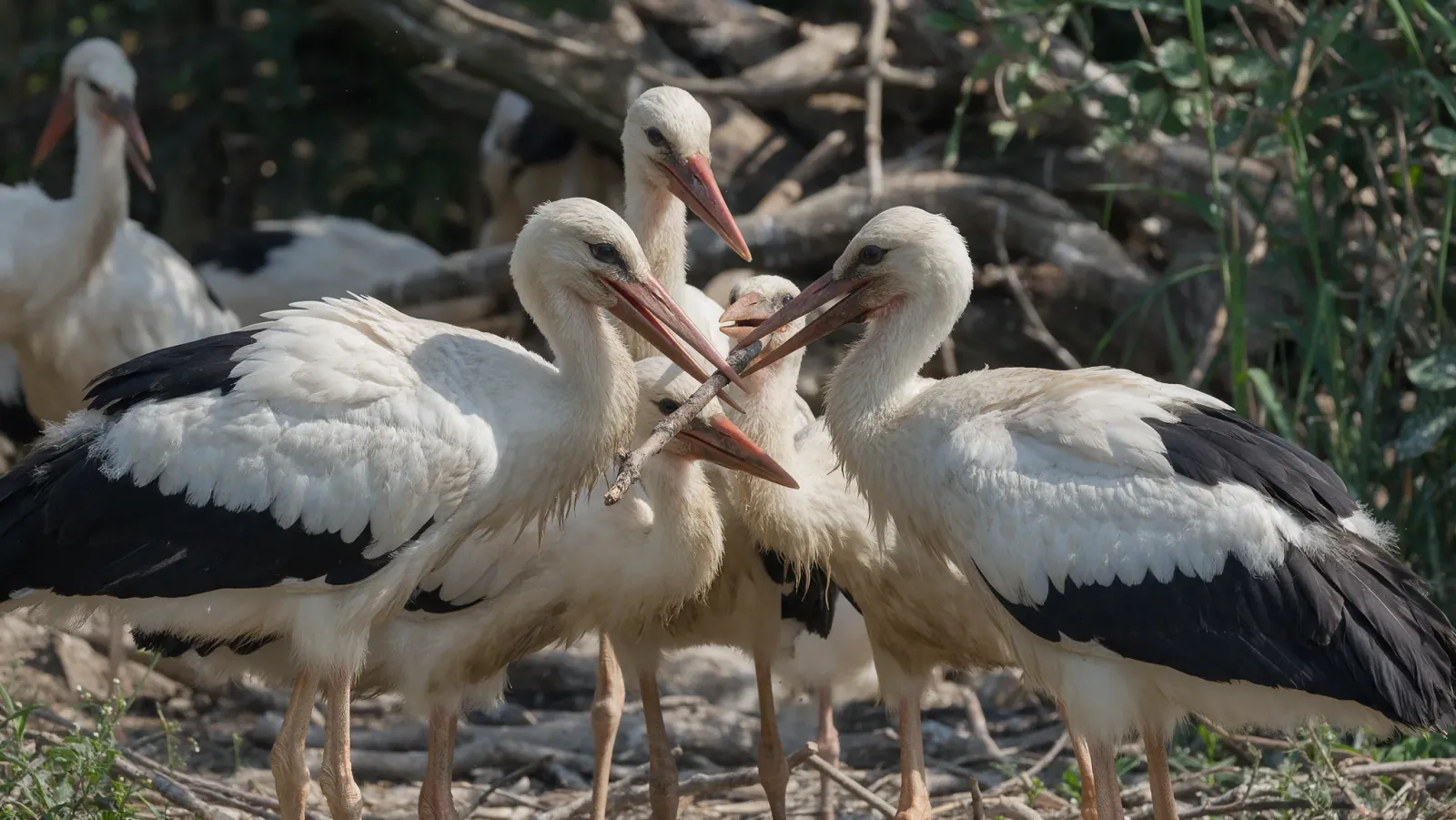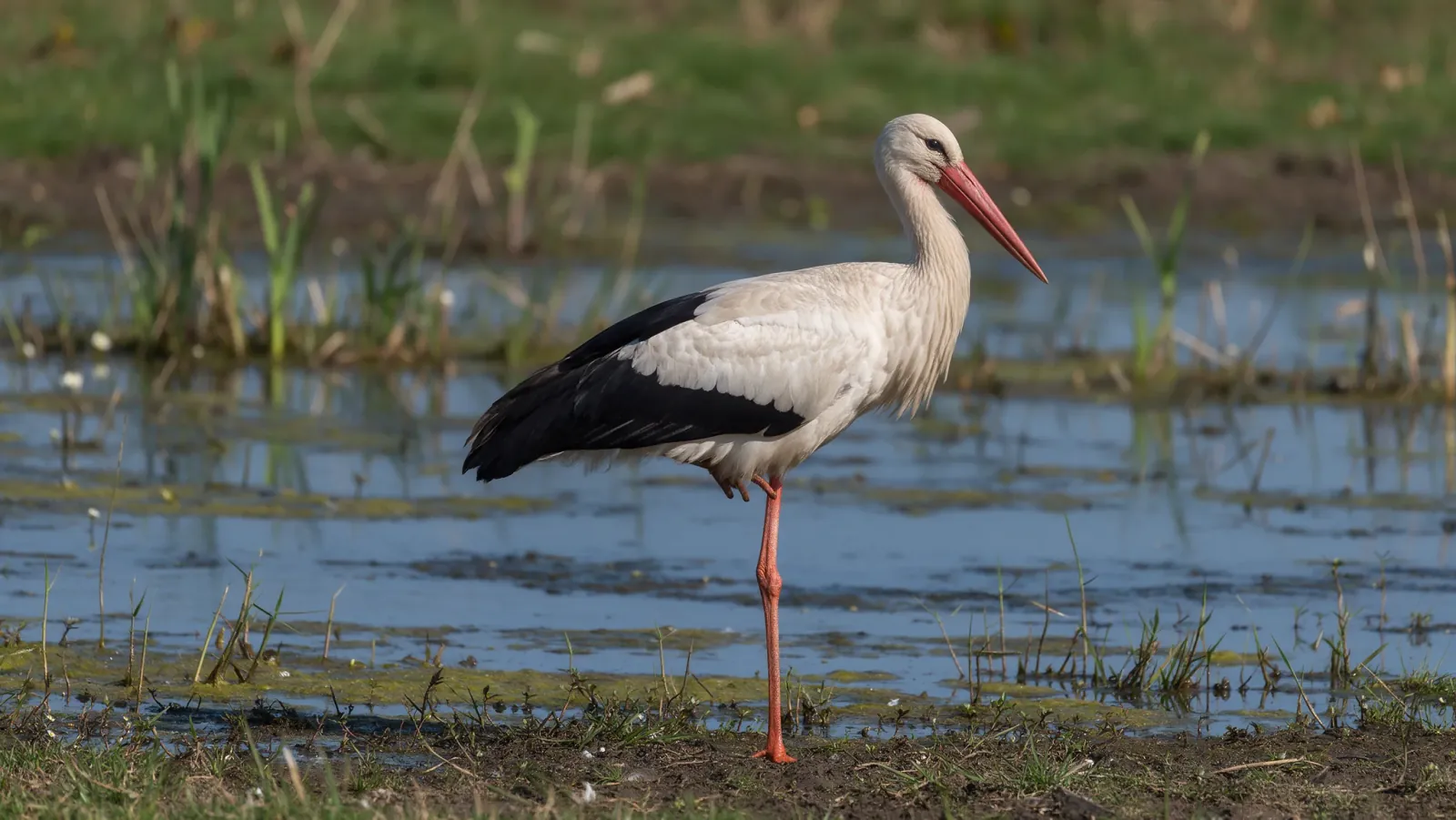
A white stork can stand in a wet meadow for hours without showing fatigue. The reason is a small piece of engineering in its legs. When the bird settles its weight onto a straightened leg, a tendon pulls tight and the joint locks. The leg holds the bird up with almost no muscular effort.
The joint that locks
A bird's leg bends at more than one place. The knee bends one way and the ankle bends the other, and the tendons running down the back of the leg pass over both joints on their way to the toes. When the stork stands tall and its weight presses down, those tendons draw tight. The joints are held straight by the tension.
The lock is passive. It needs no decision and very little energy, because the bird's own weight does the work. A standing stork is mostly resting on its own skeleton. The arrangement works while the bird is awake and while it sleeps, and it does not tire the way a held muscle would.
The same mechanism releases easily. When the bird decides to move, it bends the leg and the tension slackens. The lock opens, the foot lets go and the stork steps as easily as any other bird. Nothing has to be unlatched by a separate movement.
The foot closes under weight
The same mechanism reaches the toes. The tendons that straighten the leg also tighten the foot, so the bird's weight closes its grip on the ground. The taller it stands, the firmer the toes hold.
This is why a stork can sleep on a nest platform in a high wind and not fall. The leg locks, the foot grips, and the arrangement works without the bird thinking about it. Weight does the holding in both directions. A gust that pushes at the feathers pushes against a bird that is already braced by its own mass.
On soft mud the spread toes carry the load across a wider surface. On a branch or a nest rim the same grip closes around whatever the foot finds. The stork does not need a different foot for each surface, because the closing action adapts to the shape beneath it.
Weight over one foot
A stork stands on one leg the way most people stand on two: easily, and without thinking about it. It lifts one foot, folds it into the feathers of its belly, and balances its whole weight on the leg that remains. The pose can last for a long stretch.
The secret is where the weight falls. A standing stork keeps its locked leg directly beneath its centre of gravity. The line of the leg runs almost straight up through the body. When the weight and the foot line up, the bird does not have to fight to stay upright.
A small wobble is corrected by a slight shift of the head and body. The corrections are tiny and continuous, and they cost the bird almost nothing. Balance is a series of small adjustments, most of them invisible.
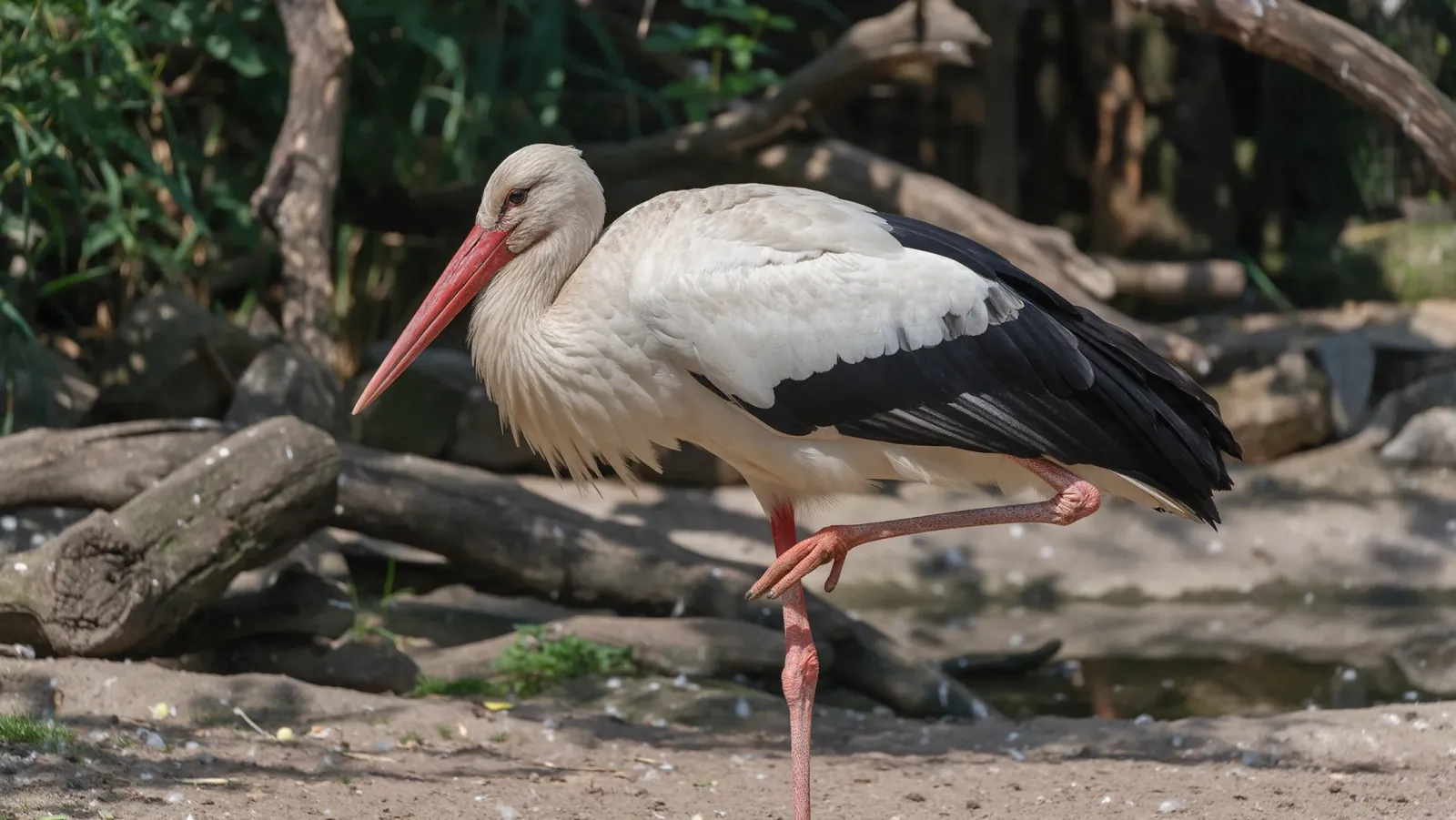
The pose is common among large wading birds, and the reason is the same for all of them. Legs in cold water lose heat, and a foot held against the body stays warm. The stork's version is unusually steady because the standing leg locks, so the bird can rest without a constant muscular correction.
The tucked foot
The lifted leg folds up so the foot rests against the warm feathers of the belly. For a bird that spends its days in cold water, this is the useful part of the pose. The feet and lower legs have little insulation, and tucking one foot in keeps it warm and lets it dry.
In cold weather a stork stands on one leg more often. In warm weather it does so less. The habit is a way of holding heat in, and it also gives one foot a rest from the cold water and the weight above it. A bird feeding in cold water lifts one foot more often than one on dry ground.
A stork does not keep the same leg up forever. After a while it lowers the tucked foot, shifts its weight and lifts the other. Each foot gets a turn in the warmth and a turn on the ground. The change is quick and smooth. One foot comes down, the other comes up, and the bird is balanced again on the other side.
On a mild day the stork may rest the foot against the belly without folding it deep into the feathers. The pose shifts with the weather, and the bird finds the version that suits the hour. People often read the one-legged stance as rest or as patience. It is both, and it is also a small piece of heat management.
Keratin plates on the bare leg
The lower leg carries no feathers, and the skin there is covered in small overlapping scales that run to the toes. They look like the scales on a lizard, and they do similar work. They shield the skin from cuts, cold water and rough ground.
The scales are hardened plates of keratin, the same material that makes the bill and the claws. Each plate overlaps the next like tiles on a roof, so water runs off and the soft skin beneath stays protected. The pattern is set early in the chick's life and grows with the bird.
Scales do not fall out and regrow the way feathers do. They thicken, wear down slowly and are repaired from beneath. An old stork's legs look thicker and more worn than a young bird's, and the plates are still doing their work after many seasons.
A stork's legs take a hard life. The bird wades through cold mud, steps on stones and sharp reeds, and stands for long hours in wet grass. The scales spread that wear across many small plates. They also slow the loss of water through the skin, which matters to a bird standing in the sun. The surface is faintly ridged, and those ridges grip wet ground the way the tread of a boot does.
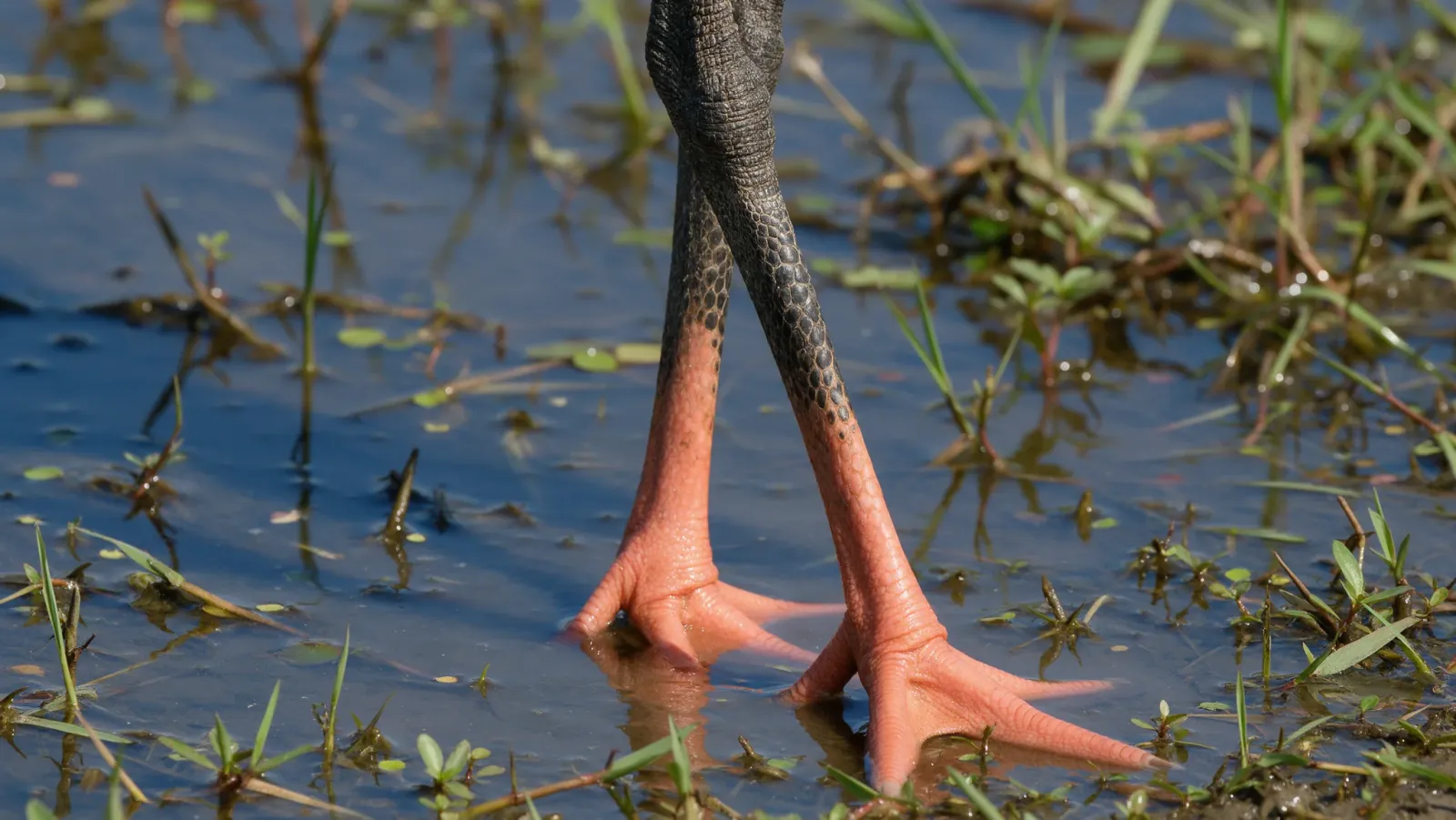
The colour of the leg shows through and around the scales. An adult white stork has warm pinkish red legs, a colour that comes from blood vessels close to the surface. In a young bird the legs are paler and greyer, and they redden as the bird matures. The scales themselves are pale grey, so they show against the red skin as a fine lattice of lines.
Scales are made of the same protein as feathers. A feather is a more elaborate version of the material, built into a branching surface. The scales on a stork's leg are the older, simpler form, kept where a hard flat surface works better than a soft one. On the bare legs the old coat remains, while feathers took over warmth on the rest of the body.
Why stillness pays
Much of a stork's day passes without a step. It stands over the nest, at the edge of a pond, in a field waiting for a frog to move. If those hours cost real effort, the bird would wear itself down before it caught anything.
The locking joint removes the cost. The stork can hold a hunting posture for as long as it takes, and it does not burn through the food it is waiting to catch. Stillness is part of the hunt, and the leg makes stillness cheap.
A stork can also stand through a long cold spell without feeding. The locked leg and the tucked foot let it wait out bad weather, and the bird loses little energy while it waits for the ground to thaw. On an exposed nest it can hold its position while gusts push at its feathers, and it does not need to shift its feet to stay upright.
The leg is a prop, and the bird settles onto it. The stork rests on a locked column, and the muscles stay quiet. That small arrangement explains a great deal of the bird's patience. It also means the hours between catches cost almost nothing, and the stork can afford to wait longer than the frog can stay still.
Explore the gift