What to write in the card is the question that stops people at the last step. The bird is chosen, the message box is open, and the cursor sits there. The pressure comes from imagining the child reading it at eighteen, which is the right thing to imagine and the wrong thing to aim at.
Start with the date and the weather
A date is the easiest good line in any card. So is the weather on the day. Neither is profound, and both are true and hard to reconstruct later.
A date and the weather outlast a paragraph about how precious life is. A sentence about rain on the window the morning the baby came home will be more interesting in fifteen years than a page of good wishes, because it holds the week in place.
The date does a second job. It turns the card into a record, and a record can be compared with other records later. A child who finds a date from before their memory has a fact to hold, and facts are easier to keep than moods.
Why advice curdles
Sleep when the baby sleeps. Enjoy every moment. It goes by so fast. None of it is wrong and none of it is useful, and all of it sounds tired by the second reading. Advice is the first thing people write and the first thing that curdles.
One specific piece of help survives where general advice fades. If you want to give advice, give the name of a book that helped, a shop that delivers, the fact that the fourth month was harder than the first.
The message will be read aloud, probably once, by a tired parent in a dim room, and then it will sit on a shelf until a child is old enough to read it themselves. Advice aimed at the parent reads as a note to the household. A fact about the day reads as a gift to the child.
One true sentence about the child
Describe something small you noticed. The way the baby held a finger. The noise they made in the first week. The expression on the other parent's face.
A stork gift already carries the grand framing: a wild bird, a name, a year of news. The card needs one observation nobody else would have made, in the handwriting of the person who made it.
Length is worth deciding early. Two to four sentences is plenty for a card that will be read aloud once and then kept. Longer messages are not warmer; they are simply longer, and they put pressure on the reader to be moved. If the space is small, write on the back. A card with a date and three lines on the front and a paragraph on the back looks like what it is: a person who had more to say than the design allowed.
The announcement card and the stork
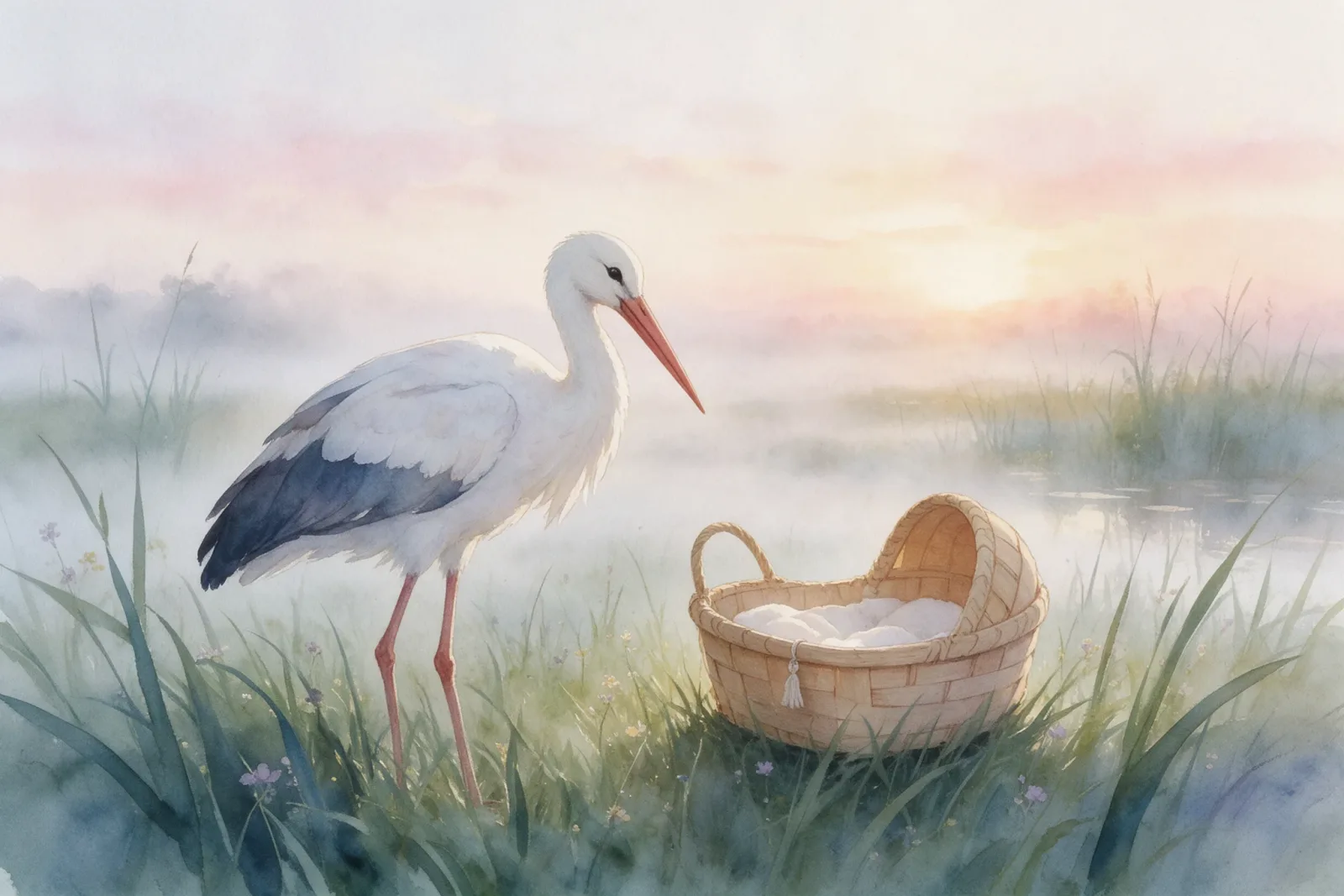
Birth announcements have carried the bird for centuries, long before photography. The image did the work of a sentence: a child has arrived. The story behind it is old European folklore, told in villages long before it was written down, and fixed in a form everyone could read by Hans Christian Andersen in the 1830s.
A stork on an announcement does two jobs: it announces a birth and makes a joke about one. A photograph says this is our child. A stork says this is our child, and we know how it sounds, and we are enjoying it.
Announcement cards get read at a distance before they get read properly. They sit on a fridge, a mantelpiece, a pinboard in an office, and the picture is doing the work from across the room. A stork reads at that distance. A photograph of a baby is hard to see, and the bird is a shape.
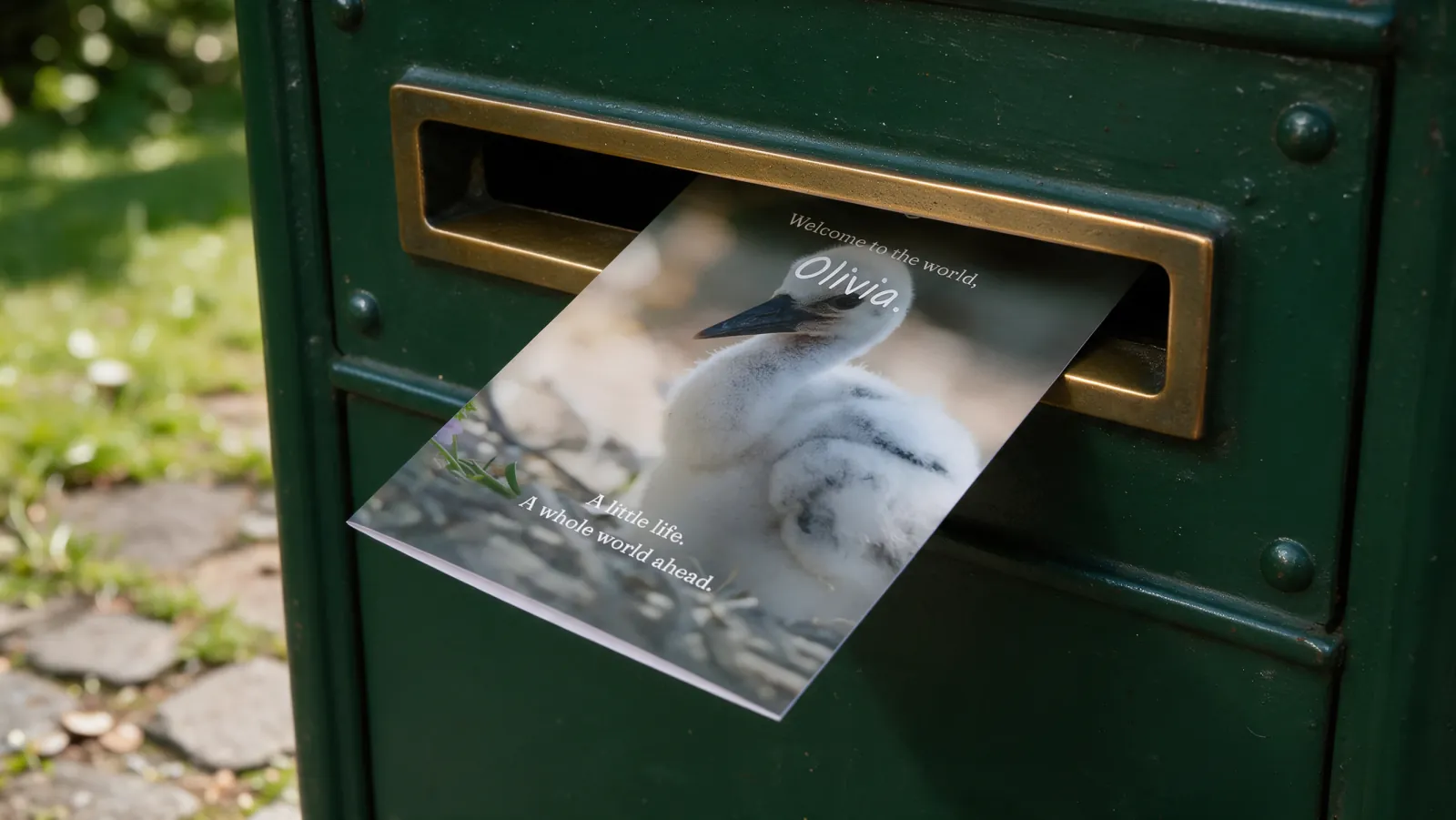
Modern announcement cards often leave out the cloth bundle and keep the bird: a stork on a chimney, a stork in flight, a pair on a nest. The picture still reads as a birth, and it does it with less fuss. When an announcement and a stork gift are sent together, the two cards do different work. The announcement says who arrived. The gift card says which bird was chosen.
Sign it properly
Full name, and the relationship. A first name alone will mean nothing in a decade, when the friend has moved away and the child has no idea who Uncle Tim was. If the card is from a group, list them. A list of names from a welcome party is a small historical document, and it costs nothing to write.
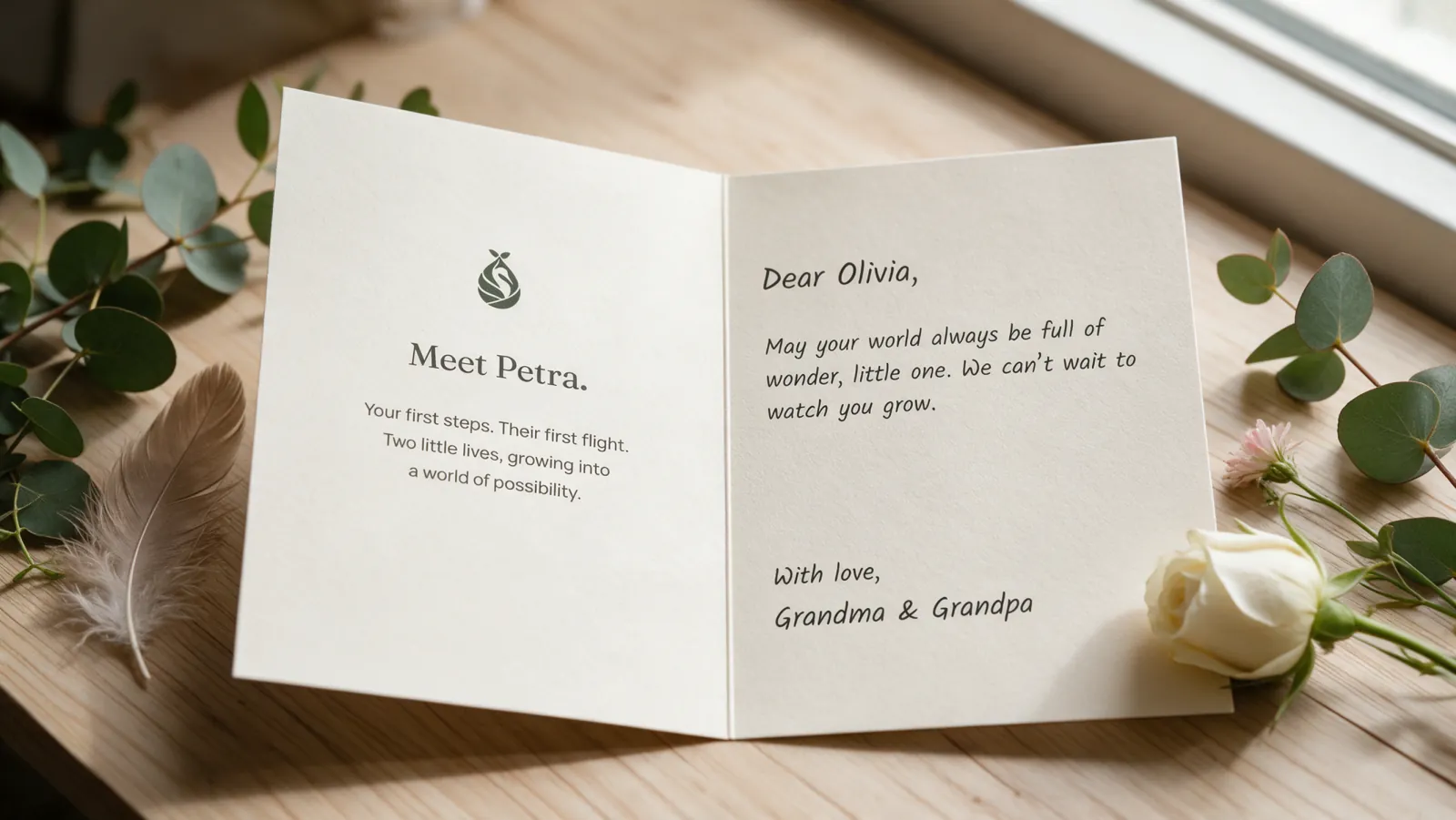
A workable shape is the date and the weather, one thing you noticed, one thing you hope for, your name. In practice: 'For Ada, who arrived in the rain on a Tuesday, and who held my finger for a full minute. I hope you grow up liking weather. Love from Ruth.'
Four sentences carry a fact, an observation, a wish and a signature, and every part will still make sense in fifteen years. That is the whole test. The signature matters as much as the sentence. It tells the reader who to picture when the words are read aloud, and it stays legible after the ink has faded.
If you are still stuck
Write the shortest true thing you can think of and stop. A card with three lines on it is finished. A card with a paragraph of striving is also finished, and worse.
Read the message aloud before you send it. If it sounds like a speech, cut it. If it sounds like you talking to a friend, keep it. Do not wait for the perfect sentence. The perfect sentence is usually the one that arrives after you have written three ordinary ones.
Start with the date and the weather, then add the one thing you saw. Write for the second reader, the one who was not there. They will want facts, a date, a name, and something that sounds like a person rather than a greeting card. A stork gift gives those lines somewhere to live: a card with a bird's name on it, and a year of news that belongs to the same story.
The card also has a life beyond the message. It goes in a drawer with the scan, the wristband and the first lock of hair, and it is looked at again when the child is old enough to ask about the day. A second card from the same gift says the bird has a name, and is somewhere south of here, and will be back.
An announcement card is sent once and kept for a long time. The stork gift adds a second card to that drawer, and a bird that is still going. The announcement said the child had arrived. The second card says which bird was chosen, and why.
That is why the wording deserves a few minutes more than the wrapping. The paper will yellow and the ink will hold. The lines will still be in your voice, and the child will hear them in a room you may never see.
Explore the gift