
What a newborn teaches about time is that the clock was never the measure. The day becomes a series of needs, and the needs set the pace. A day measured in feeds is a different day from one measured in hours. It has no meetings and no lunch, only the next thing.
A day measured in feeds
You will still look at the clock, and it will tell you less than the baby does. This is disorienting for anyone who has worked to a schedule. It is also, briefly, a kind of freedom. Put the clock where you cannot see it from the feeding chair. Checking it every ten minutes is a habit that makes a long night longer.
The day divides into stretches: after the nine o'clock feed, after the noon feed, after the feed that happened at four because everything slid. You will start to say things like before the last feed and mean a real unit of time.
The stretches are not equal. Some are forty minutes, some are three hours. The variability is what makes the first weeks feel both endless and fast. If you are bottle feeding, the stretches are easier to see, and no more predictable. A baby who took 90ml at noon may take 60 at two.
The hours that leave no trace
You will look up and find that three hours have gone and you have done nothing but feed, change, and hold. Those hours went into a person. This is the part that is hard to explain to anyone who has not done it. The work leaves no visible trace. The house looks the same. The baby is a little heavier.
Take a photograph at the same time each week. The change is invisible day to day and obvious in the sequence. Write the feed times down in the first weeks if you like, a small record of a life measured in milk. Later the page looks like a code, and you will remember exactly what it meant.
The tired days will not feel meaningful while they are happening. Meaning is something you add later, in hindsight, when you see what the repetition built. For now, the work is enough.
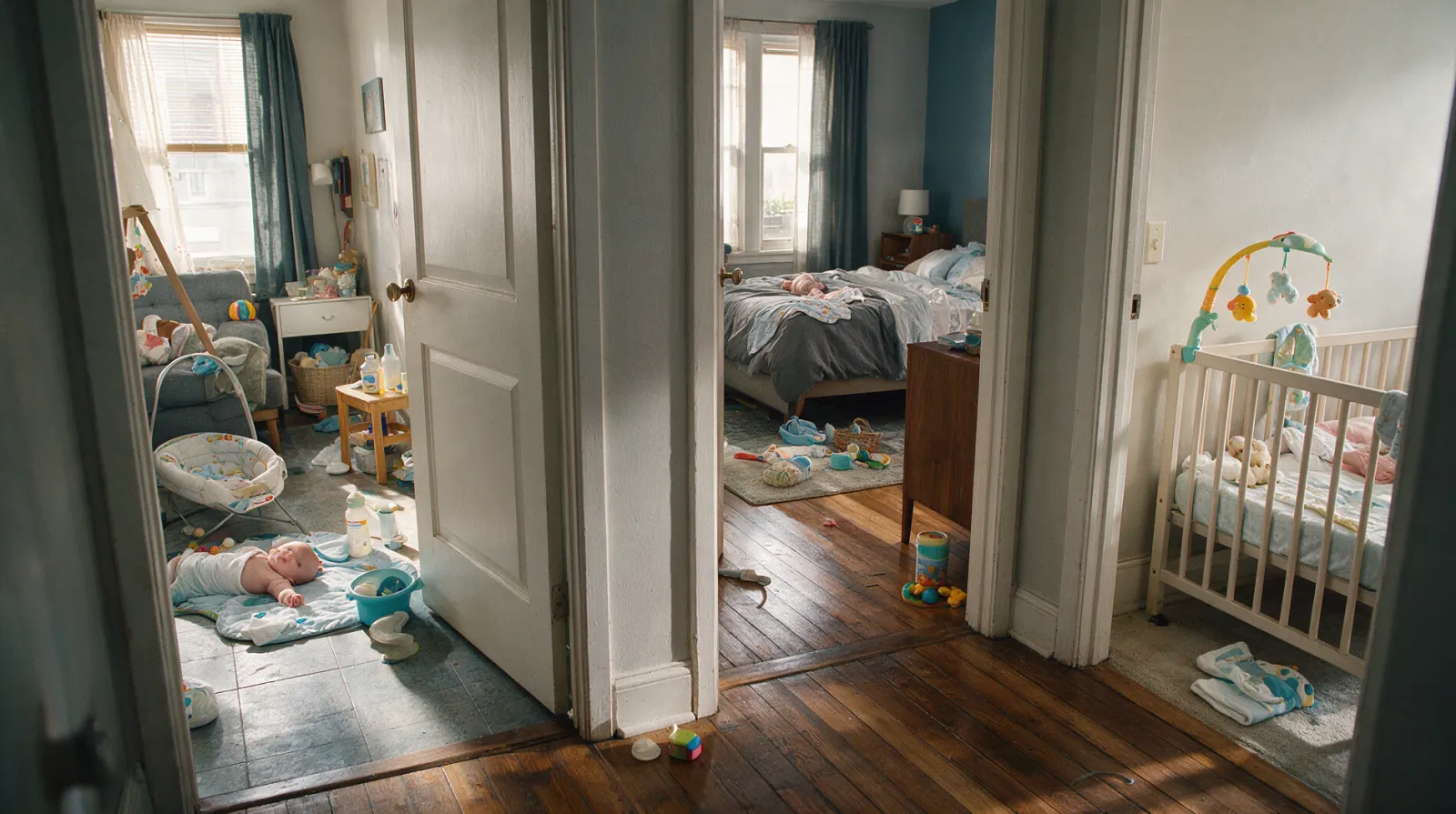
A baby in every room
The pram in the hall is the first sign. Then a muslin on the banister, a bottle of cold tea on the windowsill. Nothing stays where it belongs. A cardigan on the kitchen table, a nappy sack by the front door, a dummy in the bathroom. The objects travel because the baby travels, and the baby travels because you do.
You will develop a route that collects them: up the stairs, past the cot, into the bathroom, back down with a basket. The basket is the only piece of equipment that makes the trail manageable. Put a small bin in each room the baby uses. It sounds dull, and it is the difference between a house with a baby in it and a house with a mess in it.
The bedroom becomes a feeding room. The kitchen becomes a bottle-washing station. The bathroom becomes a place with a plastic tub in it. A flat does not get bigger when a baby arrives; it changes what each room is for. If you have a spare room, you will be tempted to make it a nursery. You do not need one yet. A cot in your room and a chair that fits your body will do more in the first six months.
The hallway and the bath
The hallway is where the outside comes in. Shoes, post, the pram, a coat over the banister. Leaving the house becomes a small expedition. Keep a bag packed by the door: nappies, a spare vest, a muslin, a snack for you. The bag will not stay packed, and having it there saves ten minutes.
The bathroom adds more than any other room: a bath seat, a towel with a hood, a bin for nappies, a thermometer, a stack of flannels. The bath is the warmest room in the house, and it will be used more than you think. Never leave the baby alone in the bath, not for the phone, not for the towel. Have everything within reach before the water goes in.
You will tidy the same room four times in a day and it will not stay tidy. A house with a newborn in it is a working house, and working houses look like it. Invite people who do not mind the mess. The ones who mind can come later, when the trail is smaller.
The letter with a date
A letter to the baby you just met does not need to be good. It needs to exist, and to have a date on it. The first weeks blur. You will remember the feeling and lose the facts: the weight, the time, the weather, the name of the midwife. A letter written now catches what memory will drop.
Write the date, the place, the weight, the length if you know it. Add one ordinary detail: what was on the radio, what the room smelled like, who visited. Then one true sentence about how it felt. Write the true sentence, even if it is tired and strange and full of contradiction.
A page is plenty. A short letter gets finished; a long one becomes a project. Write it in one sitting, while the baby sleeps, and do not edit it. If you miss something, write a second letter later. A letter in pencil on a torn page is as good as one on nice paper.
Put it somewhere it will survive: a box with the hospital bracelet, the first hat, the card from the flowers. Put the date on the envelope and label the box with the year. Tell someone where it is. In twenty years you will not remember which box.
One day the child will ask what it was like. You will hand over the letter, or read it aloud, and the room will go quiet. The letter will do the work that memory cannot. You may cry when you read it. The letter was written by a person you used to be. If you have another child, write them one too. The letters will be different, and they will both be true.

When the rhythm shifts
Around three or four months, the stretches lengthen and the nights change. The rhythm will shift without asking, and you will have to learn the new one. Just as you get good at the current version, it becomes a different version. This is why advice about schedules is so unreliable. The baby is the schedule, and the baby is changing.
The four-month change is often the first big one. Sleep gets worse before it gets better, and then it settles into something you can work with. Do not blame yourself for it. It happens to babies in quiet houses and loud ones alike.
You will keep a looser relationship with time. Deadlines will feel less absolute, and an hour will feel like either a lot or almost nothing. You will never be this free of the clock again, and you may miss it later, on a Tuesday with three appointments in it.
If you want a marker for this strange season, adopt a stork in the baby's name and write the date on the base, when time was measured in feeds.
Explore the gift