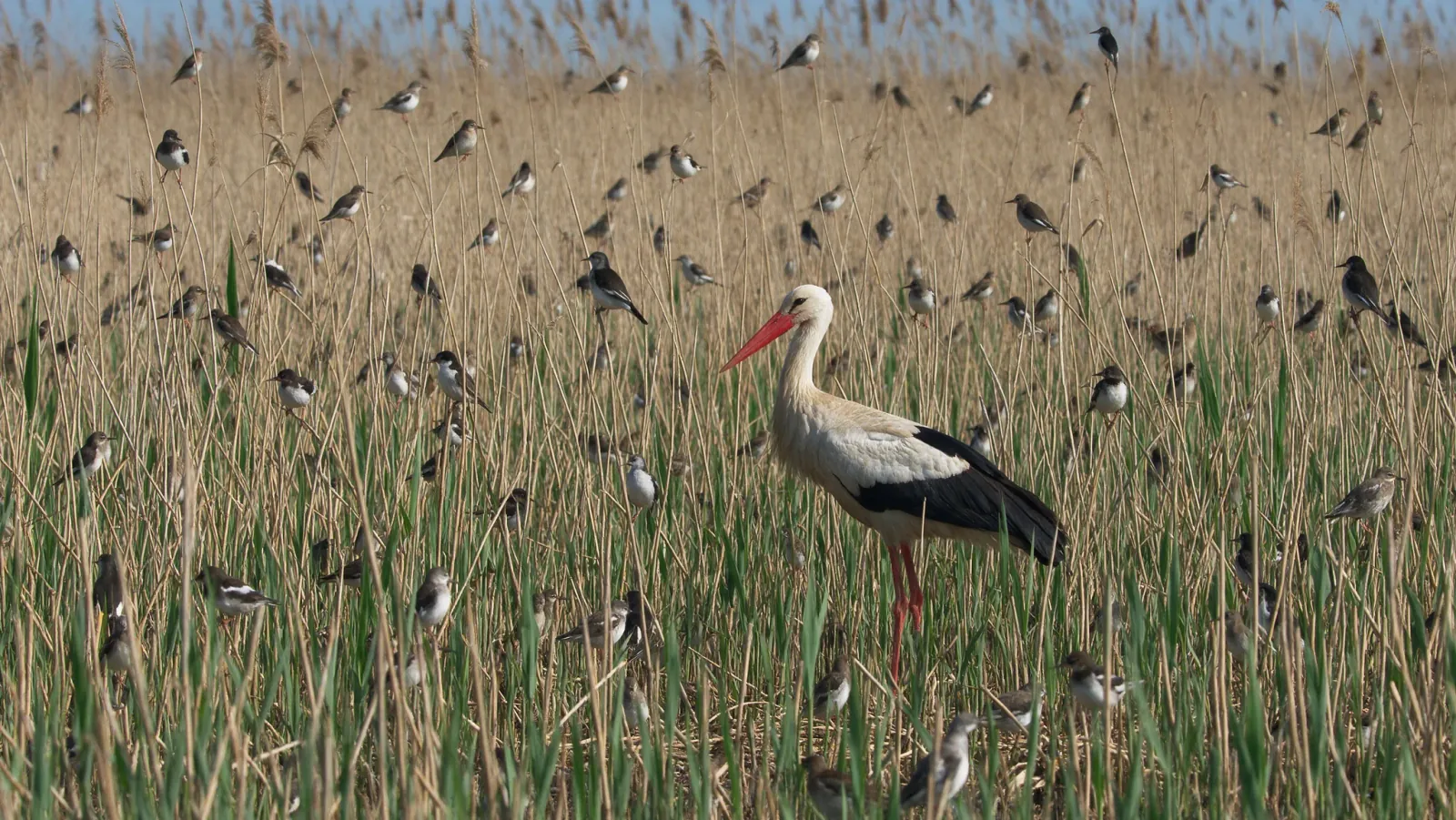
A reed bed looks like one plant repeated to the horizon. From a path it is a wall of stems; from a boat it is a maze of channels; from above it is a pale green field with dark water threaded through it. A white stork rarely enters the middle. It walks the margin, where reeds meet open water, and takes what comes out. The birds that live inside the bed are another community entirely.
A vertical world
Reeds grow in water and stand two or three metres high, and that height creates floors. The water surface is one layer, the mass of stems another, the seed heads at the top a third. Insects live at all of them. Warblers work the middle, harriers hunt above, and water voles swim the channels at the base. A reed bed works like a building with several storeys, and every storey has its own tenants. The reeds themselves are the structure. Their stems hold the nest, their seeds feed small birds, and their dead litter becomes next year's mud.
Nests woven between stems
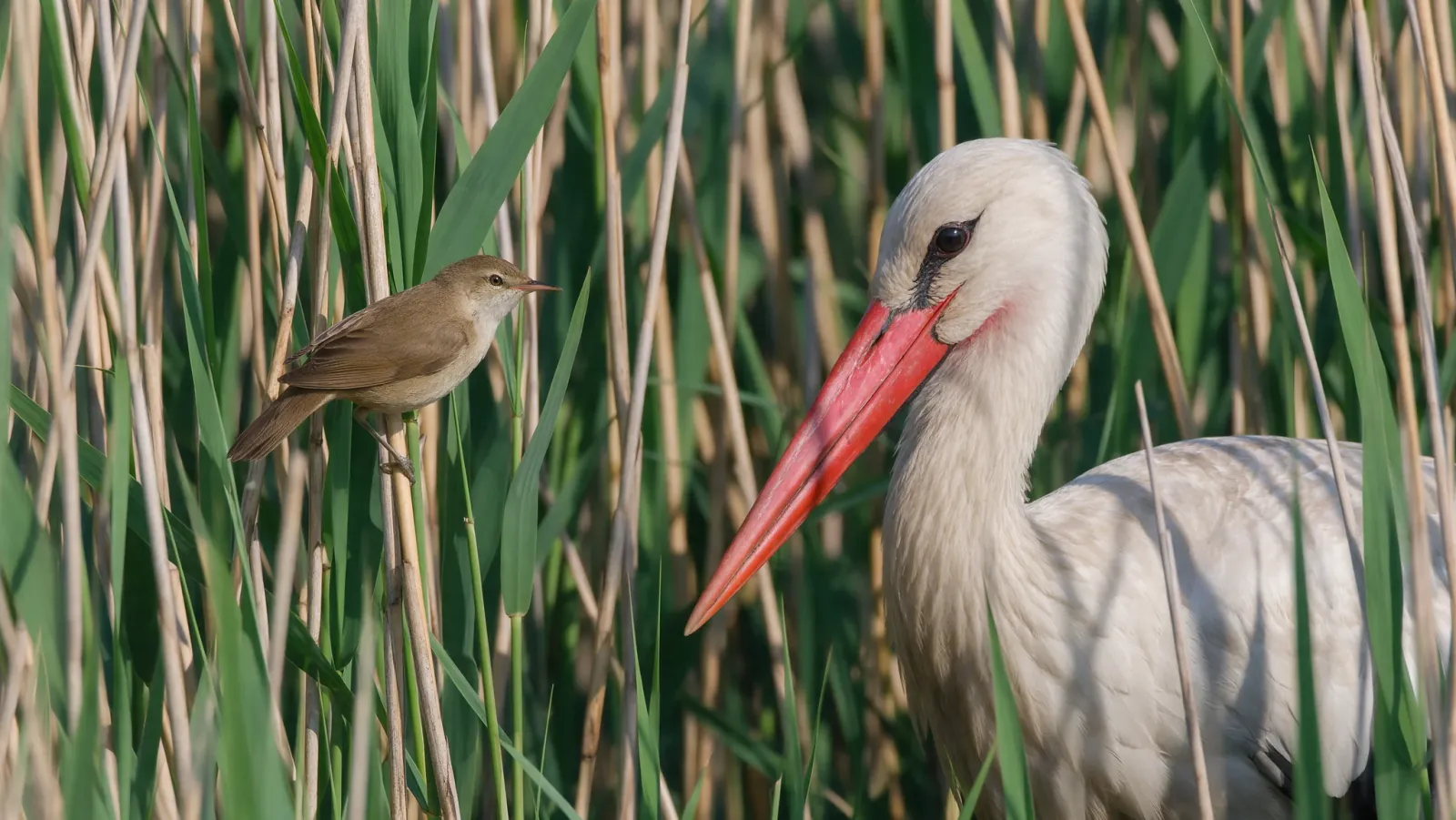
A reed warbler is a small brown bird that builds a deep cup slung between four or five upright stems. The nest rises and falls with the wind and with the water. The clutch is small, the incubation short, and the chicks grow fast. The nest is a piece of engineering that depends on the reeds staying upright, which is why cutting or spraying a reed bed in spring destroys the whole breeding attempt.
Bearded reedlings, small and long-tailed, prise open reed stems to reach the seeds inside and add insects in summer. Reed buntings nest lower, near the water. These birds are brown, quick and hard to see, and the bed's summer sound is mostly theirs. The small birds are the reason the bed is worth protecting, even when no stork is in sight.
The cuckoo in the reeds
Reed warblers are the most common hosts for the cuckoo in Europe. A female cuckoo lays an egg in the warbler's nest, and the chick that hatches throws the warbler's own young out. The warblers raise the intruder as their own. The reed bed is the stage for one of the strangest arrangements in European wildlife, and the warblers pay for it every year. The cuckoo's call and the warbler's chattering song are the two sounds most associated with spring reeds.
A reed warbler feeds on small insects, especially aphids and flies, picked from stems and leaves. It works the reeds at mid-height, moving quickly and rarely staying still. Its food is not the stork's food, though both eat insects: the warbler takes tiny items one at a time, while the stork takes larger mouthfuls from the ground. The two birds use the same marsh at different scales, and they do not compete because their prey and their hunting methods are different.
Water voles and open channels
A water vole swims with its head up and its body low, and it cuts runs through the reeds to reach feeding platforms. It eats stems, roots and bank plants, and it needs soft earth to burrow into. Drainage and hard banks remove both. Where the channels are kept open and the bank is left alone, voles persist, and their grazing keeps small openings in the reeds that other animals use. A reed bed without mammals is a bed that has been simplified.
Hunters over the stems
The marsh harrier quarters the reeds on slow wings, dropping into the stems after frogs and young birds. A bittern stands at the edge of a channel, brown and vertical, and becomes invisible when it raises its bill to the sky. In spring the male booms, a sound that carries across the whole marsh. These birds need the interior, the unvisited middle, and that is exactly the part a visitor never walks.
The easiest way to count the residents is to stand at the edge after sunset in May and listen. A bittern booms, a reed warbler chatters from the stems, a sedge warbler runs through its borrowed phrases, and water voles plop into the channel. None of these birds is likely to be seen, and all of them can be identified by ear. A reed bed is surveyed with the ears more often than the eyes. That is why a quiet bed is worrying. The sound drops when the water goes, and the silence is the first record of loss.
Dragonflies and their doubled lives
A dragonfly over a marsh in July is the visible end of a year spent underwater as a hunter. Dragonflies and damselflies spend most of their lives as nymphs in water. They moult repeatedly, hunting insects, worms and tadpoles, and some take several years to reach full size. Then they climb a stem at dawn, split their skin and emerge as winged adults. The insect that dries its wings on a reed in June has been a predator in the pond since the previous summer.
The nymph waits in the silt or among water plants, and when something comes close it extends a hinged lower jaw and pulls the prey in. That jaw is one of the fastest movements in the pond, and it makes the larva a serious predator of tadpoles and small fish. A pool full of dragonfly nymphs is a pool where small frogs have to be careful.
The emergence is the vulnerable moment. A nymph climbing a stem is exposed to birds, and a new adult has to wait for its wings to harden before it can fly. Storks walking the margin will take emerging insects without much effort, and so will frogs sitting at the water's edge. Many nymphs that reach the surface never make it to the air. The ones that do spend the next weeks hunting flies and midges over the water.
A dragonfly is a small meal. A stork needs bulk, especially when feeding chicks, and chasing fast insects over open water costs more than it returns. The bird takes them when they are slow, newly emerged or crowded, and otherwise leaves them alone. Damselflies are the dragonfly's slender relatives. At rest they fold their wings along the body instead of holding them flat, and they fly more slowly among the stems. Their nymphs live in the same water and are eaten by the same fish and frogs.
Cutting on rotation
Reed beds silt up and dry out if nothing disturbs them. Cutting in winter, on a rotation, keeps the stems young and stops scrub from taking over, and the cut reeds have been used for thatch for centuries. The work has to be done in patches, late enough to spare the insects that overwinter in the stems. A bed cut all at once in the wrong month goes quiet for years. A bed cut in strips, in January, keeps its birds and its thatcher. A bed left alone fills with willow and alder, and the open water the warblers need disappears under scrub. The birds return to the same strips year after year, and the thatcher returns for the stems.
Explore the gift