An ibis and a stork are both long-legged, long-necked birds of wet ground, and in poor light a dark ibis can pass for a small stork. The bill settles the question. An ibis carries a long, down-curved bill. A stork carries a straight dagger. Follow the curve and you have your bird.
The bill is the whole identification
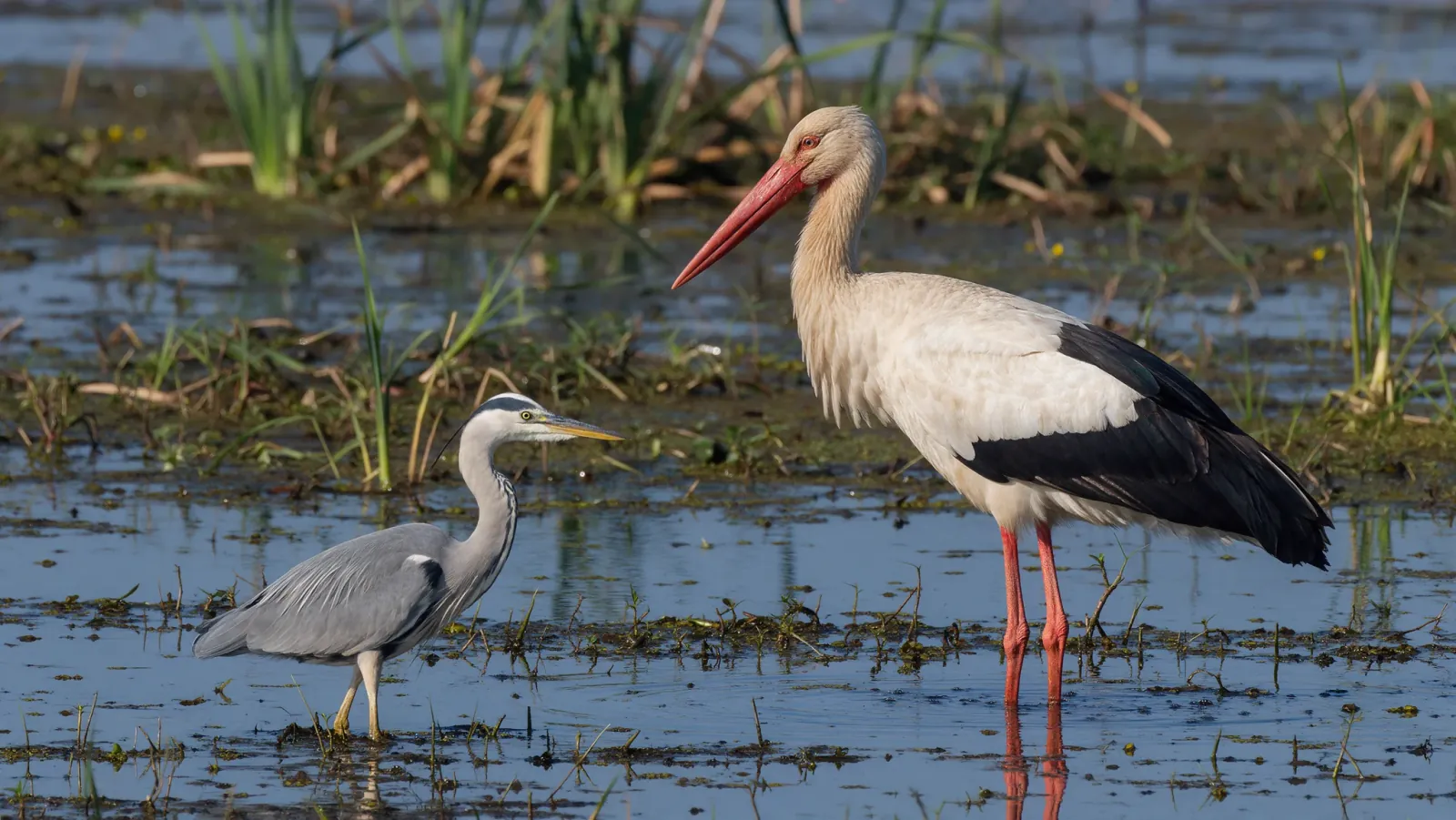
The curve of an ibis bill is gentle and unmistakable, and the bird uses it to probe soft mud for worms, insects, and small crustaceans. The tip is sensitive and can feel prey without seeing it. A stork's bill is straight and heavy, made for seizing rather than probing. At close range the difference is obvious. At a distance, look at the angle of the bill against the body: an ibis often holds it slightly down, as if reading the ground, while a stork holds its dagger level or tilted up. A curved bill belongs to an ibis; a straight one belongs to a stork.
Size and stance
Ibises are smaller and lighter than storks. A white stork stands about a metre tall, with broad wings and a thick neck. Most ibises are noticeably smaller, with a slimmer body and a shorter neck. The glossy ibis is dark, and in good light its feathers shine bronze, green, and purple. The sacred ibis is white with a bare black head and neck and black plumes at the rear. The hadada ibis is grey-brown and loud. Colour varies, size does not: the ibis is the smaller bird. A stork in flight looks like a glider; an ibis looks like a strong flier in a hurry. A stork's nest is a great platform of sticks on a roof or a pole. An ibis nest is smaller, often low in reeds or in a bush.
How they feed
Ibises feed by touch. They walk slowly through shallow water or wet grass and sweep the curved bill from side to side in the mud. A stork feeds by sight. It walks, stops, aims, and strikes. The ibis reads the mud; the stork watches the grass. That difference in method explains why ibises often feed in loose groups, while storks spread out and keep their distance. It also explains why an ibis can feed in water too muddy for a stork to see through. An ibis can feed in a field that looks almost dry, probing the soft ground at the edge of a ditch. A stork needs standing water or wet grass to hunt.
The flock in flight
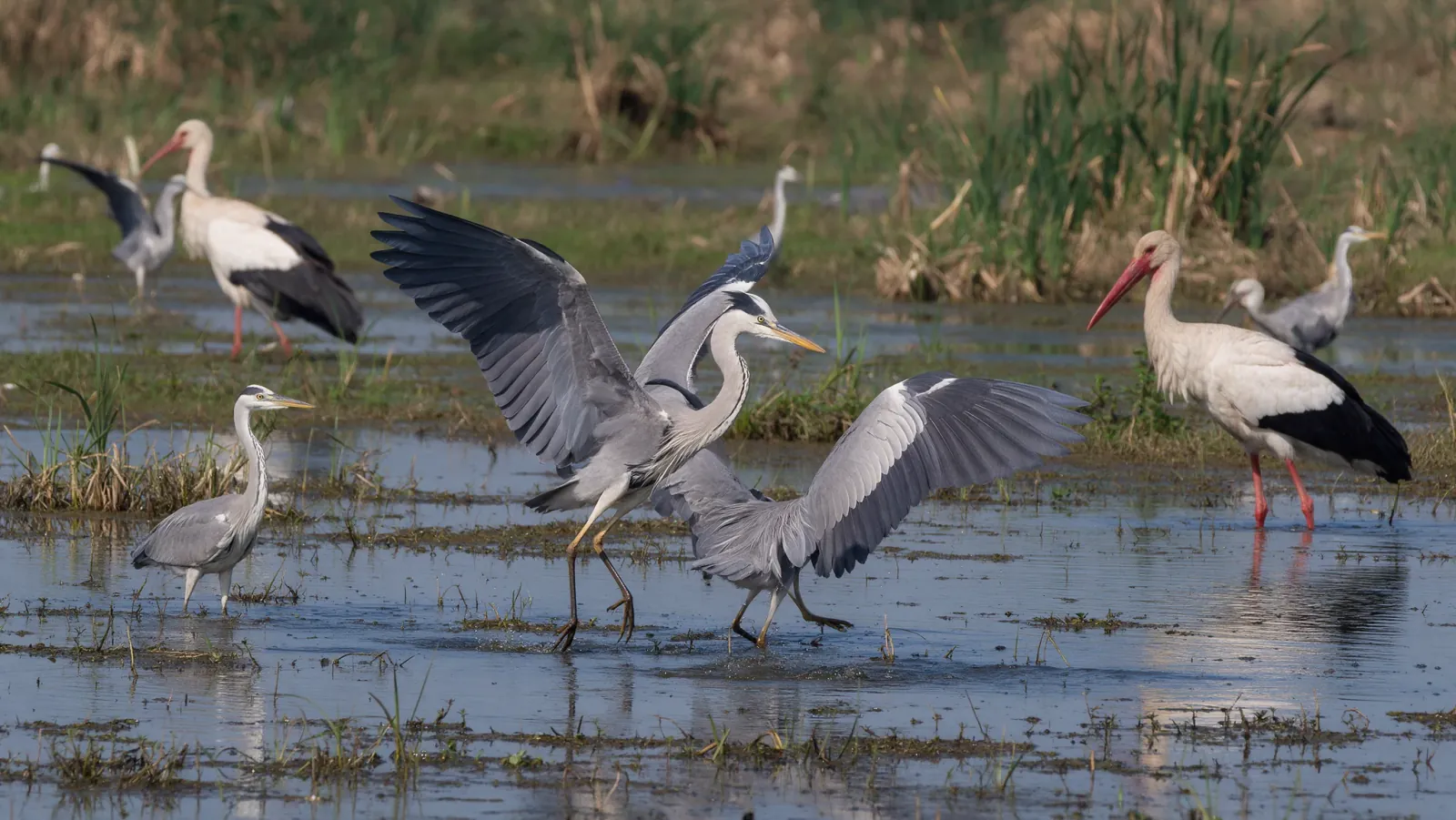
Both birds fly with the neck extended and the legs trailing, and both can look dark against a bright sky. Ibises usually fly in tight formations, often a V or a line, with steady wingbeats. Storks fly in looser groups and rely more on soaring. If you see a compact flock of dark birds with curved bills, you are watching ibises. If you see a few large white birds with black wingtips, you are watching storks. In a mixed wetland, the two often feed within sight of each other, and the size difference is the quickest way to sort them. At dusk, ibises move to a roost in a reedbed or a stand of trees, often in the same place night after night. Storks return to the nest or to a favourite roof.
Where the mistake happens
The confusion usually starts in a photograph. A white ibis with a black head can look like a stork at the edge of a field, and a glossy ibis in dull light can look like a small dark stork. The sacred ibis was once common along the Nile and is still widespread in parts of Africa, where it often feeds near people. Check the bill, then the size, then the way the bird feeds. A bird that probes is an ibis; a bird that stabs is a stork. The rest is distance and light.
Explore the gift