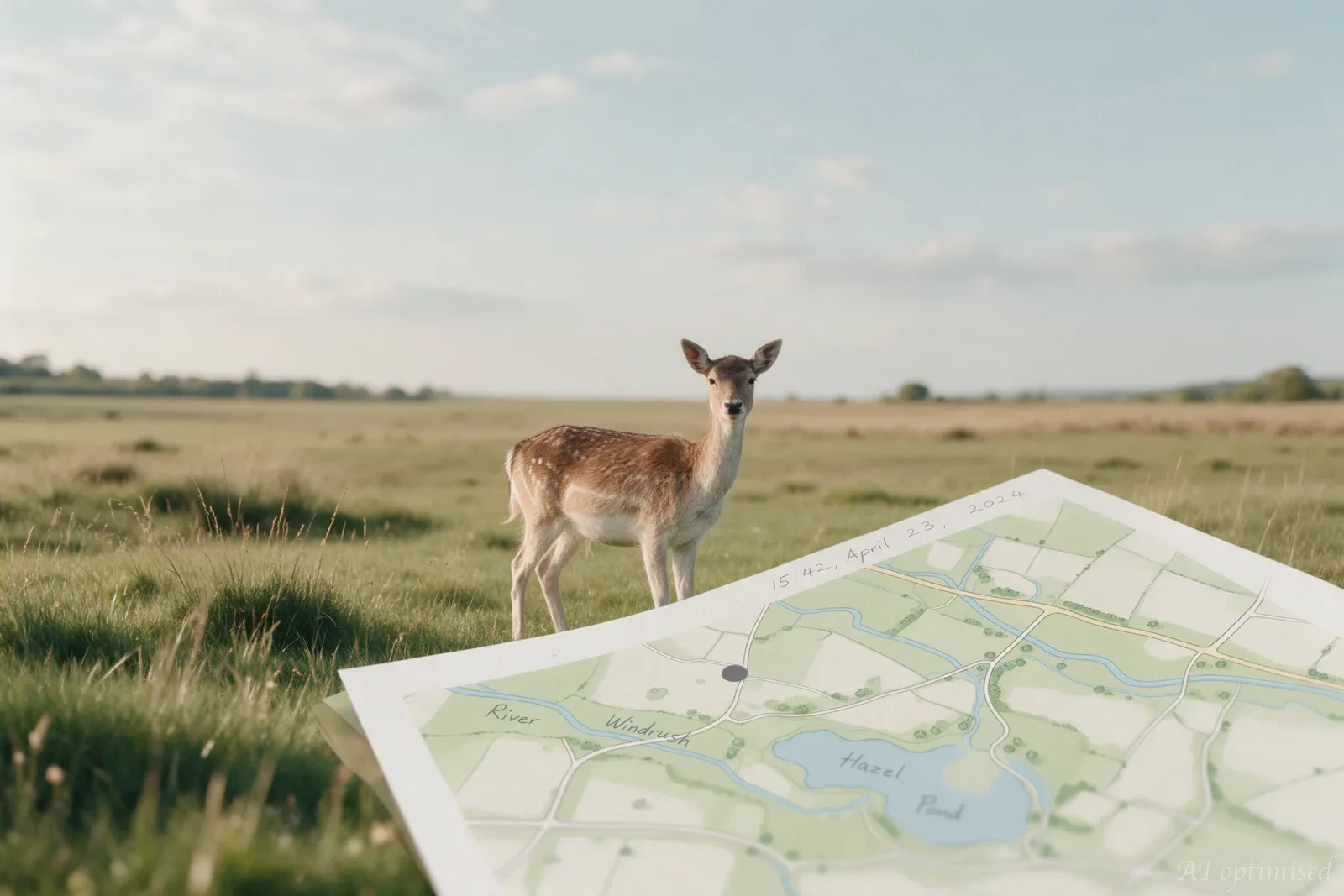
Tracking points and what they mean is a small lesson in honest reading. When you follow a tracked stork, you are not watching a live broadcast of the bird's life. You are reading a series of snapshots, each one a position taken at a moment in time, and the gaps between them matter as much as the points themselves. A little patience with the data turns a confusing map into something you can read the way you read weather, or a river, or the slow change of the seasons.
What a timestamp tells you
Each point on a stork's map comes with a timestamp, the date and hour when the device took its reading. That timestamp is the most honest thing on the screen. It tells you when the bird was where the dot says it was, and nothing more. Two dots close together may be minutes apart or hours apart, and the line drawn between them is a guess the map makes, not a path the bird flew. The timestamp is your anchor. Trust it, and treat the line as a suggestion.
Why there are gaps
Gaps appear in every tracked journey. A stork may fly through a region where the transmitter cannot send its signal. Cloud and rough weather can block a reading. The device may save its battery and stay quiet for a while. None of this means the bird is lost or in trouble. It means the instrument is working within its limits, and the silence between points is simply the part of the journey you could not see. Gaps are not failures. They are the texture of honest data.
What a cluster means
Sometimes the map shows not a moving line but a cluster of points, many dots in one small area over several days or weeks. That cluster is meaningful. It tells you the stork has stopped travelling and settled, perhaps to feed after a crossing, or to rest through the worst of the weather, or to pass a whole winter in one place. A cluster is the data's way of saying the bird found something worth staying for.
What the timestamp really marks
The timestamp on a tracking point is easy to misread, and it rewards a second look. It tells you the moment the reading was taken, not the moment you are seeing it now. A point stamped for Tuesday may reach your screen on Friday, after the bird has moved again. The data is always a little behind the bird, a letter posted from yesterday's sky. Reading it well means holding the two times apart, the bird's and yours.
Time zones add another fold. The bird crosses them without noticing, and the map has to decide which clock to use. The hour on the timestamp is a convention, not a truth about the bird. What matters is the sequence, the order in which the points arrive, and the shape they make when laid end to end. The story is in the sequence, not in any single number.
None of this makes the data less honest. It makes it honest in the way all careful records are honest, aware of what they measured and when. A good reader treats the timestamp as a small, precise fact and lets the rest of the story be told by the spaces in between.
The device itself is modest, a small solar unit carried on the bird's back, and its reading is the most ordinary of things, a position and a time. But ordinary facts, gathered over a whole migration, become something larger. They become a record, a line of breadcrumbs across the world, and the reader who follows them is following something real.
Reading the story between the points
Tracking points and what they mean comes down to this. The points are real, the line is imagined, and the story lives in both. You read the dots for the facts, and you read the gaps for the mystery, and together they give you a picture of a life you will never see directly. The bird moves, the signal arrives, the map fills in, and over time the whole thing resolves into what it always was, a journey you are allowed to watch from a great and gentle distance.
Explore the gift