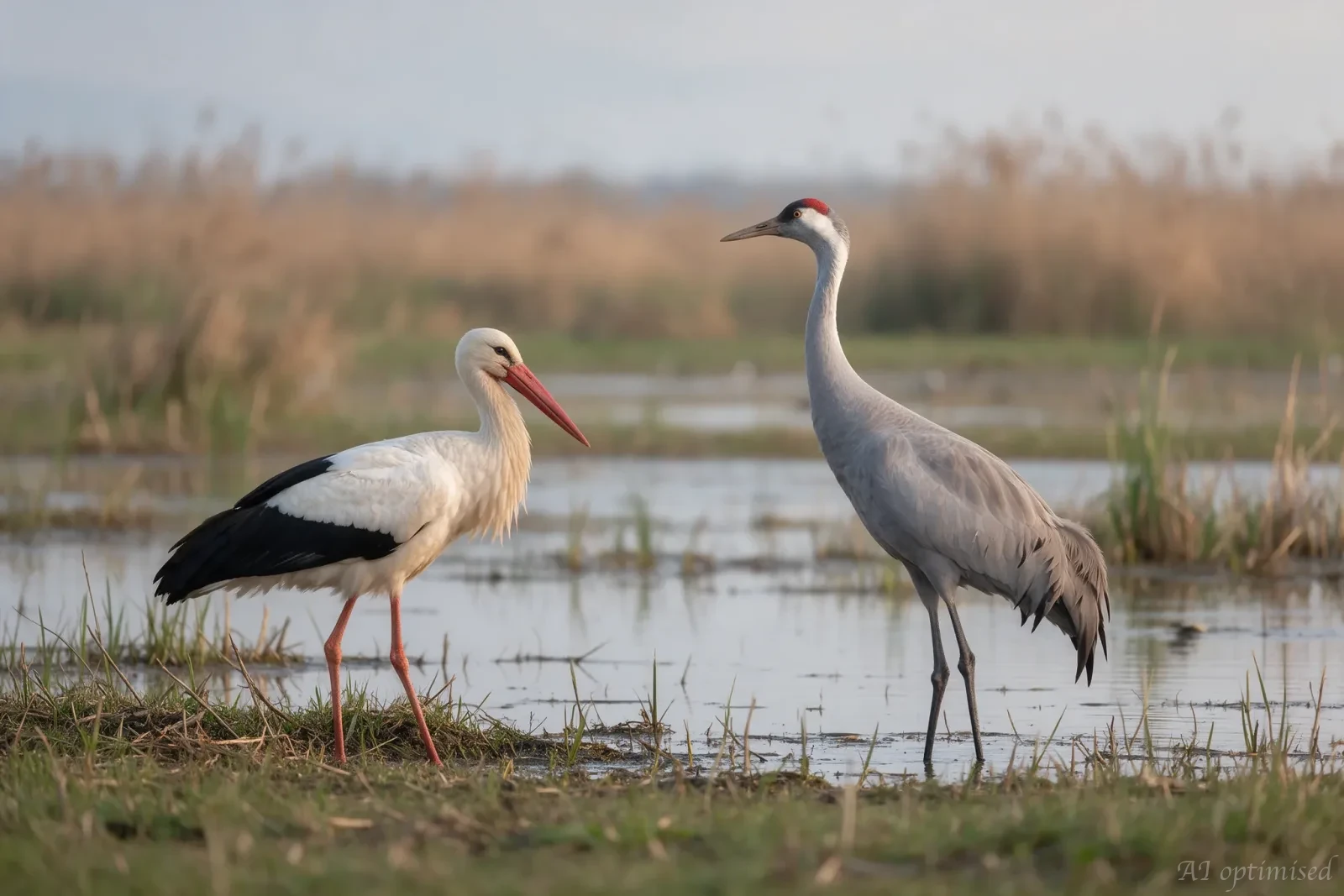
A stork and a crane are both tall, long-legged, long-necked birds, and both fly with the neck stretched out, so the neck will not separate them. The differences sit in the bill, the colours, the voice, and the place each bird stands.
The neck test does not work here
Herons fold the neck back in flight, and that trick separates them from storks. Cranes also fly with the neck straight ahead, like a stork, so a silhouette against a bright sky can fool anyone. With cranes you need the bill, the colours, and the habits. Both birds also trail their legs behind in flight, which removes another easy clue. A clear view of the head and the legs settles the question quickly.
Red against grey
A white stork has a white body, black flight feathers, a long straight red bill, and red legs. A common crane is mostly grey, with a black head and neck, a white stripe running from the eye down the side of the neck, and a small red patch on the crown. Its bill is shorter and darker, and its legs are dark grey or black. The colour test is simple: red bill and red legs mean stork, grey body and dark legs mean crane. A crane's red crown patch sits on top of the head, and a stork has no red there at all. Young storks are duller, and their legs can look brownish, so give them a second look.
Legs, toes, and perching
Storks have long toes that can grip a branch, and they sometimes perch in trees. Cranes have a short back toe that sits high on the leg, and they rarely perch in trees at all. If the bird is standing in a tree, it is probably a stork. Cranes stand and walk in shallow water, in wet fields, and on open ground. Their legs are built for wading and walking, and they roost in shallow water where a fox is less likely to reach them. A stork will happily stand on a roof, a pole, or a nest platform.
Voice and dance
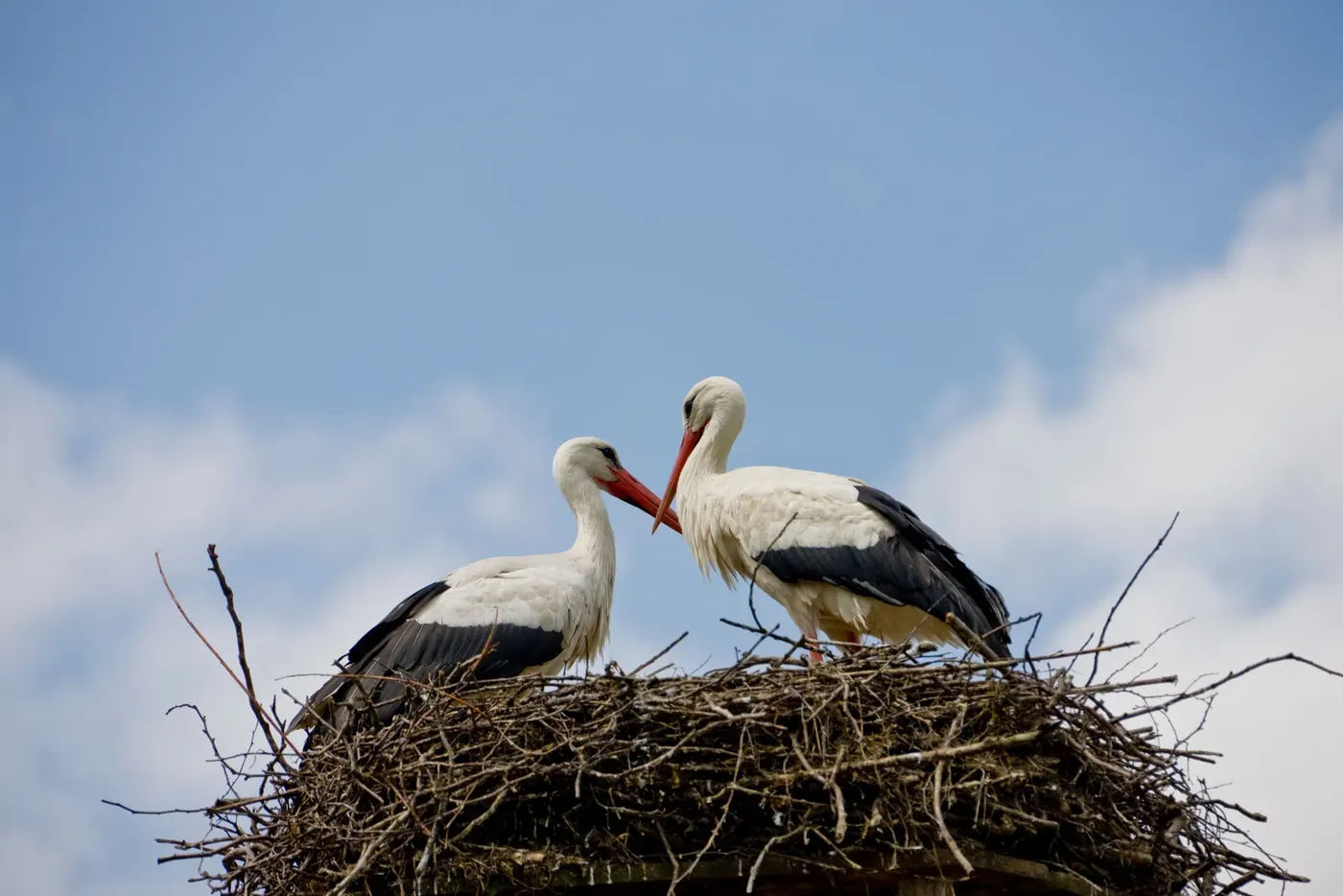
A crane calls with a loud, carrying trumpet that can be heard far across a marsh. Cranes also dance: they bow, leap, flap, and toss grass in the air, often in pairs or small groups. A stork has no trumpet. It greets its mate by clattering its bill, fast and dry, and it hisses near the nest. The voice is the fastest way to tell them apart without a clear view. A crane's call rolls, and a stork's rattle clicks. The dance is easiest to see in spring, before the birds settle down to nest.
Flight and formation
Both birds use rising air to save energy. Cranes often fly in a V or a long line, and they call while they fly. Storks gather in looser flocks, spread across the sky, and stay mostly silent. A noisy V of large grey birds is a crane flock; a quiet, scattered group of white birds is a stork flock. Cranes call often in flight, even when the group is high. In autumn both head south, and a lucky watcher can see them on the same day.
Where each one nests
A stork builds a great platform of sticks on a roof, a chimney, a pole, or a tree, often close to people. A crane nests on the ground in a marsh, among reeds and shallow water, well away from a village. A nest on a building belongs to a stork; a nest hidden in reeds belongs to a crane. That single difference is often enough on a walk, even before the bird comes into clear view.
Explore the gift