White storks are the tall birds that stand on roofs and walk through wet fields. Most of what children ask about them comes down to four things: size, food, nests, and the long trip south.
A bird built on stilts
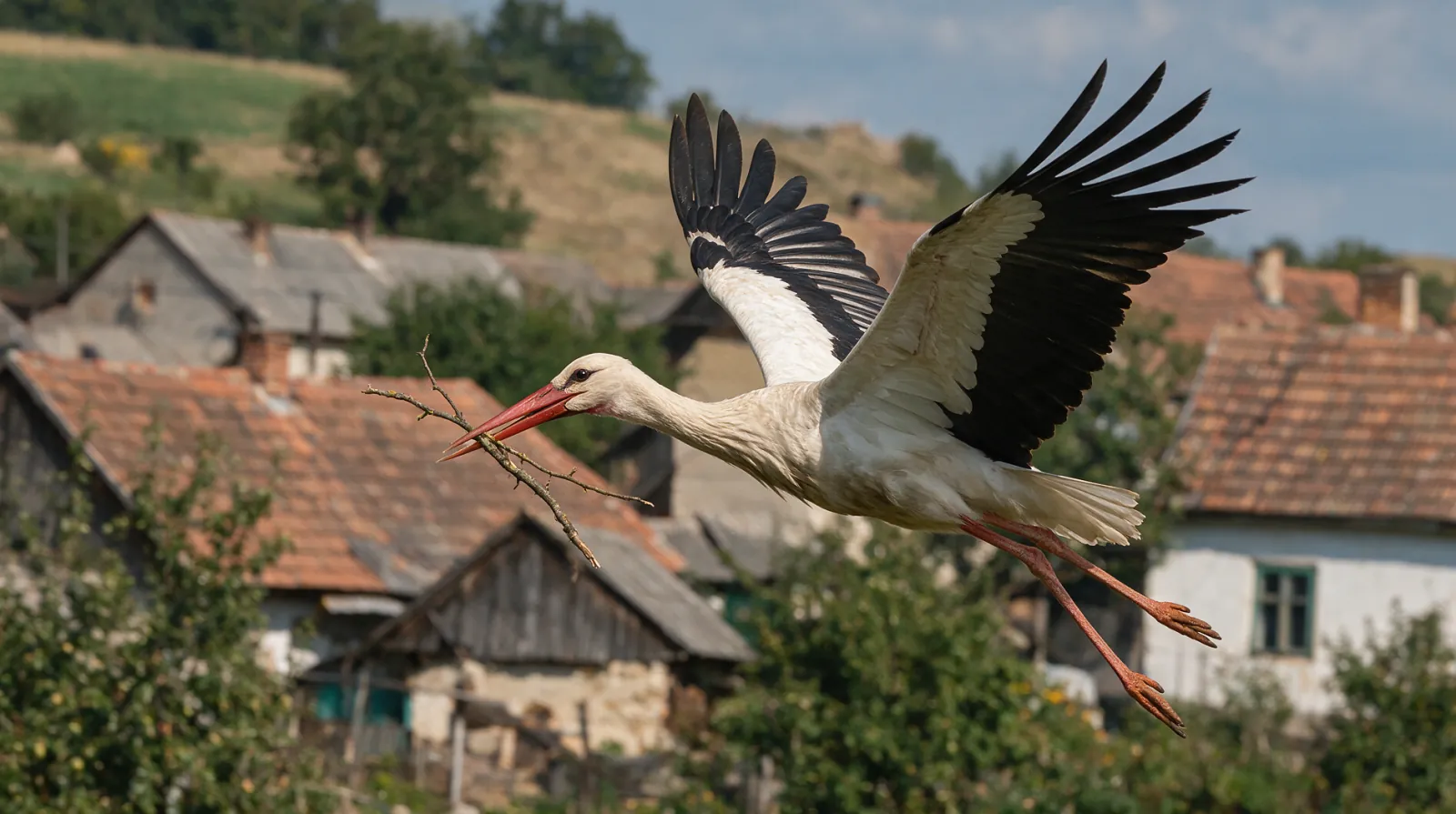
A white stork stands about a metre tall, and its wings reach about two metres across. The body is white, the wing tips are black, and the long legs and straight bill are red. Those legs look thin for such a big bird, and they work like stilts. They lift the body above tall grass and shallow water, so the bird can see movement below. The white body and black wing tips make a stork easy to name in flight. The black shows as a dark stripe along the back edge of each wing, and the legs stretch out behind, past the tail. Young storks have duller bills and legs, more grey or brown, and they look untidy before the adult feathers come in.
Food from wet ground
A stork eats animals it can catch in fields, meadows, and the shallow edge of ponds. Frogs are the best-known meal, and a stork also takes insects, grasshoppers, worms, mice, voles, small fish, and now and then a snake or a lizard. It walks slowly with its head forward and watches the ground, then strikes with the bill. A stork feeds by walking and watching, which is why it spends so much time in short grass. The bird needs ground it can wade or walk across. It does not swim after fish or dig for worms like a mole.
The nest on the roof
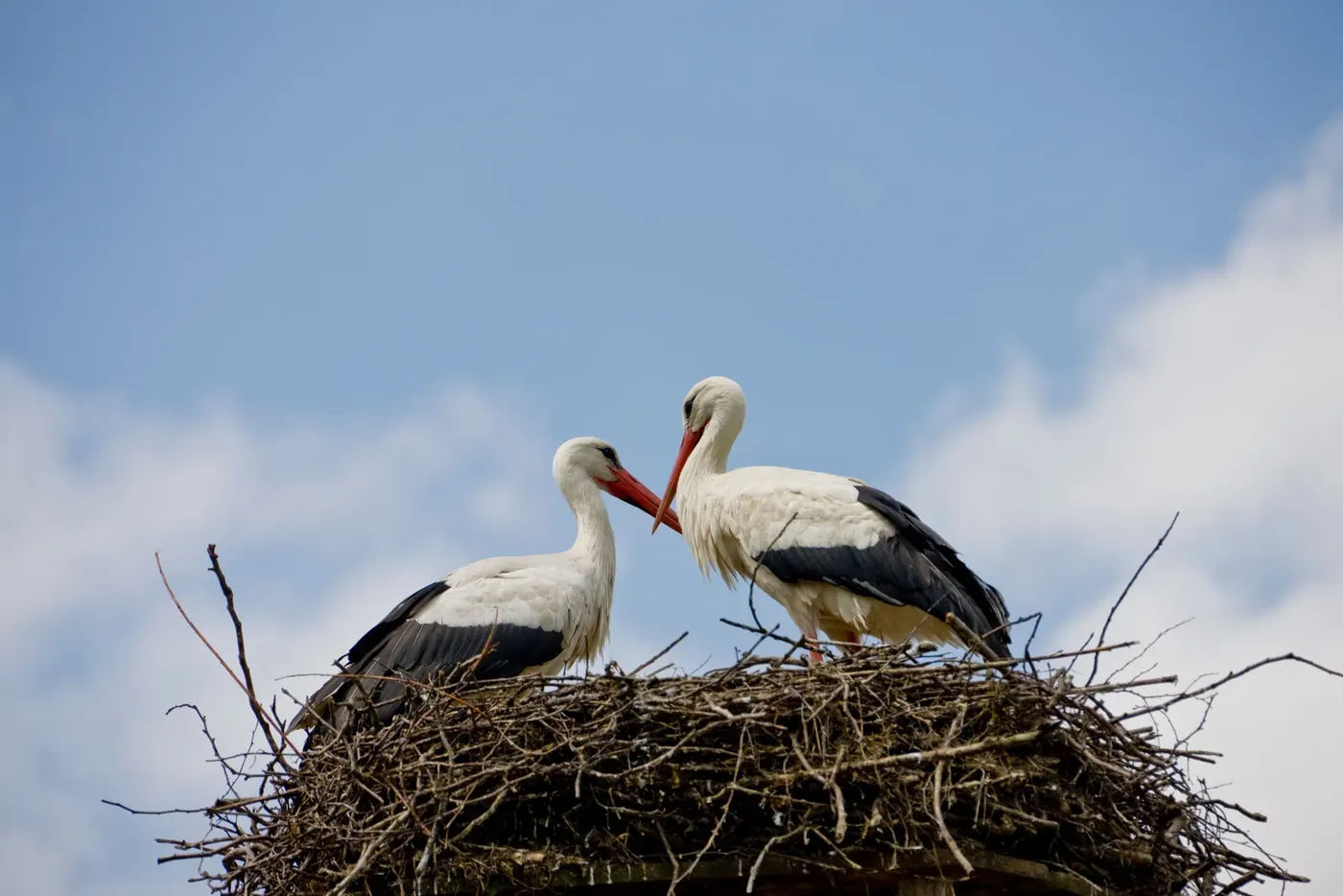
Storks build a platform of sticks on something high and open: a roof, a chimney, a pole, or a tree. Both birds of a pair add sticks, and an old nest gets used again and made bigger each spring. Some nests grow wide enough for a child to sit inside. A stork nest is a heap of sticks that gets taller every year. The eggs are white, and the parents take turns keeping them warm for about a month. Chicks hatch covered in soft down, and both parents bring food. After a few weeks the young birds stand up in the nest and flap. By late summer most of them can fly.
The long flight south
In autumn many white storks leave Europe and fly to Africa for the winter. They travel by day, when the sun warms the ground and makes rising air called thermals. A stork circles inside a thermal until it is high, then glides on to the next one. The birds save energy by riding air they cannot see. A flock spreads out across the sky. Some storks now spend the winter in Spain or Portugal, where the weather is mild and food is easier to find. In spring the birds come back north and return to the same area, often to the same nest.
The sound of a stork
A stork has no song. It clatters its bill instead, snapping the two halves together fast so the sound carries across a village. The noise is loud and dry, like a wooden rattle. Storks also hiss and clap softly near the nest. A stork's voice is its bill. Chicks beg with soft calls that sound nothing like the rattle of the adults. People who live near a nest hear the clattering begin in spring, when pairs greet each other.
Watching one without disturbing it
A stork is easy to watch from a distance. It stands still for long stretches, then walks a few steps and stops again. It may rest on one leg with the other pulled up into the feathers. If a stork lifts its head and looks straight at you, it has noticed you, and it is worth stepping back. A path or a road makes a good place to stand. Binoculars help, and the bird will carry on with its day while you watch.
Explore the gift