Not every stork is a gentle white bird on a rooftop. The stork family, the Ciconiidae, includes some of the strangest and least cuddly birds on earth, and two of them stand apart from the rest. The marabou and the shoebill are storks by family, though they look like creatures from another age, and they are a reminder that the world of storks is far wider than the one white bird we all know. They are the family's most surprising members, and they ask us to look past first impressions to the remarkable lives beneath. They are not exceptions to the family so much as its extremes, the proof that a single family of birds can stretch from a white rooftop to a muddy swamp and still remain one family. Their strangeness is not a flaw. It is a strength, a shape fitted to a hard life.
The marabou
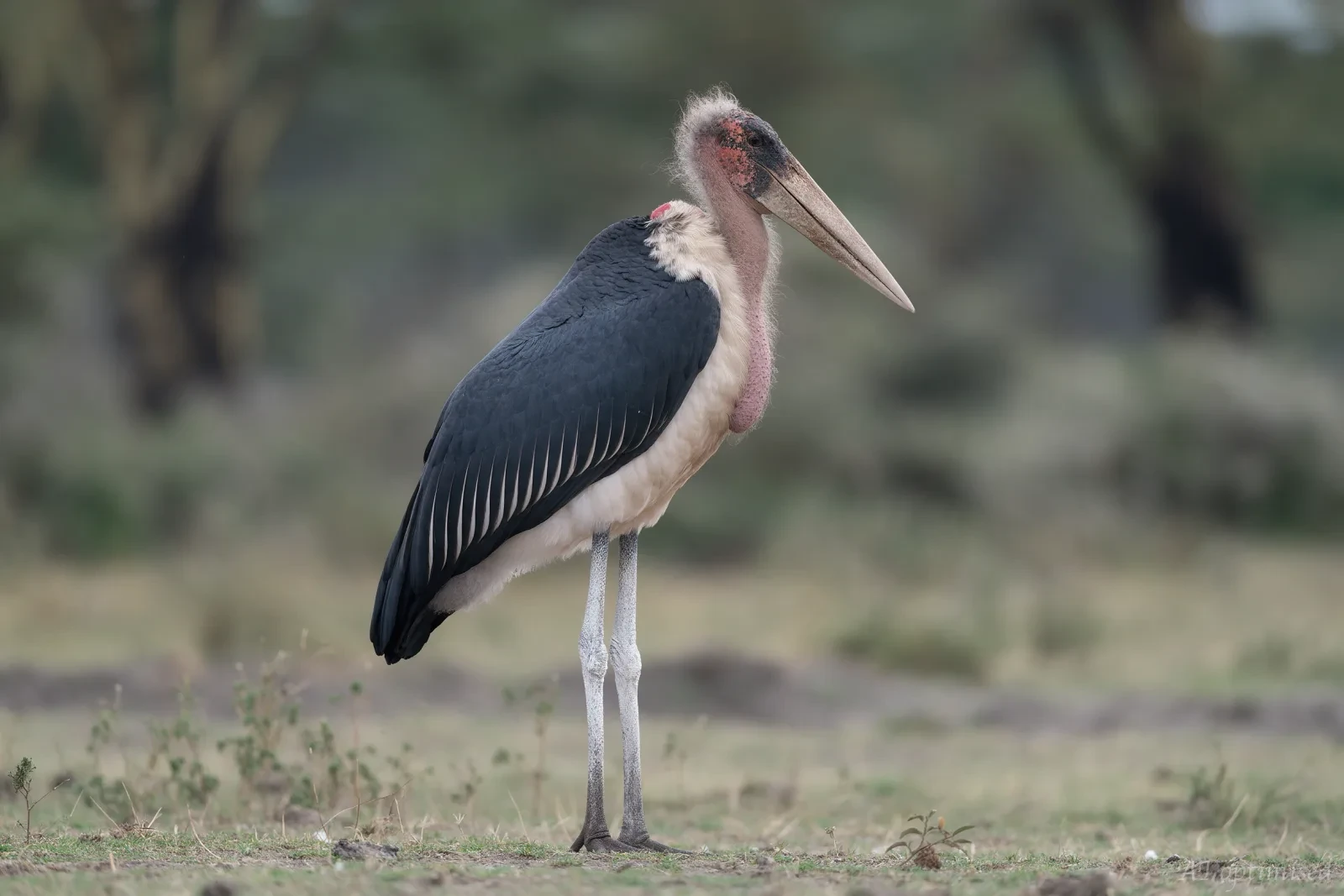
The marabou stork is a huge African bird with a bare pink head, a heavy bill, and a reputation for ugliness. It stands over a metre tall and carries the same long legs and broad wings as its prettier cousins, but it has traded grace for usefulness. The marabou is a scavenger. It gathers at carcasses, at fishing villages, and at refuse, eating almost anything it finds. Its naked head and neck keep it clean while it feeds on messy things, the way a vulture's bare head does, and a dangling pink pouch hangs at its throat, soft and strange.
A useful scavenger
For all its looks, the marabou plays a real part in the places it lives. It clears away what other animals will not touch, and it turns waste into a living. It also hunts, taking fish, frogs, and small animals when the chance comes, and it is far more capable than its shuffling walk suggests. A marabou moving along a riverbank with its wings folded and its head held forward looks odd, but it moves with the same patience as any stork, waiting for the right moment to strike. Its ugliness, if that is the word, hides a bird that has found a very successful way to live.
The shoebill
The shoebill is a bird of African swamps, and it is perhaps the most remarkable member of the family. It has a vast, shoe-shaped bill, pale and broad, which gives it its name. The bill is the tool for catching lungfish and other prey in muddy, reed-choked water. The shoebill stands for long stretches, still as a stone, then lunges with its whole head. Its stare is direct and unblinking, and a close look at its grey-blue eye is enough to make a person understand why it has a reputation for being watchful. A shoebill can hold a person's gaze in a way few birds can.
A strange place in the family
Scientists have debated the shoebill's exact place among birds for a long time, and it is sometimes grouped with pelicans rather than storks. Whatever the final word, it belongs to the same broad world of long-legged, long-billed water birds, and it shares with the marabou the lesson that storks are not all softness and legend. Some of them are strange, patient, and entirely their own, shaped by swamps and plains where no legend has followed them.
The worth of the unlovely
There is a temptation to admire only the pretty members of a family, the white birds on the roofs. The marabou and the shoebill argue against that. They are strange to our eyes precisely because they are finely fitted to their own hard worlds, and their oddness is a kind of wisdom, a shape earned by long use. What looks wrong to our eyes is often exactly right for the life the bird leads, and there is a deep beauty in that rightness. A bird that looks wrong to us is often a bird that is exactly right for the life it leads.
The white stork may be the face of the family, but the marabou and the shoebill are its depth. They remind us that the world of storks holds room for the beautiful and the bizarre, and that every branch of the family is worth a second, longer look.
Explore the gift