At some point, usually around three or four, a child who has been following a stork will ask the question every child asks. Where is our stork now? The words are small, but they are a doorway, and stepping through it together is the beginning of a trip that neither of you has to pack for.
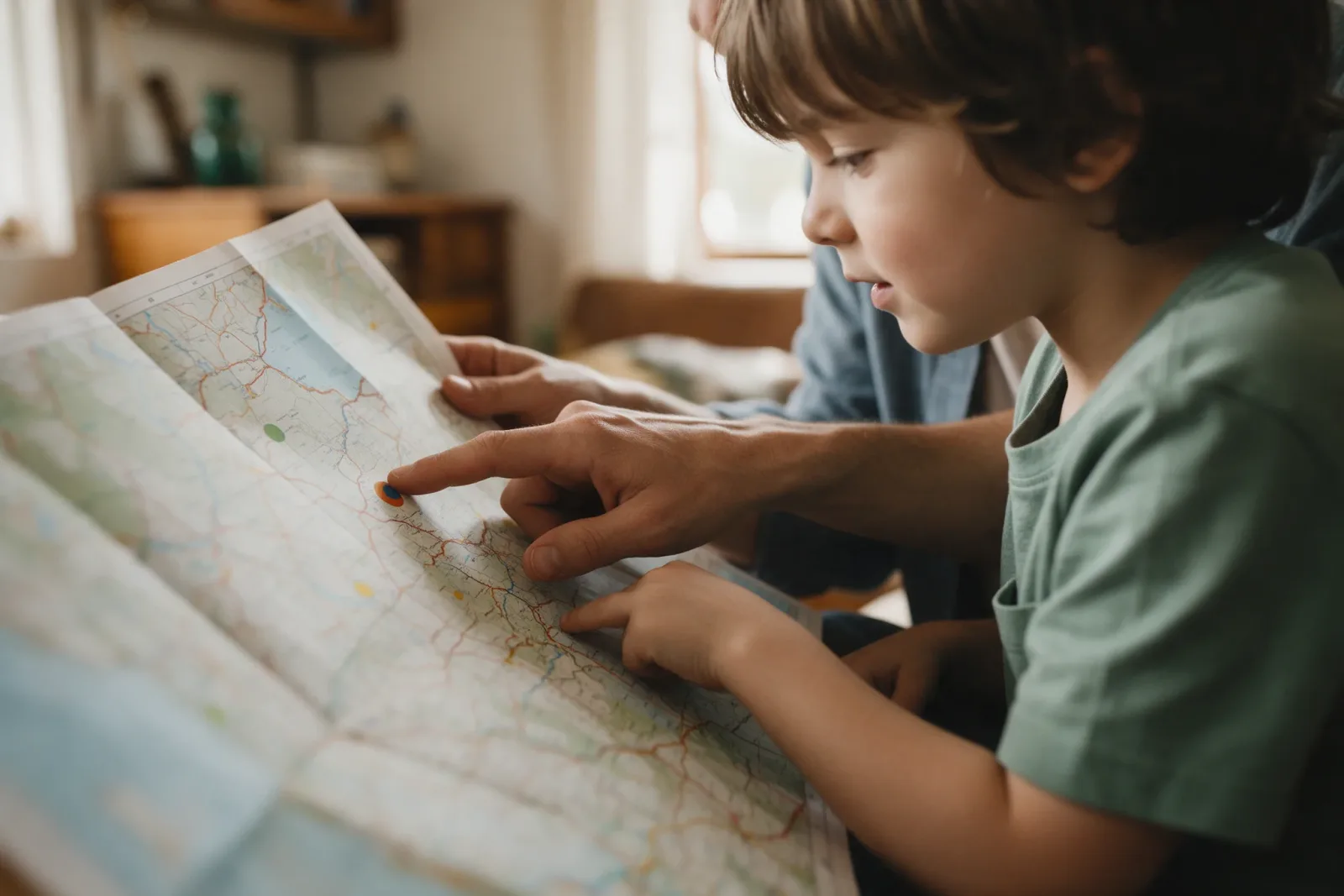
The beauty of the question is that it has a real answer. You do not have to make anything up. You can walk to the map together, find the dot, and point. Here. This is where our stork is right now. The child's finger lands on the paper, and suddenly a bird that is thousands of miles away becomes something you can almost touch.
The answer that begins a trip
What starts as a simple answer becomes a journey, because the next question follows naturally. What is it doing there? Why is it so far away? When will it come back? Each answer opens onto the next question, and before long you are talking about Africa and rivers and the sun, about a bird that crosses the sea and comes home to the same nest every spring.
Let the map do the talking
A map is a kind of magic for a child. It is a picture of the whole world that fits in two hands. Point at your home, then point at the stork, and trace the line between them. The distance becomes real, and so does the idea that the world is much bigger than the street you live on. That is a gift no toy can match.
You can let the map be the hero of the moment. Run your finger slowly along the route, and let the child's own finger follow. The shared tracing is the answer, and it is a better answer than any spoken one.
The question that never gets old
The child will ask the same question again and again, not because the answer changes but because the asking is part of the joy. Each time you go to the map together, the ritual is the reward. Where is our stork now? You know the answer, and you will say it anyway, and it will never quite get old.
Questions are how children travel
A child who asks where a bird is, is a child who has begun to understand that the world is connected, that the sky over your house and the sky over a far country are the same sky. The question is small, but it contains all of geography and weather and wonder, folded up and waiting.
The question matters as much as the answer. Where is our stork now? is not really about geography. It is about belonging, about a child checking that the world it knows is still in order, that the bird it loves is safe somewhere. The answer you give, however brief, is a reassurance.
You may be tempted to give a long and complete answer, full of countries and distances. Resist that a little. A three year old does not need the whole map. It needs the dot, and your finger on it, and the warmth of finding the bird together. The details can wait for later years.
Keep the map where the child can reach it. A question that can be answered by pointing is a question that returns again and again, and each return is a small act of love, a child coming home to the same dot and finding it, and you, still there.
The question will change as the child grows. Where is our stork now? becomes will it come back? becomes did it cross the sea today? Each version is the same question wearing a different coat, and each one deserves a gentle, true answer. You will come to know them all by heart.
There will come a day when the child answers its own question, finger on the dot, before you have even reached the map. That day will feel like a small victory, and it is. The question has become a skill, and the skill is the beginning of a lifelong habit of looking for what you love.
One day the child will ask a question you cannot answer, and the map will not help, and that will be the real moment. Because by then the child will be doing the travelling, and you will be the one who was asked along for the ride.
Explore the gift