The stork has been stitched into the fabric of family life for centuries, and nowhere more plainly than in the wedding banner. Storks on wedding banners appear across the traditions of central and eastern Europe, where the bird of new families was embroidered into cloth meant to bless a marriage and, in time, a cradle.
The bird that blessed a marriage
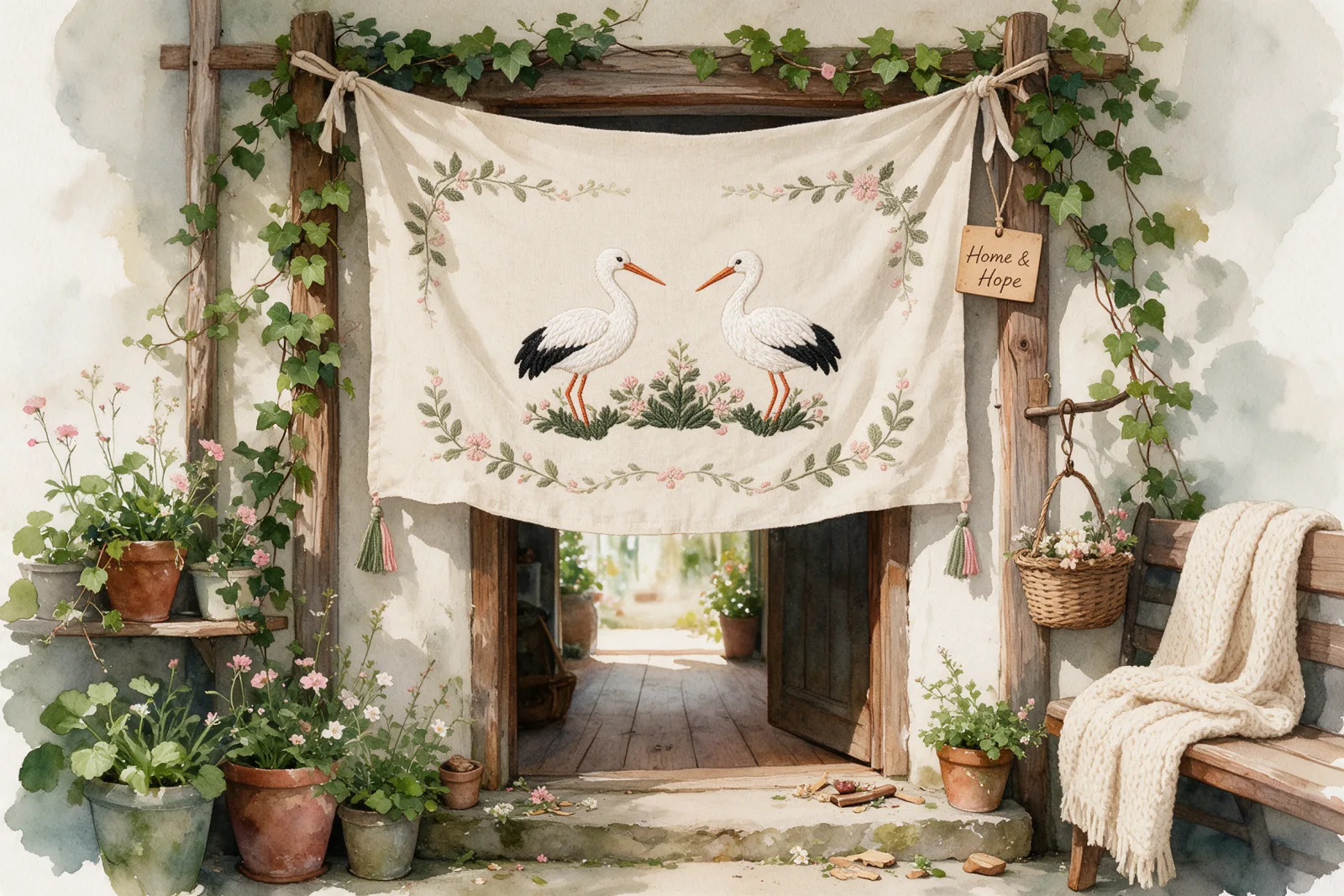
A wedding was the moment a new household began, and the stork, faithful and home-loving, was its natural emblem. Two storks on a cloth meant a pair that would return to each other, season after season, the way the birds return to one nest.
The banner was hung at the door or over the table, a wish made visible. It asked the stork for exactly what the bird was known for, loyalty, a full nest, and a safe roof.
The embroidery and its colours
The banners were worked by hand, and the stork took the colours of the cloth around it. White thread for the bird's body, black for the wing tips, red for the bill and legs, the same colours that appeared on the bird itself and, not by accident, on so much festive cloth.
The work was slow and careful, because the image had to be right. A badly stitched stork was no blessing at all. The care in the needlework was part of the wish.
From the wedding to the cradle
The same bird that blessed the marriage was expected to bless what followed. A household that hung storks at the wedding would stitch them again into the cradle cloth, so that the symbol travelled from one beginning to the next.
This is the stork's great talent in folk art. It belongs to both the wedding and the birth, the two doors through which a family grows, and a single embroidered bird can stand at both.
The banner as a form of hope
These cloths were not decorations in the modern sense. They were kept, handed down, and repaired, because they held a family's hope in thread. A banner that had hung at a grandmother's wedding might hang again at a grandchild's, the stork grown thin but still recognisable.
To inherit such a cloth was to inherit the wish itself, along with the bird that carried it.
A tradition that still hangs
The custom has thinned with time, and fewer houses hang the old banners now. But the image has not gone. The stork still appears on wedding gifts and christening cloths, stitched or printed, in much the same colours it always wore.
Storks on wedding banners are a reminder that the bird was never only a children's story. It was the emblem of the family itself, and people wove it into the cloth that held their lives together.
Explore the gift